


Mystics in Bali (1981) Blu-ray Review


Mondo Macabro
Blu-ray Release: May 12, 2026 (standard edition)
Video: 2.35:1/1080p/Color
Audio: Indonesian and English DTS-HD Master Audio 2.0 Mono
Run Time: 85:59
Director: H. Tjut Djalil
Note: Mondo Macabro is releasing standard edition versions of both Queen of Black Magic and Mystics in Bali on the same day. I’m writing two separate reviews, but also recycling the introductory paragraphs.
A young American woman named Catherine (Ilona Agathe Bastian) is on holiday in Bali when she becomes fascinated by tales of the local black magic cult known as the Leyak. She seeks out a Leyak witch and attempts to learn her secrets. Needless to say, it all goes horribly wrong! (From Mondo Macabro’s official synopsis)

Indonesian genre cinema saw a major boost over the last decade, thanks to streaming distribution models the efforts of a new crop filmmakers, including Gareth Evans, Timo Tjahjanto, Kimo Stamboel, and Joko Anwar, who brought a new flavor of martial arts action and Southeast Asian horror to international audiences who’d grown tired of the Hong Kong and Japanese influences of the early ‘00s. These films are themselves rooted in a series of films that emerged in Indonesia during the post-coup era, when censorship standards and western media regulations loosened.
Like their rip-off/remix-loving counterparts in Italy, India, Turkey, and Hong Kong, the Indonesians did their best to ape Hollywood, but the lack of industry infrastructure and strong cultural identity instead produced an entirely unique series of cinematic artifacts. This golden era of Indonesian exploitation cinema was kicked off in large part by two influential classics from director Sisworo Gautama Putra – The Warrior (Indonesian: Jaka Sembung, 1981) and Satan’s Slave (Indonesian: Pengabdi Setan, 1980).

While Putra and Liliek Sudjio, who directed the similarly influential The Queen of Black Magic (Indonesian: Ratu ilmu hitam, 1981), set the template for Indonesian horror in the ‘80s, H. Tjut Djalil quickly established a new baseline for how insane the region’s genre output would become. Little is known about his directorial debut, Benyamin spion 025 (1974), but his second feature, Mystics in Bali (Indonesian: Leák, 1981), is an unhinged, shock-a-minute crowd-pleaser that has gone on to define Indonesian horror outside of the country.
Similar to Queen of Black Magic, Djalil’s film has ties to the black magic themed films that directors Ho Meng-Huathe and Kuei Chih-Hung made for Shaw Bros., which tended to take place outside of Hong Kong (in Thailand, Malaysia, or Singapore) and celebrated the extraordinary cultural mythology of each country. But Mystics in Bali also hinges on a common trope of the Italian cannibal movies: an upstanding woman of the west – in this case, a curious American anthropologist – finds herself in over her head (no pun intended) while investigating a dangerous culture in an exotic land*.

Italian cannibal movies were popular enough in Indonesia to garner at least one knock-off – 1978’s Primitif, directed by regional genre godfather Sisworo Gautama Putra – so I don’t think it’s out of the realm of possibility to think that Mystics in Bali screenwriters Putra Mada** and Jimmy Atmaja were inspired by Ruggero Deodato’s Cannibal Holocaust (1980), though the film it most resembles (right down to the white female anthropologist) is Umberto Lenzi’s Cannibal Ferox (aka: Make Them Die Slowly, 1981), which was released the same year as Mystics in Bali and was unlikely to have influenced it.
It’s arguably the inverse of the Italian template, because, instead of hubristic white characters meeting their doom after trying to exploit indigenous cannibals, it features a indigenous witch doctor exploiting an American (or Australian, according to the Indonesian dub) tourist. In fact, the real inspiration here (or at least the inspiration behind the inspiration) would be Jacques Tourneur’s I Walked with a Zombie (1943), in which a Canadian woman finds herself in over her head while working on a Caribbean island beset by voodoo.

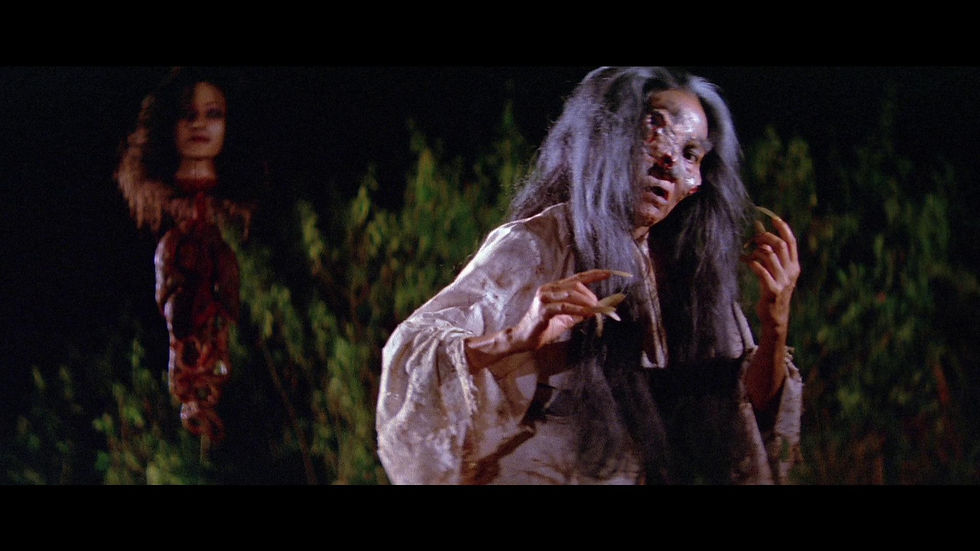
Our heroine is even transformed into a sort of Indonesian variation of a Caribbean zombie, becoming a mindless monster in the thrall of a sort of witch doctor, the Queen of the Leák (Sofia W.D.). But her fate is much worse, because, instead of becoming a glossy-eyed automaton, she metamorphosizes into a léyak (or leák), the Balinese version of a creature otherwise known as a penanggalan (Malaysia) or manananggal (Philippines). A léyak is a fanged, flying head with internal organs hanging from its neck that, among other things, feeds on the blood of fetuses.
The DIY effects are crude (some shots are achieved via analog video compositions and, in others, the léyak is clearly just a mannequin’s head hanging from a wire), but the concept is so thoroughly disturbing that it doesn’t really matter. And the léyak isn’t the only outrageous onscreen grotesquery. The evil sorceress has detachable, werewolf-like hands and a meters-long tongue. Her powers turn herself and Catherine into pigs and snakes via makeshift bladder prosthetics and lap-dissolves, Catherine barfs live mice and sucks baby blood from between its mother’s legs, and, later, the Leák Queen and a benevolent sorcerer do battle with telepathy and laser fingers.
Djalil (sometimes credited as Jalil Jackson) continued dabbling in effects-laden horror madness well into the ‘90s. Mystics in Bali might have become his signature work, but it wasn’t his most deranged. He followed it up with The Warrior and the Ninja (Indonesian: Jaka Sembung & Bergola Ijo, 1985), the third in the Jaka Sembung trilogy, White Crocodile Queen (Indonesian: Ratu buaya putih, 1988), starring the Queen of Black Magic herself, Suzzanna, Lady Terminator (Indonesian: Pembalasan Ratu Pantai Selatan, 1989) – a film that combines black magic folklore with a gender-swapped Terminator rip-off – and the incomparable Dangerous Seductress (1992). We’ll get all of those on Blu-ray soon, Rangda willing.
* Italian filmmakers were borrowing ideas from their own mondo shockumentaries at this point, some of which took place in Southeast Asia, and exploited Southeast Asian cultural practices.
** After I finished this review, Pete Tombs informed me that Putra Mada also wrote the book from which the screenplay is derived a few years before the film was put into production.
Bibliography:
Fear Without Frontiers: Horror Cinema Across the Globe, edited by Steven Jay Schneider (FAB Press, 2003) – Specifically, Witches, Spells and Politics: The Horror Films of Indonesia by Stephen Gladwin
Mondo Macabro: Weird and Wonderful Cinema Around the World by Pete Tombs (St. Martin's, 1997)

Video
I can’t find any evidence of an official North American VHS or Beta release of Mystics in Bali, though bootlegs were available. Mondo Macabro premiered the film on UK DVD in 2003 and US DVD in 2007. This Blu-ray version was initially only available as a limited edition double-feature with Queen of Black Magic, but this review refers to the solo standard edition release. The advertising materials call this a digital restoration from the original negative. Mondo Digital further elaborates that the transfer is derived from Mondo Macabro’s own HD scan, which they first used for their 2007 US DVD.
As I’ve mentioned before, these movies weren’t treated very well, so there was a time when fans feared that none of them would make it to HD. This transfer isn’t perfect, but it’s probably as good as we can expect from this particular film, barring someone finding pristine elements in a random basement. Colors are rich, highlights are vivid, and blacks are deep and consistent, which puts it ahead of some of Mondo’s other Indonesian BDs. Grain and other textures appear natural, in spite of purposeful diffusion effects and a hint of noise.

The big issue here is that a lot of the composite effects were done using ‘80s video editing tech. They are lo-fi and low-definition, and the 1080p resolution magnifies all of their flaws. I’ve included examples on this page for illustrative purposes. Similar issues arise during some optical effects, specifically black scratches in the footage.
Audio
Mystics in Bali is presented with English and Indonesian dub options, both in uncompressed DTS-HD Master Audio 2.0 mono. Again, I discovered most of these films in English, so I tend to defer to English dubs for nostalgia reasons, but I sampled both for the review. Generally, the sound quality is similar, at least in terms of condition and clarity. The English dialogue is a bit cleaner and louder, but the Indonesian tracks are more naturally mixed and feature less aspirated hiss. Unusually, the Indonesian track is pitched slightly higher, which is most notable in Gatot Sudarto’s synth soundtrack.

Extras
Extended Indonesian cut of the film (118:13, SD) – A much longer version of the film presented in non-anamorphic standard definition with a compressed Dolby Digital mono Indonesian soundtrack.
Joko Anware on Mystics in Bali 2026 (8:47, HD) – The director of Impetigore (2019), the Satan’s Slave remake (2017), and writer of the Queen of Black Magic remake (2019, directed by Kimo Stamboel) talks about the film’s place in current culture, the importance of the Bali location, and the fact that it follows a Hindu tradition, instead of a Islamic one.
Monsters Movies & Myth (10:48, HD) – In this new video essay, film historian Jake Giallo explores Indonesian horror cinema, the mythology and folk tales that inspired it, various floating head vampires/ghosts across Southeast Asia, and the pantheon of films based on those monsters.
Archival interview with Tjut Djalil (14:50, SD) – The director chats about his career and films on this interview from the original DVD.
Theatrical trailer (2:41)
The images on this page are taken from the BDs and sized for the page. Larger versions can be viewed by clicking the images. Note that there will be some JPG compression.
Comments