


Hex Blu-ray Review

Updated: Dec 15, 2025

Arrow Video
Blu-ray Release: December 9, 2025 (as part of Shawscope: Volume 4)
Video: 2.35:1/1080p/Color
Audio: Cantonese and Mandarin LPCM 1.0 Mono
Subtitles: English
Run Time: 97:06
Director: Kuei Chih-Hung
A sickly woman (Niu Tien) and her nursemaid (Chan Sze-Kai) murder her abusive husband (Wang Jung) and hide the body. Soon after, he appears to haunt them from beyond the grave. But all is not as it seems…
Few filmmakers set the temperature for Shaw Bros. horror better than Kuei Chih-Hung, beginning with the pre-Legend of the 7 Golden Vampires (1974) creature featureThe Killer Snakes (1974) and the pre-Black Magic (1975) vampiresque thriller Ghost Eyes (1974). He hit his stride back-to-back-to-back in the ‘80s with Hex (1980), Hex vs. Witchcraft (1980), Corpse Mania (1981), Bewitched (1981), Hex After Hex (1982), Curse of Evil (1982), and The Boxer’s Omen (1983). In previous reviews and podcasts, I referred to The Boxer’s Omen as Kuei’s best movie*, but I’ve come to question that assertion. Boxer’s Omen is definitely a culmination of images and themes, making it the most Kuei Chih-Hung movie, but I can’t stop thinking about Hex.

Hex’s success inspired the rest of Kuei’s increasingly outrageous possession and curse movies, but it has a degree of visual refinement and structural clarity rarely seen throughout the series. Whereas those later movies are nauseating and chaotic, Hex is spooky and focused (aside from some particularly unfunny comic relief during the second act, something that Kuei went all-in on for the two semisequels). It’s still brimming with energy and atmosphere – sometimes in the vein of Sam Raimi (whose Evil Dead wouldn’t hit Hong Kong cinemas until 1983) and Dario Argento – but it’s not constantly trying to blow our minds with colorful monsters and elaborate rituals. It builds in insanity, rather than bursting out of the gate with the pedal to the metal.
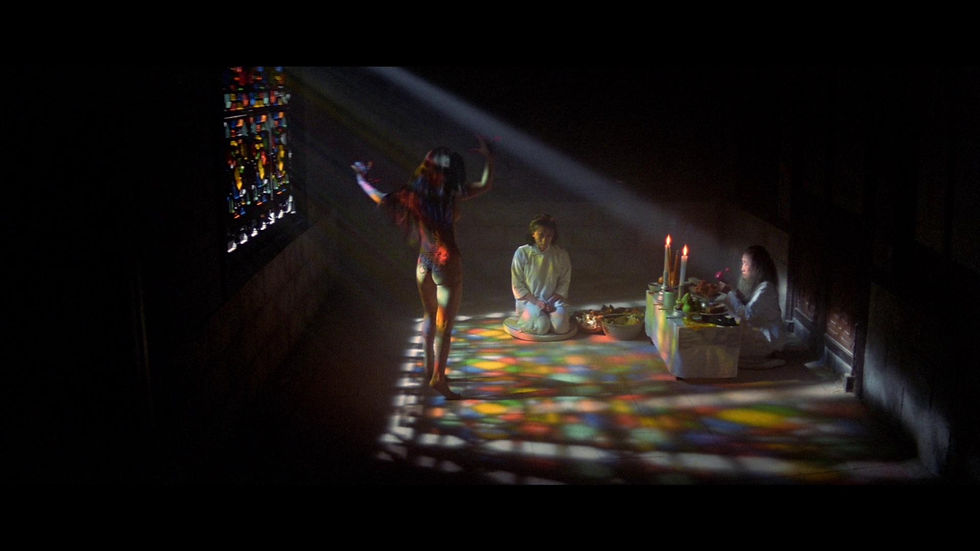
Hex’s unique artistry is best expressed during its climax, specifically the scene in which a fully nude woman is forced to do a long, spastic dance as part of a cleansing ceremony. The whole set up is a thinly veiled excuse for T&A, yet it’s so beautifully lit and carries on for so long that it outstrips its simple exploitation spectacle and becomes strangely moving and meaningful. It also breaks from the wider Kuei/Ho Meng-Huathe curse/possession tradition by being a period piece, instead of a contemporary tale, drawing comparisons to the Sammo Hung and Tsui Hark supernatural comedy formula that ran parallel to Shaw’s run of horror films.

Hex’s comparatively clean, straightforward narrative can be attributed to the fact that it is a remake of Henri-Georges Clouzot’s Les Diaboliques (1955). Well, sort of. The first half of the film is a China-set remake of Les Diaboliques, the second half carries Boileau-Narcejac’s original story (She Who Was No More [1952]) beyond its conclusion and big twist, making the villains into victims and turning a faux-supernatural scheme into an actual supernatural happening (or is it?). Kuei and co-writer Tam Gam-Wa top it all off with an unlikely mini-remake of author Lafcadio Hearn’s Japanese folktale Hoichi the Earless, as also seen in Masaki Kobayashi’s Kwaidan (1964). While Hearn’s story perhaps an odd one to associate with Les Diaboliques, the image of a figure painted head-to-toe in Buddhist prayer script was clearly one that fascinated Kuei, because he used it again in Boxer’s Omen.
Somehow, Kuei and Tam avoid making Diaboliques' lesbian subtext more explicit, which is surprising, given how many other excuses they make to titillate and squeeze extra nudity into the film. There would’ve been a precedent for girl-on-girl exploitation at Shaw already, following Chor Yuen’s Intimate Confessions of a Chinese Courtesan (1972) and Kuei's own The Bamboo House of Dolls (1973).

If you’d like to hear more about Hex, along with other films available as part of Arrow’s Shawscope: Vol. 4, check out the Shaw Bros. Horror episode of the Genre Grinder podcast, which I recorded with Stefan Hammond, the author of Sex & Zen and a Bullet in the Head (with Mike Wilkins; Touchstone, 1996), Hollywood East (Contemporary Books, 2000), and More Sex, Better Zen, Faster Bullets (Headpress, 2020).
* I could also make the argument that Kuei’s devastating wuxia, The Killer Constable (1980), is actually his best movie (and I think I might have?), but it isn’t a horror film and that feels like a completely different conversion.

Video
Hex never officially made it to North American home video, but it was easy enough to import on English-friendly DVD from Hong Kong. It made its Blu-ray debut via 88 Films in the UK (technically a BD/DVD combo pack). Again, like the other 88 Films Blu-rays, that one was based on a dated Celestial Pictures HD master. Arrow’s new 2.35:1, 1080p transfer (which shares disc space with Bewitched) is an upgrade taken from a new 2K remaster.
Cinematographer Li Hsin-Yeh ended up working with Kuei on several movies, beginning with Killer Constable, and you can see them developing what would become the super-diffused, Lite-Brite highlighted look of Boxer’s Omen here. Overall, Hex is a softer, far less saturated film and the transfer doesn’t try to oversharpen the foggy details or blow-up the dynamic ranges. Everything is a little foggy and brighter colors bloom, all as intended. Do note that the wide-angle anamorphic lenses cause a lot of distortion throughout. This is also the intended effect.
Audio
Hex is presented with Cantonese and Mandarin dubs, both in uncompressed LPCM 1.0 mono sound. The two tracks are similar in sound quality and each have their own advantages. The Cantonese dub is slightly louder and has better lip sync (I guess the cast was speaking Cantonese on set), while the Mandarin track is a tad cleaner and less tinny. Eddie Wang is credited with the score, but, as per usual, a lot of the music is taken from other sources, like the De Wolfe library, pop radio, and other movies (for example, a suspense theme was swiped from Piero Regnoli’s proto-giallo Appuntamento a Dallas [1964]). Being a period piece, there’s more traditional Chinese music here than in the other Shaw horrors, including diegetic music playing through radios that helps set the story in a specific time and place.
Extras
Unfortunately, there aren’t any Hex specific special features included with this collection.


The images on this page are taken from the BD and sized for the page. Larger versions can be viewed by clicking the images. Note that there will be some JPG compression.
https://mm88.today/ là địa chỉ tôi kiểm tra khi muốn xem cách hình ảnh đại diện cho trò chơi được sử dụng trong việc nhận diện nội dung. Tôi quan sát kích thước ảnh, tên hiển thị và vị trí của các biểu tượng trên danh sách trước khi mở từng mục. Nếu hình ảnh quá giống nhau hoặc tên bị thu nhỏ đến mức khó đọc, tôi sẽ phải mở từng trò mới xác định chính xác nội dung. Vì vậy tôi đối chiếu nhiều nhóm game để xem cách hình ảnh và văn bản hỗ trợ nhau trong quá trình lựa chọn. Tôi cũng chú ý những trường hợp ảnh chưa tải đầy đủ để xem phần tên có còn…
https://uu88.army/ Tôi thử mở khu vực xổ số theo hướng tìm lại một kết quả đã được công bố thay vì chỉ xem nội dung mới nhất. Tôi quan sát cách phân chia theo khu vực và ngày để xem việc tìm kiếm thông tin cũ có thuận tiện không. Nếu có nhiều mốc thời gian hoặc nhóm kết quả, tiêu đề cần đủ rõ để tôi biết mình đang xem phần nào trước khi mở chi tiết. Tôi cũng kiểm tra cách các bảng kết quả hiển thị trên điện thoại, đặc biệt khi có nhiều cột hoặc con số nằm cạnh nhau. Nếu màn hình nhỏ khiến dữ liệu bị ép sát, khả năng đọc có thể giảm đáng…
luck88 là nền tảng tôi thử đánh giá bằng tiêu chí khả năng giảm thao tác lặp lại. Tôi thực hiện cùng một nhu cầu ở những thời điểm khác nhau, chẳng hạn tìm tài khoản, quay lại menu hoặc mở phần hỗ trợ, rồi xem mình có phải đi qua cùng một số bước hay không. Tôi cũng thử rời khỏi một trang giữa chừng rồi quay lại để kiểm tra khả năng tiếp tục. Những chi tiết nhỏ này giúp tôi nhận ra liệu cấu trúc có hỗ trợ thói quen sử dụng hay chưa. Phần giao dịch được tôi xem tiếp với sự chú ý đến trạng thái và thông tin cần kiểm tra, trong khi phần hướng…
hitclub inc thường là nơi tôi xem các ưu đãi theo từng nhóm người dùng thay vì đọc chung toàn bộ danh sách. Với thành viên mới, tôi kiểm tra điều kiện nạp đầu và phạm vi áp dụng; với người dùng đang hoạt động, mình lại xem điểm danh, USDT hoặc các chương trình theo sảnh. Nếu ưu đãi casino, bắn cá và nổ hũ được tách rõ ngay từ tên, việc hiểu điều kiện sẽ dễ hơn. Tôi cũng quan tâm chương trình nào cần liên hệ CSKH trước khi sử dụng để tránh bỏ sót bước. Với tôi, khu khuyến mãi hợp lý khi người dùng biết mình thuộc nhóm nào, điều kiện nào đang áp dụng và…
tải iwin khiến tôi chú ý đến dung lượng trải nghiệm sau cài đặt chứ không chỉ quá trình lấy file về máy. Tôi thường mở ứng dụng, chuyển qua một vài khu như hướng dẫn, khuyến mãi và Tiến lên để xem tốc độ phản hồi có ổn định không. Nếu mỗi lần chuyển mục đều tải lại lâu hoặc mất vị trí trước đó, lợi ích của bản cài đặt sẽ giảm. Tôi cũng quan tâm ứng dụng có hiển thị nội dung mới mà không làm xáo trộn menu chính hay không. Với tôi, một bản tải tốt cần duy trì được tốc độ, cấu trúc và trạng thái sử dụng sau khi cài, giúp người dùng mở…