


Black Magic & Black Magic Part 2 Blu-ray Review


Arrow Video
Blu-ray Release: December 9, 2025 (as part of Shawscope Volume 4)
Video: 2.35:1/1080p/Color (both films)
Audio: Mandarin and English LPCM Mono (both films)
Subtitles: English, English SDH
Run Time: 97:51 (Black Magic), 92:59 (Black Magic Part 2)
Director: Ho Meng-Huathe
At the top of its most internationally successful decade, the 1970s, Shaw Bros. Studios began diversifying their genre output, including a comparatively small, but vital series of horror films. The turning point was arguably 1974, which saw the release of two definitively Hong Kong-flavored films, Kuei Chih-Hung’s The Killer Snakes and Ghost Eyes, and a combination of Shaw kung fu and Hammer Gothic, The Legend of the 7 Golden Vampires, co-directed by Chang Cheh and Roy Ward Baker (technically the second such collaboration, following the espionage action thriller Shatter [also 1974]).

When the ambitious Legend of the 7 Golden Vampires experiment disappointed at the box office, plans for a sequel were canned. Not long after, during the early ‘80s, Hong Kong horror came into its own when Sammo Hung’s Encounters of the Spooky Kind (1980) hit theaters and opened the flood gates to an ongoing series of films that mashed-up slapstick comedy, martial arts acrobatics, and elaborate special effects with ghouls, ghosts, and monsters.
Hung’s film was an extension of Lau Kar-leung’s supernatural kung fu comedies The Spiritual Boxer (1975) and The Shadow Boxing (1979), which were produced under the Shaw Bros. banner. But Shaw wanted their superstar directors, like Cheh and Lau, making straight action movies, especially after Legend of the 7 Golden Vampires was a box office disappointment (Hammer eked out only three more movies before closing its doors). However, not wanting to abandon horror altogether, Shaw opted to tie the genre in with their growing exploitation output. And thus a new branch grew from the phylogenetic tree of Hong Kong horror.

Evolving in tandem with martial arts comedies, this new brand of sexually-charged, gross-out horror also struck a chord with audiences. These films weren’t set in an ill-defined era of China’s past, like the wuxia costume dramas that build Shaw studios. Instead, they took place largely outside of China and Hong Kong, in other modern Southeast Asian cities, and drew from local folklore. This new formula, which built on Kuei’s early films, was initially embodied by a pair of films from director Ho Meng-Huathe – Black Magic (1974) and Black Magic Part 2 (1975)

Black Magic
An evil magician (Ku Feng) makes his living selling spells and services to malcontents and jilted lovers. One day, he bites off more than he can chew after making a love potion for a woman with a crush on a married man.
Kuei’s work might better represent the Shaw brand of horror, but Ho helped establish a lot, beginning with the use of disgusting rituals. Black Magic sets the precedent with flash-grilled human flesh, rotting victims, and loads upon loads of squirming bugs. Bodily functions also play an important role, because, apparently, black magic runs on breastmilk and goop from decaying corpses. It’s all pretty puerile and ridiculous, but it works, because Ho creates this inescapable nightmare logic that defies any sense of unsuspended disbelief.
First-time viewers might be surprised to learn that Black Magic is as much a tawdry romantic melodrama as it is a horror film. It’s actually shocking how heavily the middle section of the story is bogged down in the machinations of a petty love triangle. Or I suppose a love pentagon. Characters are continuously downing love potions, counter love potions, and counter-counter love potions. Combined with the ongoing grotesqueries, it’s all quite funny and I assume it was meant to be. It’s sort of a secret precursor to Michael Mak’s Sex & Zen (1991).
Ultimately, Black Magic has more in common with early ‘80s Indonesian and Malaysian fantasy horror movies than its Hong Kong counterparts. Perhaps this is because those films were mimicking Ho’s work, though it seems just as likely that Ho was being influenced by the culture of Malaysia and Singapore, where both Black Magic films were shot. In a lot of ways, these and the other Shaw Bros. horror films that take place in other Southeast Asian countries remind me of Italian cannibal films in that they’re often shot like tourist bureau propaganda, practically begging you to come visit these exotic locations. Yet, they also employ some of the worst cultural stereotypes imaginable, essentially warning viewers that, if they do come, you’ll probably end up murdered as part of a blood ritual.
Still, if there’s one thing these films have in common with the Mr. Vampire movies and Encounters of the Spooky Kind sequels, it is the presence of wizard battles. But Ho (and later Kuei) don’t match Golden Harvest’s model, in which evil wizards and Taoist monks fight using increasingly over-the-top acrobatics and pyrotechnic special effects. Instead, the Shaw model calls for their good and evil wizards to fight using more bugs, more gore, more of anything that might make the audience cheer and/or barf in the aisles.


Black Magic Part 2
A (different) evil magician realizes that his lucrative black magic monopoly is in danger when a group of doctors arrive from out of town.
With the formula set, Ho and Shaw’s hardest working screenwriter, Ni Kuang, threw plot and logic out the window and doubled-down on the crazy spectacle for Black Magic Part 2 (aka: Revenge of the Zombies in the US). Boy, did it pay off, because the sequel is better than the original in almost every way. The violence is bloodier, the boils are puss-ier, the bugs are buggier, there’s a gondola lift battle worthy of a Bond film, and the rituals and wizard battles are so unreasonably complicated that they take up a near-majority of the runtime. So much happens at such a chaotic clip that the filmmakers tend to forgo consequences to heinous acts, such as the time a major character is impregnated with a demonic baby that develops to full-term in a matter of hours, only to be completely forgotten by the next scene.
Apparently shot back-to-back with its predecessor, Black Magic Part 2 features largely the same cast, but in wildly different roles. No longer lovesick dopes, Ti Lung, Lily Li, and Ni Tein now play doctors who have come to investigate a black magic illness, assuming they can use their expertise to find a scientific explanation. The real star, though, is Lo Leih, who was cast against type as a pathetic loser in Black Magic. Here, he plays a wealthy, self assured, and extremely evil magician who keeps a harem of undercover zombie women in his dungeon, like Hammer’s Dracula crossed with a pimp. Lo always had range and really excelled as sneering baddies and Black Magic Part 2 is a career highlight, alongside his similar performance in Sun Chung’s Human Lanterns (1982).
If you’d like to hear more about the Black Magic duology, along with other films available as part of Arrow’s Shawscope Vol. 4, check out the Shaw Bros. Horror episode of the Genre Grinder podcast, which I recorded with Stefan Hammond, the author of Sex & Zen and a Bullet in the Head (with Mike Wilkins; Touchstone, 1996), Hollywood East (Contemporary Books, 2000), and More Sex, Better Zen, Faster Bullets (Headpress, 2020).


Video
Black Magic first hit stateside DVD via Image Entertainment in 2006 and was easily imported from Hong Kong via IVL. Black Magic Part 2’s first US DVD was from Media Blasters and is OOP. The first Blu-rays came from 88 Films in the UK in 2016 and 2018. Arrow is including both films on a single disc (disc #3 of 10 in their Shawscope Vol. 4 collection) and has produced new 2K mastered transfers, which gives them an edge over the 88 Films releases, which utilize older Celestial Pictures HD masters.
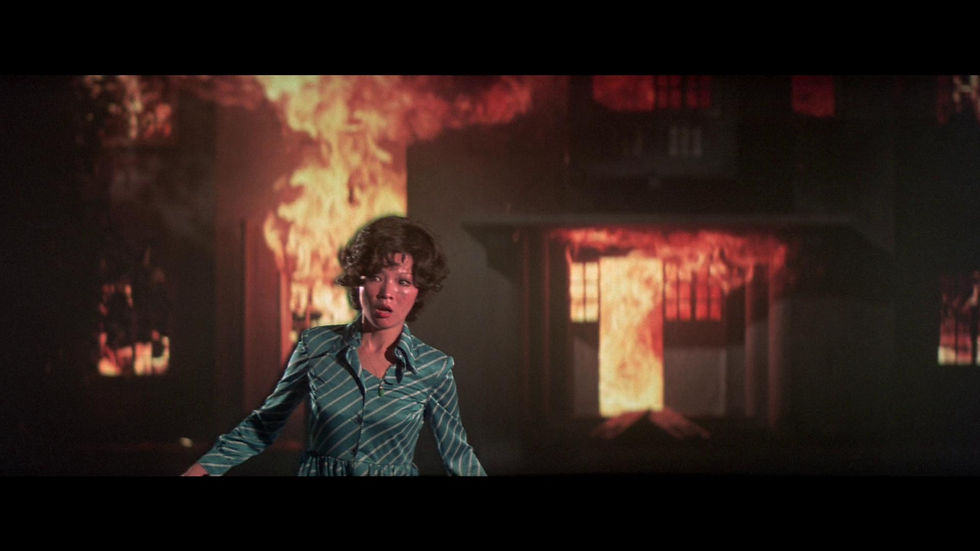
Those older transfers were quite vibrant and colorful, but lacked texture and, like many Celestial transfers, had minor edge enhancement problems. The new scans feature more texture, including plenty of natural film grain, correct the halo issue, and even improves on what were otherwise acceptable dynamic ranges. Cinematographers Cho Wai-kei and Tsao Hui-chi use a lot of soft focus, diffusion, and fog effects, as was the style at the time, which can make some sequences appear quite noisy, but it looks pretty accurate to my eyes. Overall, this is the best I’ve seen either film look.

Audio
Both films are presented with Mandarin and English dub options, all in uncompressed DTS-HD Master Audio mono. The Mandarin tracks are a bit crunchier than the otherwise clean English tracks, but have a better general mix of elements. In English, a lot of incidental effects are almost indecipherable and the score is a tad quieter. The quality of the English dubs is pretty good, though. The music is credited to Frankie Chan and Chen Yung-Yu, but, as per usual, a lot of tracks are taken from the De Wolfe library or stolen from other sources without credit. For instance, Black Magic Part 2 uses a familiar Incredible Bongo Band track without attribution during an early club scene.
Extras
Black Magic commentary with James Mudge – The critic, industry expert, and filmmaker talks about Shaw’s branching into horror and exploitation (touching upon the failure of Legend of the 7 Golden Vampires and the work of Kuei Chih-Hung), films that influenced Black Magic and its contemporaries, the mishmash of real-world religious rituals that inspired this and other black magic-type movies, and the wider careers of the cast & crew (with emphasis on Ho Meng-Huathe and Ni Kuang).
Black Magic Part 2 commentary with Samm Deighan – The co-editor of the recently published Revolution in 35mm: Political Violence and Resistance in Cinema from the Arthouse to the Grindhouse, 1960 - 1990 (PM Press, 2024) explores Shaw’s genre expansion during the mid-to-later ‘70s, Ho’s filmography, the careers of the rest of the cast & crew, the Singaporean locations, and various themes shared by the Black Magic films and similar Hong Kong supernatural thrillers and comedies.
Alternate Revenge of the Zombies US credits (1:59, SD)
The images on this page are taken from the BD and sized for the page. Larger versions can be viewed by clicking the images. Note that there will be some JPG compression.
Comments