


Beatrice Cenci Blu-ray Review


88 Films
Blu-ray Release: November 10, 2026
Video: 1.85:1/1080p/Color
Audio: English and Italian DTS-HD Master Audio 2.0 mono
Run Time: 93:42
Director: Lucio Fulci
At the end of the 16th century, the prestigious Cenci family is awaiting execution following a scandal involving an abusive patriarch’s secret torture chamber and retalitary murder plot between his daughter, her stepmother, their servant, and a bandit.
For the first decade of his career as a director, Lucio Fulci excelled at making popular comedies and musicarelli. Over ten years, he churned out 24 features and only deviated from his chosen genre path with a single western, 1966’s Massacre Time (Italian: Le colt cantarono la morte e fu... tempo di massacro; aka: The Brute and the Beast). Massacre Time revealed glimpses of the sadistic, gore-hungry horror flicks to come, but the bloodier moments were justified in matching the violent tone set by spaghetti western pioneers, the Sergios Leone and Corbucci*.
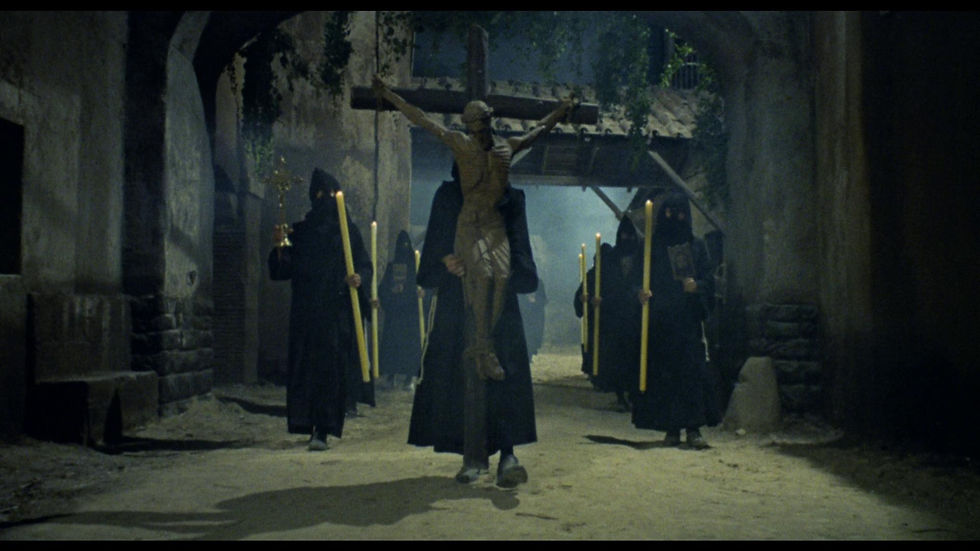
In 1969, Fulci’s work took a sharp turn. That year, he cowrote Riccardo Freda’s giallo/krimi Double Face (Italian: A doppia faccia; German: Das Gesicht im Dunkeln), cowrote and directed his own giallo, Perversion Story (Italian: Una Sull'altra; aka: One on Top of the Other), and made a bleak and bloody historical drama Beatrice Cenci (aka: The Conspiracy of Torture). Based on the historical story of the Cenci family, more specifically Percy Shelley’s 1819 five-act tragedy, entitled Les Cenci, and ambitiously (and somewhat confusingly) told via two interlacing timelines by the director and cowriter Roberto Gianviti, Beatrice Cenci marks the true beginning of the grim & gory period of Fulci’s career.
Fulci often referred to his esoteric, nihilistic horror films as “Artaudian” in nature and Beatrice Cenci offered him the chance to adapt a famously scandalous story already connected to playwright Antonin Artaud, who himself had re-adapted Les Cenci for his Theater of Cruelty in 1935**. It also introduces an unambiguously anti-Catholic sentiment that followed through to Don’t Torture a Duckling (Italian: Non si Sevizia un Paperino, 1972) and City of the Living Dead (Italian: Paura nella città dei morti viventi; aka: The Gates of Hell, 1980)***.

It’s likely that Fulci was (in part) inspired to make a hyperviolent costume drama after seeing Michael Reeves’ politically-charged and pessimistic Witchfinder General (aka: The Conqueror Worm, 1968), which, along with George A. Romero’s Night of the Living Dead (1968), had pushed the boundaries of cinematic violence in the previous year. To be clear, Beatrice Cenci isn’t a wall-to-wall gorefest on par with City of the Living Dead, but it does represent a major shift in tone and escalation of violence that defined his next decade of filmmaking.
The torture scenes don’t have the grand guignol quality of other post-Witchfinder General witch hunter movies, like Michael Armstrong’s Mark of the Devil (1970), but Fulci doesn’t pull his punches where it counts. Early in the film, German shepherds are sicced on a prisoner, anticipating a nastier dog attack in The Beyond (Italian: ...E tu vivrai nel terrore! L'aldilà; aka: Seven Doors of Death, 1981), and the assault ends with a crash zoom into a freshly torn neck wound, which is a shot Fulci recycled ad nauseum throughout his first hardcore gore flick, Zombie (Italian: Zombi 2, 1979). Francesco Cenci’s murder is the juicy centerpiece, though, and features the first instance of the Lucio Fulci gore trademark – eye trauma.

This was the first of three movies Tomás Milián made with Fulci, followed by Don’t Torture a Duckling and Four of the Apocalypse (Italian: I quattro dell'apocalisse, 1975). All three of their collaborations feature torture sequences. In Beatrice Cenci, he’s stripped nude, stretched on the rack, branded, and broken on the wheel. In Don’t Torture a Duckling, an innocent witch is beaten to death (Milián’s character does not witness this). Then, in Four of the Apocalypse, he graduates from torturee to torturer and flays a trussed up lawman.
Fittingly, torture scenes, specifically torture scenes in various states of undress, were already a Milián trademark before he was cast here. In Giulio Questi’s Django Kill... If You Live, Shoot! (Italian: Se sei vivo spara, 1967), he’s crucified and ensanguinated via vampire bat and, in Sergio Sollima’s Run, Man, Run (Italian: Corri uomo corri, 1968), he’s attached to a windmill and beaten upon each rotation.

Fulci made three more straight comedies during the 1970s – The Eroticist (Italian: Nonostante le apparenze... e purchè la nazione non lo sappia... all'onorevole piacciono le donne, 1972), Dracula in the Provinces (Italian: Il cav. Costante Nicosia demoniaco ovvero: Dracula in Brianza, 1975), and My Sister in Law (Italian: La pretora, 1976) – but was more or less all in on ultraviolence. Even his boy’s adventure westerns, White Fang (Italian: Zanna Bianca, 1973), Challenge to White Fang (Italian: Il ritorno di Zanna Bianca, 1974), and Silver Saddle (Italian: Sella d'argento, 1978), are unnecessarily, often hilariously brutal.
* Fulci tested the waters of on-screen torture when he shot a whipping sequence for Massacre Time. The scene is similar to the beating Clint Eastwood endures in A Fistful of Dollars (Italian: Per un pugno di dollari, 1964) and even ends on a joke, diffusing the situation, but still portends the viscous chain beatings to come in The Beyond and Don’t Torture a Duckling.

** While describing the Artaudian qualities of The Beyond during an interview for Luca M. Palmerini & Gaetano Mistretta’s Spaghetti Nightmares, Fulci refers to Massacre Time as “a western that went beyond time and space,” implying that it was his first attempt at applying Artaud’s principles to a motion picture. I truly don’t know what he’s referring to, because Massacre Time is the most straight-forward of his westerns.
*** Biographer/critic Stephen Thrower traces the anti-Catholic hypocrisy theme back to Fulci’s 1967 comedy Operation St. Peter's (Italian: Operazione San Pietro). I’ve never been able to find a copy of that film with English subtitles, so I’ll take his word for it.
Bibliography:
Beyond Terror: The Films of Lucio Fulci by Stephen Thrower (FAB Press, 1999)
Spaghetti Nightmares by Luca M. Palmerini & Gaetano Mistretta (Fantasma Books, 1996)

Video
Beatrice Cenci never had an official stateside VHS release and it made its (possibly grey market) DVD debut via defunct label Midnight Choir in 2009 as a double-feature with Mario Bava’s The Whip and the Body (1963), under the alternate title Conspiracy of Torture. 88 Films released the first Blu-ray edition in the UK in 2019. That same edition is now finally available in the US. This transfer (like that one) was remastered in 2K from the original camera negative and is presented in its original 1.85:1 and 1080p.
This is a very earthy movie, sporting a largely brown, beige, and black palette, so tonal variation is important. A few scenes skew a bit orange and shadows a little bluish/greenish, but not on the level of some earlier L’Immagine Ritrovat restorations. When necessary, bloody reds pop, black levels are rich with a hint of crush, and the darkest sequences are more discernible than the Midnight Choir or German New Entertainment World discs. Close-up details are tight, wide angle shots have a slight softness, and grain quality seems natural for a 2K scan, though perhaps a bit noisy at points. Until someone does a full 4K scan of the available materials, this is easily the best Beatrice Cenci has ever looked on home video.

Audio
Beatrice Cenci is presented with Italian and English dub options, but in uncompressed DTS-HD Master Audio 2.0 mono. As per usual, the film was shot without on-set sound and all audio options are dubbed, so lip sync and performance quality will always be a bit off and there is no ‘official’ language mix. It appears that the leads, including Cuban-born, American-trained Milián, American-born Adrienne La Russa, and French-born Georges Wilson, were performing in English, though I don’t believe any of them dubbed their own performances. Overall, the Italian track has slightly louder incidental sound effects, but the English track is preferable for dialogue qualities and the clarity of Angelo Lavagnino and Silvano Spadaccino’s sparse score.

Extras
Commentary with Troy Howarth – The author of Splintered Visions: Lucio Fulci and His Films (Midnight Marquee Press, 2015) explores Beatrice Cenci’s production, Fulci’s wider filmography and favorite collaborators, connections to later movies, the historical story behind the film, and the wider careers of the cast & crew.
A Jack of All Trades (28:52, HD) – Actor Antonio Casagrande, who plays Don Giacomo Cenci, chats about his upbringing, his career as an actor and singer, and making Beatrice Cenci.
A Most Violent Year: Stephen Thrower on Beatrice Cenci (33:00, HD) – The author of Beyond Terror: The Films of Lucio Fulci discusses the shift in the director’s career upon making Beatrice Cenci, elements of darkness and violence in his early comedies, the historical context and accuracy of the story, a competing, bigger budget version of the story, critical reactions upon release, ties to Artaudism, political and spiritual meanings, and the wider careers of the cast & crew.


The images on this page are taken from the Blu-ray and sized for the page. Larger versions can be viewed by clicking the images. Note that there will be some JPG compression.
Comments