


The Double (1971) Blu-ray Review


Radiance Films
Blu-ray Release: July 28, 2026
Video: 1:85:1/1080p/Color
Audio: English and Italian LPCM 1.0
Subtitles: English SDH, English
Run Time: 90:41
Director: Romolo Guerrieri
Giovanni (Jean Sorel) is shot in an underground parking garage by a mysterious bearded man. As his life flashes before his eyes through flashbacks, we learn about his life and what led to this moment. His flirtatious wife, Lucia (Ewa Aulin), and the fissures her behaviour creates complications with the family business, Lucia's relationship with a travelling hippie, and her beautiful mother-in-law (Lucia Bosé). (From Radiance’s original synopsis)

In early 2023, perennial Genre Grinder podcast co-host Patrick Ripoll and I recorded a two-part piece on the giallo movies released during the genre’s peak year (in terms of theatrical output), 1971 (listen to it here and here). Of the 40-plus gialli and giallo-adjacent films I researched, we covered 12, which I picked based on their accessibility, familiarity of the filmmakers, and particular thematic qualities that I hoped would paint the most complete picture of the genre at the time. A number of films were skipped in spite of interesting premises and genuine star power, because they simply were not available on (English-friendly) disc or stream.
Among those films we didn’t cover was Romolo Guerrieri's The Double (Italian: La controfigura, 1971). Given the caliber of its director, writers, and cast, The Double’s obscurity is surprising. Guerrieri’s name isn’t as synonymous with gialli as Dario Argento’s or Umberto Lenzi’s, but his 1968 film, The Sweet Body of Deborah (Italian: Il dolce corpo di Deborah), was one of the foundational titles of the genre, along with Mario Bava’s Blood and Black Lace (Italian: 6 donne per l'assassino, 1964) and Umberto Lenzi’s Orgasmo (aka: Paranoia, 1969).

Sweet Body of Deborah was written by another genre architect, Ernesto Gastaldi, and became a template for several ‘70s era gialli. It is formulaic, but only in retrospect. The Double is a remarkable follow-up, because it isn’t indebted to Gastaldi’s formula, nor is it to Dario Argento’s even more popular The Bird with the Crystal Plumage (Italian: L'Uccello dalle piume di cristallo, 1970) formula.
The Double has a low body-count, its protagonist is particularly unpleasant, its chronology is muddled, and, despite being sold on its sex appeal, it cares more about Freudian psychology and social dynamics than titillation. It’s all in the vein of more avant-garde Italian thrillers, like Giulio Questi’s Death Laid an Egg (Italian: La morte ha fatto l'uovo, 1968, also co-starring Ewa Aulin) and Elio Petri’s A Quiet Place in the Country (Italian: Un tranquillo posto di campagna, 1968). Stylistically, the film centers on kaleidoscopic editing techniques that shunt us back & forth through time, revealing pieces of information, mixing fantasy with reality, and reproducing the unreliable nature of memory.

The screenplay is credited to Sandro Continenza and Sauro Scavolini, based on the 1971 novel La controfigura by Libero Bigiaretti, an author known for exploring moral ambiguity, femininity, and social inequality – all themes found throughout The Double, despite the screenwriters reportedly taking liberties with the novel’s plot. Scavolini is mostly remembered for working with Sergio Martino on The Case of the Scorpion's Tail (Italian: La coda dello scorpione, 1971), All the Colors of the Dark (Italian: Tutti i colori del buio, 1972), and Your Vice is a Locked Room and Only I Have the Key (Italian: Il Tuo Vizio è Una Stanza Chiusa e Solo Io ne ho la Chiave, 1972). Continenza co-wrote Riccardo Freda’s Iguana with the Tongue of Fire (Italian: L'iguana dalla lingua di fuoco, 1972) and Sergio Pastore’s Crimes of the Black Cat (Italian: Sette scialli di seta gialla, 1972).
French-born actor Jean Sorel’s* career didn’t begin with the gialli, nor did his stardom in Italy, but he was there at the beginning, appearing in The Sweet Body of Deborah, Lenzi’s third giallo, A Quiet Place to Kill (Italian: Paranoia, 1970), and his first collaboration with Lucio Fulci, Perversion Story (Italian: Una Sull'altra; aka: One on Top of the Other, 1969)**. The Double’s toxic love triangle is mirrored in all three films, especially Quiet Place to Kill and Perversion Story, establishing a type for Sorel that he’d also play in Fulci’s Lizard in a Woman’s Skin (Italian: Una Lucertola con la Pelle di Donna, 1971) and José María Forqué’s In the Eye of the Hurricane (Spanish: El ojo del huracán; aka: Fox with the Velvet Tail, 1971).

The Double also has some curious connections to Aldo Lado’s Short Night of Glass Dolls (Italian: La corta notte delle bambole di vetro, 1971). Both feature Sorel on the verge of death as the events of the last several days flash before his eyes. The circumstance is different, as in Lado’s film, his character is mysteriously trapped in his own body, on the verge of being dissected alive for an autopsy, and desperate to signal to the people around him that he’s still alive. But the similarities are still unusual, especially considering that the two films were released within a month of each other in 1971, The Double in September and Short Night of Glass Dolls in October, with a wider Turin release in January of 1972.
* Guerrieri reportedly wanted Giancarlo Giannini for his lead, but had to settle for Jean Sorel when Giannini ended up in Paolo Cavarao’s Black Belly of the Tarantula (Italian: La tarantola dal ventre nero, 1971).

** The Double and Perversion Story both owe a sort of thematic debt to Hitchcock’s Vertigo (1958), along with Umberto Lenzi’s So Sweet, So Perverse (Italian: Così dolce... così perversa, 1969), which combined aspects of Vertigo and Henri-Georges Clouzot’s Les Diaboliques (1955). By random coincidence, both The Double and the Vertigo-themed sexploitation thriller Sugar Cookies (1973) are getting Blu-ray releases in the same month, so I’m writing reviews of them concurrently.
Bibliography
Italian Giallo in Film and Television: A Critical History by Roberto Curti (McFarland, 2022)
Video
The Double has never been officially released on North American VHS or DVD, but fans did put together a surprisingly watchable bootleg using a Spanish print and European VHS audio. For everyone that didn’t have access to that bootleg (I only found it myself while researching this review), Radiance’s new Blu-ray isn’t only the first HD availability of the film, but the first chance to see it at all. This 2.35:1, 1080p transfer was supplied to Radiance by Video Mercury, who scanned and remastered the original camera negative.
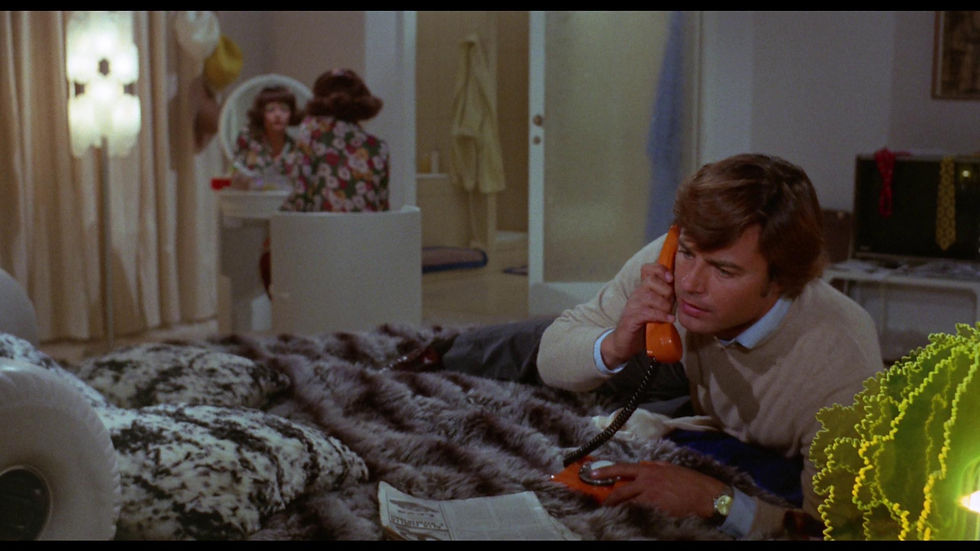
Cinematographer Carlo Carlini (The Big Gundown [Italian: La Resa dei Conti, 1966], Death Rides a Horse [Italian: Da uomo a uomo, 1967], Autopsy [Italian: Macchie solari, 1975]) shoots the film cleanly and brightly lit, mostly avoiding the dark and spooky compositions of more horror-based gialli. Grain levels clump a bit when the shot is particularly diffused (like underwater shots), but generally seems natural. Dirt causes some minor discoloration, though this is partially due to how neutral the overall palette is. Details are crisp without oversharping issues and dynamic range is tidy, again, in spite of the bright, clean, and neutral quality of the film.

Audio
The Double is presented with Italian and English dub options, both in uncompressed LPCM 1.0 mono. As per usual, the film was shot without sync’d sound with an international cast (Sorel is French, Lucia Bose is Italian, Ewa Aulin is Swedish, et cetera) and all language versions were dubbed in post. In this case, the English track has louder music and incidental effects, but muffled dialogue, while the Italian track is a bit sharper and a little more consistent. The main cast is speaking English on set and I think Aulin and Bose are actually dubbing their own performances.
Composer Armando Trovajoli was a long-time veteran and scored a variety of pictures, from Mario Bava’s Hercules in the Haunted World (Italian: Ercole al centro della terra, 1961), to Paolo Heusch’s Werewolf in a Girls' Dormitory (Italian: Lycanthropus, 1961), Vittorio De Sica’s Yesterday, Today, and Tomorrow (Italian: Ieri, oggi, domani, 1963), and Alberto De Martino’s Strange Shadows in an Empty Room (Italian: Una magnum special per Tony Saitta, 1976). His score contrasts big, sweeping love ballads and danceable jazz with dissonant chords and melodies in a way that supports the film’s eerie sense of time and place.

Extras
Commentary with Tim Lucas – Mr. Video Watchdog and the author of Mario Bava: All the Colors of the Dark (Video Watchdog, 2007) explores Romolo Guerrieri’s wider work, the careers of the cast & crew, The Double’s production, Libero Bigiaretti’s original novel, the film’s themes and philosophical meaning, the Morocco and Italian locations, and Trovajoli’s score.
Romolo Guerrieri and Ewa Aulin on The Double (14:25, HD) – This is a new combined reedit of a 2013 interview with the director and a 2017 interview with the actress, who look back on their own careers, the making of the film, shooting locations, working with the rest of the cast & crew (Aulin compares experiences making The Double and Death Laid an Egg, specifically).
Stephen Thrower on The Double (26:02, HD) – The author of Beyond Terror: The Films of Lucio Fulci (FAB Press, 2018) closes things out discussing the film’s status as a quasi-giallo, the meaning of the Italian title, challenges in adapting the novel, the careers of the cast & crew, how the film’s style and structure informs its themes, character dynamics, and homosexual stereotypes in Italian genre cinema.
Image gallery
The images on this page are taken from the BDs and sized for the page. Larger versions can be viewed by clicking the images. Note that there will be some JPG compression.
Slik jeg forstår systemet, bygger Norge på en enerettsmodell heller enn et åpent marked med mange konkurrerende aktører. Norsk Tipping står for lotteri, sportsspill og nettbaserte spill, mens Norsk Rikstoto har ansvaret for det som er knyttet til hest. Lotteritilsynet fører kontroll med rammeverket. Den som vil ha detaljene kan se hele gjennomgangen og vurdere om beskrivelsen passer med egen situasjon. Et poeng jeg synes er lett å overse er at en utenlandsk tillatelse ikke erstatter norsk godkjenning. Myndighetene vurderer den enkelte tjenesten, ikke bare hvor selskapet er registrert. Norskspråklige sider, priser i NOK, norsk kundestøtte og norsk telefonnummer kan til sammen tyde på at en aktør retter seg mot Norge. Det er også verdt å lese vilkårene om identitetskontroll, grenser…