


Sugar Cookies Blu-ray Review (Troma Release)


Troma Films
Blu-ray Release: July 14, 2026
Video: 1.78:1/1080p/Color
Audio: English Dolby Digital 1.0 mono
Subtitles: English SDH
Run Time: 90:47
Directors: Theodore Gershuny
When a sociopathic pornographer named Max (George Shannon) murders his star actress, Alta (Lynn Lowry), her lesbian lover, Camila (Mary Woronov), hatches an insane, elaborate revenge plan to recreate the crime using a young actress named Julie (also Lowry), who is a dead ringer for Alta.
Sold as a softcore curiosity in the midst of the Porno Chic boom (“Women will understand…Men will be shocked,” cried the adline), Theodore Gershuny’s Sugar Cookies (1973) was a commercial and critical flop, and would’ve been little more than a forgotten oddity, had it not been for the uncommon confluence of cult stars that made it.

Gershuny’s own career was short-lived, but is remembered fondly by some for moody and strange low-budget thrillers For Love or Murder (aka: Kemek, 1970) and Silent Night, Bloody Night (aka: Deathouse, 1972), the latter of which is definitely his most well-known and well-received work, thanks in large part to lapses in copyright. Eventually, he also directed episodes of made-for-TV horrors Tales from the Darkside (1985-’87) and Monsters (1988-’90). Gershuny co-wrote the script with a young Lloyd Kaufman one year before he co-founded Troma Entertainment. Sugar Cookies was only Kaufman’s third completed film as a writer, following The Girl Who Returned (1969) and Battle of Love’s Return (1971), both of which he directed himself.
Gershuny and Kaufman’s script is as disjointed as expected from the former and as trashy as expected from the latter. What makes it so remarkable, besides its main characters being lesbians at a time when that was still particularly taboo, is its loose basis in Alfred Hitchcock’s Vertigo (1958), predating Brian De Palma’s Obsession (1976) and John Grissmer’s False Face (1977). Vertigo is a classic now, but was considered a critical and commercial failure upon its initial release, too. It wasn’t fully reevaluated until after Hitchcock had died, which makes it so interesting that it was already the thematic inspiration of multiple ‘70s thrillers.*

Vertigo lends itself to a lesbian softcore reimagining (original authors Boileau-Narcejac’s Celle qui n'était plus [pub: 1952] is brimming with homoerotic subtext), but turning it into a feminine revenge story is such a strange choice that only succeeds because of how much of a square peg it is. In the end, Sugar Cookies is too depressing to be sexy and too silly to work as an arthouse drama, but, like Silent Night, Bloody Night and, to a certain extent, Vertigo, its uncanny tone, languid pacing, experimental soundtrack, and ragged, impressionistic editing gives it a unique and oddly enjoyable flavor. Kaufman threatens to sabotage it by shoehorning in a very unfunny, Troma-esque comedic subplot about the villain’s overweight nephew, but even this is weird enough to fit the film’s anarchic tone.
As he had before, Gershuny tailored the script for his then-wife Mary Woronov, who, in spite of the nepotism, became almost as influential a cult personality as Kaufman. Prior to Sugar Cookies, she worked at Andy Warhol’s studio The Factory, appearing in several films and shorts, which, in turn, also associated her with Lou Reed and The Velvet Underground. After her divorce from Gershuny (the same year Sugar Cookies was released), she hooked up with Roger Corman’s people, acting in Allan Arkush & Joe Dante’s Hollywood Boulevard (1976), Arkush’s Rock ‘n’ Roll High School (connecting her to The Ramones, 1979), and Paul Bartel’s Death Race 2000 (1975). She and Bartel collaborated on 17 films, including Eating Raoul (1982). From there, her career never really stopped.

Woronov’s co-star (in a dual role) Lynn Lowry’s career is defined by a short burst of all-time great cult films, followed by decades largely out of the public eye. Her crowning achievement was a coincidental trilogy of pseudo-zombie/outbreak movies – David E. Durston’s I Drink Your Blood (1970), George A. Romeros’ The Crazies (1973), David Cronenberg’s Shivers (aka: They Came from Within, 1975) – but, over that five year period at the beginning of the ‘70s, she also appeared in Kaufman’s Battle of Love’s Return and Radley Metzger’s Score (1973), another Porno Chic era classic that makes a good double-feature with Sugar Cookies (assuming you’re watching the softcore cut).
Veteran actress Monique van Vooren was already a cult star at the time of production, having made her name as the titular she-devil in Kurt Neumann’s Tarzan and the She-Devil (1953). Her storied career saw her playing an uncredited showgirl in Best Picture winner Gigi (1958), villainess Miss Clean on the Batman TV series (1968), the Queen of Skulls in Pier Paolo Pasolini’s X-rated adaptation of The Decameron (1971), and Baroness Frankenstein in Paul Morrissey’s Flesh for Frankenstein, aka: Andy Warhol’s Frankenstein (1973). She doesn’t have a lot of screentime here, but she makes the most of it and boosts Sugar Cookies’ overall camp appeal.
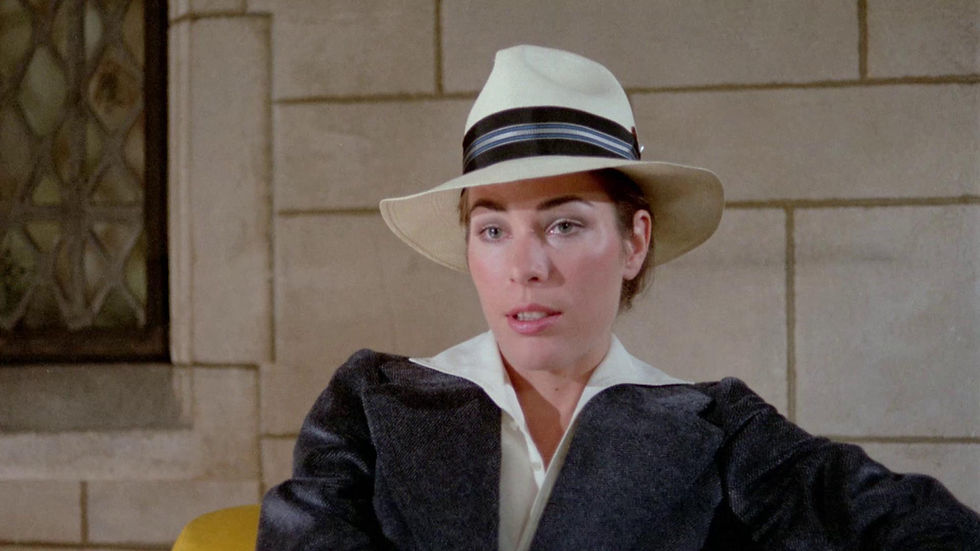
And speaking of Andy Warhol and camp appeal, Factory founding member Ondine (aka: Robert Olivo) rounds out the supporting cast. As more of an intellectual than an actor, male lead George Shannon didn’t have the cult pedigree of his costars, but was coming off of a stint on soap opera General Hospital (1963-), which came with its own cultish fanbase. Finally, Kaufman reportedly wrangled/tricked future Oscar-winning director Oliver Stone into a producer credit, a full year before his directorial debut Seizure (1974), which also featured Woronov in a major role.
As tends to happen with the films that found themselves under the stewardship of Troma Entertainment, Sugar Cookies benefited from years of aggressive home video promotion. In a strange way, this might have actually hurt its long term cult reputation, because fans didn’t need to dig into lost VHS archives to find it. For example, Peter S. Traynor’s Death Game (aka: The Seducers, 1977) is a similarly delirious, softcore-coded, feminine revenge thriller that garnered near-legendary status in part due to its lack of availability. I don’t think that Sugar Cookies is as outrageous or good as Death Game, but it is worthy of rediscovery, even if it wasn’t considered lost for a time.

* Italian filmmakers beat Americans to the Vertigo well, inspiring Lucio Fulci’s Perversion Story (Italian: Una Sull'altra; aka: One on Top of the Other, 1969), Romolo Guerrieri's The Double (Italian: La controfigura, 1971), and Umberto Lenzi’s So Sweet, So Perverse (Italian: Così dolce... così perversa, 1969), which combined aspects of Vertigo and Henri-Georges Clouzot’s Les Diaboliques (1955), as mentioned, itself based on Boileau-Narcejac’s Celle qui n'était plus. In his DVD intro, Kaufman also claims that Alexander Mackendrick’s Sweet Smell of Success (1957) was an influence.

Video
Following a series of VHS releases over the years (at least one from VidAmerica, most others from Troma), Troma put out their own Sugar Cookies DVD in 2004, recycling their shabby 1.33:1 video transfer (though it did contain a slightly longer cut than tape versions). The first Blu-ray came from Vinegar Syndrome, who went back to the original 35mm negative for a complete 4K remaster. VS actually released their version twice, once in 2014 and again in 2021. It appears that the rights and use of the remastered transfer reverted back to Troma now, five years later, as has happened with numerous VS/Troma team-ups already. I don’t have VS’ disc on hand for a direct comparison, but, aside from likely subpar authoring from Troma, you’re looking at the same transfer.
The 1.78:1, 1080p image reproduces cinematographer Hasse Wallin’s clean, ‘70s-chic photography with minimal compression artifacts. Some scenes (usually film-within-a-film sequences) are extremely soft focus, which increases grain and can make details appear blobby. Outside of these instances, important patterns and details are maintained without artificial oversharpening. Inconsistencies in color quality can usually be attributed to inconsistent filmmaking, though some hues, like brighter reds, have a tendency to bleed a bit. The negatives exhibit a few scratches, white dots, and vertical lines throughout.

Audio
The good news is that Troma is reusing Vinegar Syndrome’s transfer and extras (see below). The bad news is that they aren’t including the lossless DTS-HD Master Audio track. Instead, we’re getting a lossy Dolby Digital 1.0 mono track. The compression isn’t awful, but definitely noticeable. Dialogue is pretty clean, despite some subpar recording conditions and weird mixing choices. Early Moog synth adopter and avant-garde composer Gershon Kingsley (aka: Götz Gustav Ksinski), who had just scored Silent Night, Bloody Night, supplies a eerie and Moogy soundtrack that includes pop rock songs “You Say You've Never Let Me Down” and “All American Boy,” both with lyrics by Kaufman. The Jaynetts’ “Sally Go ‘Round the Roses” also pops up in a diegetic capacity.

Extras
Vinegar Syndrome archival extras:
Making Sugar Cookies (13:38, HD) – Actress Lynn Lowry looks back at her early career, her relationship with Kaufman, enjoying playing dual roles, acting in the nude, working with Woronov, her honest opinion of the final film, and bad promotion tanking it at the box office.
Lloyd Kaufman Remembers Sugar Cookies (35:58, HD) – Kaufman discusses discovering Lowry, befriending Oliver Stone at a young age (he might be making some of this stuff up), co-writing, producing, and financing Sugar Cookies, connections to Vertigo, the rest of the cast & crew, the film’s general lack of sex, locations, his father’s cameo, and the disappointing release.
2004 Troma DVD archival extras:
Introduction by Lloyd Kaufman (7:17, SD) – A shorter, gag-filled collection of memories.
Interview with Lynn Lowry (4:11, SD) – A quick chat between the actress and Kaufman.
Interview with Mary Woronov (4:58, SD) – Kaufman speaks with Woronov, who offers us some brief, but important perspective on her professional relationship with her ex-husband.
Looking for Oliver Stone, Associate Producer of Sugar Cookies (3:32, SD) – A chronicle of Troma employees failing to get ahold of Stone.
Troma's JFK Asassination Theory (2:52, SD) – A joke bit at the expense of Oliver Stone’s JFK (Sgt. Kabukiman did it).
Troma video release trailer
Theatrical trailer
Tromatic archival extras:
Entombed “Seeing Red" music video (3:54, SD)
Toxic Adventures (9:58, SD)
Abbie Harper “INNARDS!” music video (1:50, HD)
Radiation March (0:54, SD)
Spice Up Your Sleepover with Troma Now! (2:06, HD)
Toxic Avenger 4K promo (1:10, HD)
Coming distractions trailer reel
The images on this page are taken from the BDs and sized for the page. Larger versions can be viewed by clicking the images. Note that there will be some JPG compression.
A reliable network connection is important before attempting router administration. After confirming your device is connected properly, enter 192.168.11.1 into the browser and check the gateway if access fails.
Dinosaur Game is a great choice for short breaks. You can play a round in just a few minutes, but achieving a high score requires considerable practice. The combination of simple gameplay and increasing difficulty makes the game highly replayable.