


Salem’s Lot 4K UHD Review


Arrow Video
Blu-ray Release: March 31, 2026
Video: 1.33:1/2160p (HDR10/Dolby Vision)/Color
Audio: English DTS-HD Master Audio 1.0 mono (miniseries/extended movie cuts); LPCM 1.0 Mono (international theatrical cut)
Subtitles: English SDH
Run Time: 95:51, 96:01 (miniseries parts 1 & 2), 183:25 (extended movie cut), 110:11 (international theatrical cut)
Director: Tobe Hooper
Author Ben Mears (David Soul) returns to the town of Salem's Lot after 25 years to write about the Marsten House, an old mansion with a bad reputation that has haunted the writer since childhood. But the sleepy town of Ben's youth is beginning to change. There's an antiques store about to open, run by the mysterious Richard Straker (James Mason) and his unseen partner Mr. Barlow (Reggie Nalder), and they're living in the Marsten House. A series of deaths and disappearances leads Ben to believe that a vampire is feeding on the town. But how can he stop them and will anyone believe him? (From Arrow’s official synopsis)

The 1970s were a golden age of made-for-TV horror in America, fronted by Steven Spielberg’s Duel (1971), Robert Day’s Initiation of Sarah (1978), and the wider oeuvre of Dan Curtis, including the soap opera Dark Shadows (1968-’69), The Night Strangler (1973), and Trilogy of Terror (1975). These films established new formulas that flourished, despite the limitations presented by FCC standards & practices. During the 1990s, Stephen King adaptations grew beyond theaters and made a splash on television, leading to a string of series, miniseries, and movies that continues to this day (assuming you count streaming services as television).
These two eras are connected by an influential miniseries called Salem’s Lot, produced in 1979 and based on the King’s novel of the same name (plus apostrophe), originally published in 1975. ‘Salem’s Lot (Doubleday, 1975) was King’s second published novel, after Carrie (Doubleday, 1974), and the series was the second adaptation of his work, also after Carrie (1976). Salem’s Lot is a fan favorite for King readers and a sort of ground zero for a number of trademark themes – the moral erosion of an idealistic American small town, outsiders as heroes, children as protagonists/antagonists, evil as a contagion, cursed objects/locations, et cetera – that defined his wider career and the film adaptations of his work.

The film was directed by Tobe Hooper, who had struggled to produce a third film, after his second, The Texas Chain Saw Massacre (1974), emerged as an era-defining horror film. His direct follow-up, Eaten Alive (aka: Death Trap and Horror Hotel, 1979), was a laborious production and commercial disappointment, and he was fired from The Dark (completed by John 'Bud' Cardos, 1979) and Venom (completed by Piers Haggard, 1981). The fact that, during this difficult period, he managed to complete an adaptation of a popular book under the watchful eye of CBS moneymen is incredible, especially considering the development hell the miniseries had already endured before he was brought on. It’s not as indelible as Texas Chain Saw Massacre (few things are), but Salem’s Lot ended up being one of Hooper’s signature films, alongside Poltergeist (1982) and, arguably, Lifeforce (1985) – both films with notoriously difficult production histories.
Thanks to the aforementioned Dan Curtis’ Dark Shadows and Dracula (1973), and E. W. Swackhamer’s Vampire (1979), there was a minor surge of vampires on network television in the ‘70s. King’s story was different in that its vamps were average townsfolk, including children, not aristocratic variations of the Bela Lugosi template. In turn, Hooper opts for an even more old-fashioned style of monster, drawing upon the creature design from F. W. Murnau’s Nosferatu (1922)*. The director’s signature style is seen most expressly when we’re finally shown inside of the Marsten House, which pays homage to Psycho (1960) and bears a stunning resemblance to the baroquely decrepit interiors of Leatherface’s Texas murder shack.
Salem’s Lot’s extended miniseries runtime could’ve been a major hindrance, as it has been for several of the later made-for-TV King adaptations, but Hooper (mostly) makes good use of the deliberate pacing, focusing on characters in a way a shorter version of the story couldn’t. He also uses the slower tempo of a primetime soap opera to build dread and even deflect the audience’s attention away from the supernatural horror, making the scares all the more shocking when they burst out of nowhere.
Hooper struggled throughout the rest of the ‘70s and into the ‘80s. After three of his films were significantly recut by distributor Cannon (Lifeforce, Invaders from Mars [1986], and The Texas Chain Saw Massacre 2 [1986]), he lapsed into taking low-budget television jobs. Even his biggest hit, Poltergeist, has been retroactively credited to producer Steven Spielberg by many fans and critics – an accusation that both filmmakers have denied. It seems unfounded, anyway, given the myriad of similarities between Salem’s Lot and Poltergeist. Hooper simply exchanged vampires for ghosts and a small coastal town for the suburbs.

Salem’s Lot was followed by a belated theatrical sequel, A Return to Salem’s Lot, in 1987. It was directed and co-written by another ‘70s horror icon, Larry Cohen, who based his script on Thornton Wilder's Our Town (1938). Subsequent TV adaptations arrived in 2004 from director Mikael Salomon and in 2021 under the title Chapelwaite (technically based on King’s later published short story, Jerusalem’s Lot), and Gary Dauberman’s feature version premiered on HBO Max in 2024.
Salem’s Lot’s child/teen characters also influenced Joel Schumacher’s The Lost Boys (1987) and Tom Holland’s Fright Night (1985), and the story’s confluence of vampirism and community is reflected in Mike Flanagan’s Netflix miniseries Midnight Mass (2021) and Guillermo del Toro & Chuck Hogan’s novel The Strain (WIlliam Morrow, 2009), as well as its TV adaptation.

* By coincidence, Salem’s Lot was actually the second time someone reimagined Max Schreck’s iconic look in 1979, following Werner Herzog’s same-year remake, titled Nosferatu the Vampyre.
Bibliography
Are You in the House Alone – Growing Up with Gargoyles, Giant Turtles, Valerie Harper, The Cold War, Stephen King & Co-ed Call Girls: A TV Movie Compendium, 1994-1999 by Amanda Reyes, Lee Gamblin, Jennifer Wallis, and Paul Freitag-Fey (Headpress, 2017)
Nightmare Movies: Horror on Screen Since the 1960s by Kim Newman (Bloomsbury, 2011)

Video
Salem’s Lot premiered on CBS on November 17th and 24th of 1979. Each part ran about 96 minutes, which filled a 2 hour time slot with ads. It was shortened to one 150-minute film for a re-broadcast and to about 110 minutes for international theatrical release. The 110 cut was recycled as Salem’s Lot: The Movie by Warner Bros. for the series’ 1984 VHS debut. A fourth cut, dubbed the extended movie version, premiered on WB DVD in 1999, then on Blu-ray in 2016. The miniseries cut could only be purchased on UK DVD.
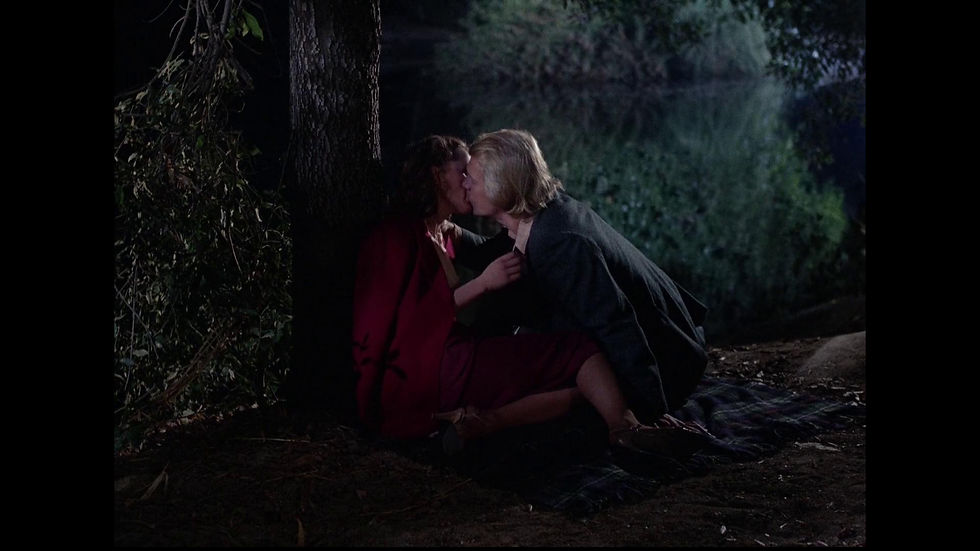
Arrow’s new UHD features new 4K restorations of the two-part miniseries (with individual episode credits, teaser, recap, and the originally censored, gorier antler death take), the full-length extended movie version, and the shortened international theatrical version. All cuts are presented in 2160p, the original television aspect ratio of 1.33:1, and with Dolby Vision/HDR10 enhancements. I can’t get screencaps from the UHD, so the images on this page are taken from the WB BD and only for editorial purposes.

These transfers are wonderfully naturalistic and brimming with texture, which is always a vital element of Tobe Hooper’s best movies. Details are tight without being oversharpened and the largely neutral, brown, green, and blue palette is consistent. Some of the brighter scenes, especially those shot outdoors in the elements, feature more grain discoloration and chunckier grit in general. This might actually be a post-production issue, because the same thing happens during optical zooms. The Dolby Vision upgrade helps delineate detail in darker shops without sacrificing the deep, dark black levels.
Audio
All three cuts of the series are presented in their original mono sound. The miniseries and full-length movie versions are presented in DTS-HD Master Audio and the shorter cut is presented in uncompressed LPCM. The tracks aren’t in the best condition, but most of the problems seem to be inherent in the material. Specifically, the dialogue is sometimes muffled in a way that makes me think the original sound editors dipped the sound floor too low in an attempt to cut background noise. This only affects a handful of occasions and dialogue is otherwise clean and understandable. Richard Kobritz’ beautiful score exhibits incredible warmth and breadth for a mono mix.

Extras
Disc 1 (4K UHD):
Miniseries part 1 (95:51)
Miniseries part 2 (96:01)
Extended movie version (183:25)
Commentary with Tobe Hooper (extended movie version) – Originally recorded in 2016, this director’s commentary is all about the brass tacks of the production, from Hooper’s hiring to locations, collaboration, paying homage to Hitchcock, adaptation, casting, and locations. Unsurprisingly, he doesn’t fill the entire three-plus hour runtime edge to edge with facts and figures, but he still does an admirable job.
Commentary with Bill Ackerman and Amanda Reyes (extended movie version) – Friend of the show and two-time co-host, Ackerman, and Reyes, author of the above-mentioned book Are You in the House Alone, combine efforts to explore the making of the film, King and Hooper’s wider careers and repeating themes, the careers of the cast & crew, various influences on the book and film, locations (I can’t believe I never recognized that the ‘Guatemalan church’ is San Xavier del Bac outside of Tucson!), the miniseries’ ratings and cultural impact, and other made-for-TV horror movies. They also dedicate the track to the late critic Lee Gambin, who was a mutual friend of theirs and who they assume would’ve done the track himself, were he still alive.
Alternate TV footage:
Commercial bumpers (0:16, HD)
Censored broadcast version of the antler kill (0:21, HD)
Original shooting script

Disc Two (4K UHD)
Theatrical version (110:11)
Commentary with Chris Alexander – In this second Arrow exclusive track, the former Fangoria Magazine editor, Rue Morgue Magazine columnist, and filmmaker discusses the differences between the miniseries and theatrical cuts, the work of the cast & crew, and television horror in general, and shares some personal anecdotes connected to Salem’s Lot.
King of the Vampires (21:09, HD) – Douglas Winter, the author of Stephen King: The Art of Darkness: The Life and Fiction of the Master of Macabre (Signet, 1986) looks back on his relationship with the author, King’s writing style and themes, ‘Salem’s Lot’s effect on King’s wider career, difficulty in adapting the novel, the TV film format, and his opinions on casting.
Second Coming (26:00, HD) – Critic and author of the novel Horrorstör (Quirk Books, 2014) Grady Hendrix chats about the genesis of King’s book and larger career, why ‘Salem’s Lot struck a nerve with readers, how classic literature and contemporary politics shaped the novel, and the semi-sequel short stories.
New England Nosferatu (13:08, HD) – Mick Garris, the director of several made-for-TV King adaptations, gives his two cents on the book, its storytelling innovations, and Hooper’s filmmaking skills.
Fear Lives Here (6:56) – A modern location tour with That Guy Dick Miller (2014) director Elijah Drenner.
We Can All Be Heroes (9:19, HD) – A general appreciation of the film from In Search of Darkness (2019) co-producer Heather Wixson.
A Gold Standard for Small Screen Screams (19:50, HD) – Joe Lipsett & Trace Thurman, the co-hosts of the Horror Queers podcast, close out the featurettes with another look at the film/miniseries’ difficult production, themes, the differences between Hooper’s adaptation and King’s novel, and queer text/subtext.
Theatrical cut trailer, A Return to Salem's Lot trailer, Salem’s Lot (2024) trailer
Image gallery
The images on this page are taken from the older WB Blu-ray – NOT the new 4K UHD – and sized for the page. Larger versions can be viewed by clicking the images. Note that there will be some JPG compression.
Comments