


Don’t Play with Fire (Encounters of the Dangerous Kind) Blu-ray Review


Cult Epics
Blu-ray Release: June 23, 2026
Video: 2.35:1/1080p/Color
Audio: Cantonese/English DTS-HD Master Audio 2.0 (international and Chinese cuts); English DTS-HD Master Audio 2.0 (export cut)
Subtitles: English SDH (international and Chinese cuts)
Run Time: 96:18 (international cut), 99:25 (Chinese cut), 89:51 (export cut)
Directors: Tsui Hark
After a fatal hit-and-run, three high school friends flee the crime scene. They are witnessed by Pearl, a sadistic young girl, who pursues the group and blackmails them into more crimes with increasingly disastrous consequences. (From Cult Epics’ official synopsis)

Arguably, the most important figure of the first Hong Kong New Wave (along with Ann Hui), Tsui Hark became best remembered for directing and producing lavish special effects fantasies, supernatural comedies, wuxia melodramas, and heroic bloodshed shoot ‘em ups that re-introduced Hong Kong filmmaking to Western audiences, eventually legitimizing the region’s box office viability alongside the likes of Jackie Chan, John Woo, Sammo Hung, and others.
Before all of that, though, Tsui was paying his dues on television and breaking into the mainstream with three transgressive, genre-skewing films – the giallo-like wuxia hybrid The Butterfly Murders (1979), the cannibal horror comedy We’re Going to Eat You (1980), and Don’t Play with Fire (1980), better-known internationally under the misleadingly Speilberg-esque title Dangerous Encounters of the First Kind. Don’t Play with Fire can’t really be defined in strict genre terms. It’s part dark (very, very dark) comedy, part political satire, part juvenile delinquent movie, part accidental espionage thriller, part straight drama, and part horror film. Notably missing from that concoction are romance, martial arts, and fantasy – all elements that came to define Tsui’s work as a filmmaker.

In not matching genre expectations, Don’t Play with Fire also doesn’t obfuscate its themes behind genre trappings and period storytelling. It is an angry film and a political one, and, while it’s not a literal translation of any specific historical events, its politics are rooted in real-life, as well as Tsui’s own experiences as a Vietnamese-born expatriate who was studying in America during college anti-war and civil rights protests. For Hongkongese audiences, he references the 1967 Hong Kong anti-government/anti-colonial riots with allusions to bombs placed by pro-CCP students. In later years, Tsui and other New Wave filmmakers tapped into the angst over the 1997 Hong Kong turnover from England to China, but that event wasn’t announced until 1984, leaving Don’t Play with Fire with a free-floating sense of political anxiety.
Don’t Play with Fire was deemed dangerously antisocial and was eventually outright banned by the HK Film Censorship Unit based on fears that teenagers would see the film and try to emulate the actions of the onscreen students, leading to a rush of copycat bombings. A recut, censored version was among a handful of movies that were retroactively re-rated as Category III (the HK equivalent to NC-17/X) when the Hong Kong motion picture rating system was established in 1988. The censors’ scissors and required reshoots leave the surviving versions of the film choppy and somewhat incoherent, but Tsui still makes his point clear. The original cut is considered lost.

While giving it the same restrictive rating as Untold Story (1993) and Dr. Lamb (1992) is somewhat ridiculous, Don’t Play with Fire is shockingly nihilistic, to the point that one wonders what audience Tsui was even making it for. The locations are dreary, filthy, and steeped in distressing poverty. The main characters are a uniquely unsympathetic batch of hapless losers, criminals, and sadists. Only Shaw Bros. veteran Lo Leih, playing the cop brother of Lin Chen-Chi’s psychopathic lead, manages to exude any sense of charisma, but that’s mostly because Lo Leih is incapable of being anything but a compelling screen persona.
The violence isn’t exactly wall-to-wall, but it is persistent. The film opens with an unseen Lin torturing mice and – heavy content warning – killing mice (the subsequent cat impalement seems to be a mix of a live cat, already dead cat, and fake dead cat). Animal intestines are splattered across a car’s hood, multiple characters are stabbed in the skull, throats are slashed with broken glass, bodies are run over repeatedly with cars, hands are severed, mouths are stitched shut, and the climax is a depressing bloodbath.
Bibliography:
Hong Kong New Wave (1978 - 2000) by Pak Tong Cheuk (Intellect Books, 2008)
Mondo Macabro: Weird and Wonderful Cinema Around the World by Pete Tombs (St. Martin's, 1997)

Video
Don’t Play with Fire never had a proper stateside release on home video. A French solo DVD was issued by HK Vidéo, but it didn't have English subtitles or an English dub track. Another French company, Spectrum, put out a Blu-ray in 2024 that included an English dub, but it was a limited edition and appears to be sold out. Cult Epics’ new Blu-ray features a 2K restoration of the uncut international cut (I assume the same as the one Spectrum used), presented in 1080p and its original 2.35:1 aspect ratio.
Don’t Play with Fire is a grim and gritty film, so don’t expect vibrant colors or wide dynamic ranges. That said, detail and texture, including grain, appear pretty accurate to my eyes, though perhaps a bit soft and noisy (there’s a bit of a mesh pattern in some shots that you can see in the final screencap on this page). The main issue is that cinematographer David Chung’s photography is quite dark and there isn’t much room for dynamic range adjustments. As a result, interiors and night shots have a fuzzy quality and some black levels have a gray-green quality. A few sequences also exhibit a bit of horizontal stretch and tilt, which is likely an artifact of the anamorphic lenses, not the result of mistreated masters. It’s all a bit rough, but preferable to the oversharpened, upscaled SD transfers of older HK BDs.
This collection also includes the so-called “banned” Chinese cut, which incorporates more footage of the youth fashioning bombs and being caught, rather than getting in trouble for a hit-and-run. This version is cobbled from a mix of HD footage and SD inserts from Tsui’s own tape. The further truncated English export version is presented entirely in SD.

Audio
The international cut is presented in its original mixed Cantonese & English language and uncompressed DTS-HD Master Audio 2.0 mono. As per usual, everything was shot without sound and dubbed in post, so the lip sync is usually off the mark. Dialogue and the largely incidental effects levels are even with only minor distortion at high volumes.
The score is a standout element, but probably not for the reasons you’d expect. All the music is credited to Siu-Lam Tang & Leun Yu, but a lot of it is stolen from other sources, including several cues from Goblin’s Dawn of the Dead and Jerry Goldsmith’s Star Trek the Motion Picture scores and various songs by the Alan Parsons Project and Jean-Michel Jarre. The music seems to have been sourced from subpar elements (possibly directly from VHS tapes and LPs?), giving it a tinny, stuttery quality.

Extras
Disc 1 (international cut)
Commentary with Frankie Balboa & Brandon Streussnig – Action cinema historian Balboa and Vulture/Paste/Fangoria writer Streussnig explore the state of Hong Kong at the end of the ‘70s, the New Wave, the world events the film was reacting to (and how they connect to the modern day), its themes, the difficult production, subsequent censorship, Tsui Hark’s wider career and development as a filmmaker, and the wider careers of the cast & crew.
2024 interview with Tsui Hark (26:03, HD) – The director discusses the true story that inspired the film, the political vibe around Hong Kong at the time, growing up in Vietnam, his other early work as director, the alternate Encounters of the Dangerous Kind title, casting, filming, locations, and his opinion of the film.
2024 interview with Paul Che (26:49, HD) – The actor talks about working his way up the filmmaking ladder, his character, his castmates, his understanding of the film’s politics while making it, working with Tsui, animal cruelty, and stunt mishaps.
2024 interview with Albert Au (44:46, HD) – The actor looks back on transitioning from singer to actor, being cast, working on his character and with his co-stars, the film’s politics, working with Tsui, the director’s international ambitions, locations, and gives his interpretation of the ambiguous ending.
2024 interview with Szeto Cheuk-hon (7:44, HD) – The co-writer chats about breaking into the industry, a first draft of the script being completed when he signed on, uncredited co-writers, and his contributions to the story.
2024 interview with O Sing Pui (23:10, HD) – The assistant director wraps up disc one with memories of meeting Tsui, his duties on the production, script changes made while filming, and the dead animals (he’s coy, but his answer makes me again assume that the cat scene was a live cat mixed with an already dead cat).
Theatrical trailer
Bonus trailer reel – School in the Crosshairs (Japanese: Nerawareta gakuen, 1981), The Island Closest to Heaven (Japanese: Tengoku ni ichiban chikai shima, 1984), His Motorbike, Her Island (Japanese: Kare no ôtobai, kanojo no shima, 1986), and The Girl Who Leapt Through Time (Japanese: Toki o Kakeru Shōjo, 1983).

Disc 2 (Chinese cuts)
English export version (89:51, SD)
Interview with Tsui Hark (11:43, SD) – A second archival interview with the director, who discusses the Hong Kong New Wave, being forced into reshoots, and trying to make sense of the multiple edits.
Interview with Lo Lieh (6:36, SD) – The actor briefly looks back on his early career and training.
Isolated score (33:28, audio only) – Hilariously, this includes all of the stolen tracks, not just original music (assuming there was any original music).
Theatrical trailer
Promotional gallery
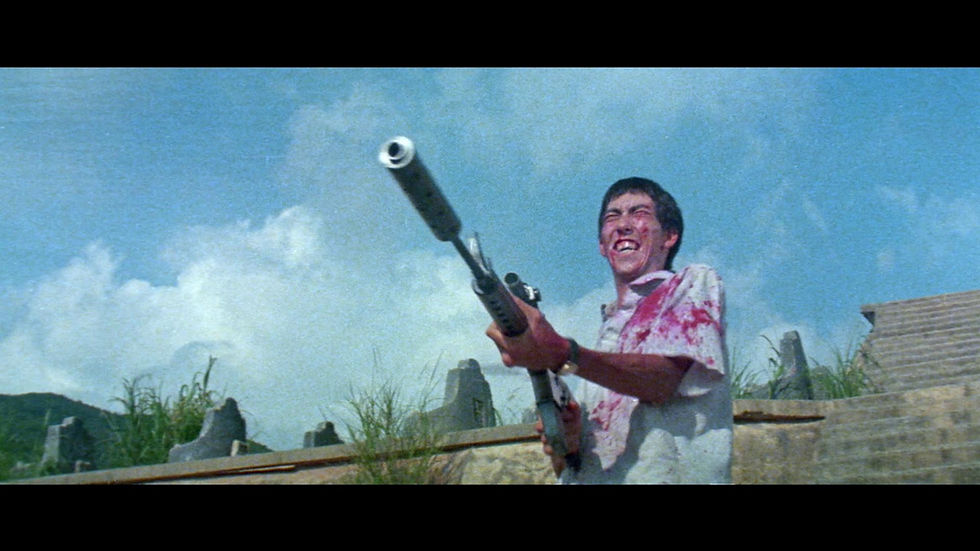
The images on this page are taken from the BD and sized for the page. Larger versions can be viewed by clicking the images. Note that there will be some JPG compression.
If you enjoy competitive games but don't want to learn a lot of controls, Agario is a very worthwhile option. The intuitive controls make it easy for beginners to get started quickly, while the splitting, dodging, and hunting mechanics provide enough depth for those who want to play for a long time.