


The Girl Who Leapt Through Time (1983)


Cult Epics
4K UHD Release: March 3, 2026
Video: 1.66:1/2160p (HDR10)/Color
Audio: Japanese DTS-HD Master Audio 5.1 and 2.0 stereo
Subtitles: English
Run Time: 104:06
Director: Nobuhiko Obayashi
After suffering a fainting spell in her school’s laboratory, 16-year-old Kazuko Yoshiyama (Tomoyo Harada) begins to experience a strange phenomenon throughout her daily life – temporal leaps backward and forward in time – disorienting her as she relives moments time and time again, as days past return to present. (From Cult Epics’ original synopsis)
Generally overlooked outside of his home country, Nobuhiko Obayashi was among the most unique and unpredictable Japanese filmmakers. Including experimental shorts, his work spanned 75 years from 1944 to 2019. Known for combining avant-garde and commercial sensibilities and best remembered stateside for House (1977) – an anarchic horror comedy co-written with his then-teenage daughter, Chigumi, that achieved retrospective cult status, thanks to a Criterion Blu-ray – Obayashi’s work is still mostly underseen in North America.

Cult Epics has recently endeavored to correct this obscurity with Blu-ray releases of Obayashi‘s School in the Crosshairs (Japanese: Nerawareta gakuen, 1981), The Island Closest to Heaven (Japanese: Tengoku ni ichiban chikai shima, 1984), His Motorbike, Her Island (Japanese: Kare no ôtobai, kanojo no shima, 1986), and the subject of this review, The Girl Who Leapt Through Time (Japanese: Toki o Kakeru Shōjo, 1983), which was one of a number of coming-of-age films the director made during the ‘80s.
The Girl Who Leapt Through Time is based on the 1967 novel of the same name by Yasutaka Tsutsui. It was the first feature adaptation of the book, which had already been made into a television series, Time Travel, in 1972 and its sequel, Zoku Time Traveler (also 1972). It was adapted to television again in 1985 as part of the series Getsuyō Drama Land, in 2002 as part of Morning Musume: Shinshun! Love Stories, and in 1994 and 2016 under the original title. There was also a 2017 stage version, another live-action movie directed by Haruki Kadokawa in 1997, another live-action movie by Masaaki Taniguchi in 2010, and, probably most famously outside of Japan, a 2006 semi-sequel animated feature by director Mamoru Hosoda.
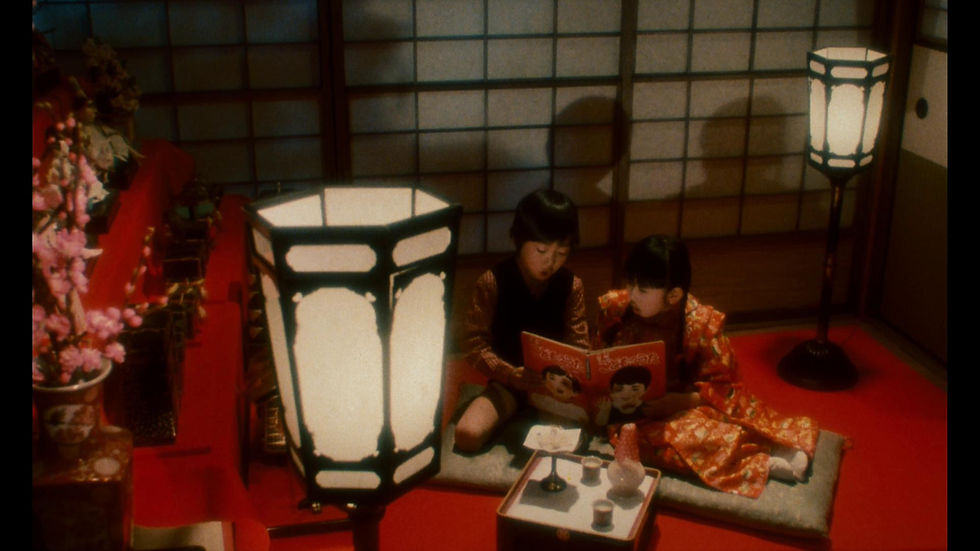
Tsutsui’s novel is structured around a time loop and, while not the first of its kind (time loop stories date back to at least the early 20th century), it was one of the first to garner popularity outside of niche pulp media. It was such a transformative hit that it in part inspired an entire ongoing subgenre of Japanese films, manga, visual novels, and anime. You could even trace Hiroshi Sakurazaka’s All You Need is Kill (2004), the basis for Doug Liman’s Edge of Tomorrow (2014), back to The Girl Who Leapt Through Time.
I suspect that Tsutsui’s story endures in part because he associates the time loop with the universal sense of nostalgia typically experienced on the cusp of adulthood. He also centers the gimmick on an intimate and relatable situation, rather than a world-shattering event. Harold Ramis’ Groundhog Day (1993) – the shorthand descriptor of the genre (as in: “Edge of Tomorrow is Groundhog Day with alien invaders”) does essentially the same thing, keeping the stakes low and focusing on the emotional development of a single character, in that case a gruff, jaded adult man, instead of a sweet adolescent girl. Recognizing the larger metatext of the similar fantasies, Obayashi makes several visual references to The Wizard of Oz.

The Girl Who Leapt Through Time is more conventional than House and School in the Crosshairs (to be clear: the only two films I’ve personally seen from the director), yet is still unmistakably a Nobuhiko Obayashi picture. Some aspects, like the introductory scene, where color is gradually introduced to gritty monochromatic footage, or collage-like special effects compositing, are pointedly Obayashi-esque, but the entire film has an almost intangible dreamlike quality that blends whimsy with aching melancholy, like an old Hollywood musical where the characters are all too introverted to break out into song.
Actress Tomoyo Harada was a Kadokawa pop idol and television star when she was cast as the title character and she continues acting and releasing studio albums to this day. She doesn’t do a lot of singing (outside of the closing theme and a few brief verses), but perfectly embodies the gentle, awkward charms of a shy teenager. Working with pop performers of all genders was actually one of Obayashi’s specialties during this era. Similar collaborations include Momoe Yamaguchi & Tomokazu Miura in Take Me Away (Japanese: Furimukeba ai, 1978), Hiroko Yakushimaru in School in the Crosshairs, and Harada again in Island Closest to Heaven.

Video
The Girl Who Leapt Through Time hit R3 DVD from IVL in Hong Kong and R2 DVD from Kadokawa in Japan. Then, it was part of a Spectrum Blu-ray double-feature and was included with the UK Blu-ray collection from Third Window, who also put it onto BD release last year. Cult Epics’ US debut UHD features a new 4K remaster that is reportedly different from Kadokawa’s own 2014 scan. I don’t have access to that transfer for comparison and the images on this page are taken from the included Blu-ray copy, which has more or less the same color timing as the 4K transfer.
The 2160p transfer is mostly framed at 1.66:1, though some scenes are pillar boxed at 1.37:1. Again, it’s a unique-looking film, so I can understand why previous remasters were reportedly controversial among fans. The stock is pretty grainy, but not excessively so and the grain texture remains consistent. Important textures are sharp without risking the softness of wide angle elements. There is an inherent artificiality to the film’s look, due to cinematographer Yoshitaka Sakamoto’s unique mix of naturalistic and stagey lighting. There are a lot of big shadows that could easily swallow up fine details and lighter shades. This is where the HDR pass makes a difference, boosting the deepest blacks without crushing out greys. I believe the sort of Technicolor homogenization of the colors – i.e. all of the skin tones and costumes are very nearly identical hues – is part of Sakamoto and Obayashi's design. Either way, color quality is vibrant and tidy.

Audio
The Girl Who Leapt Through Time is presented with 5.1 remix and original 2.0 stereo Japanese sound options, both in uncompressed DTS-HD Master Audio. The differences between the two tracks are pretty negligible with the 5.1 mix having minor LFE advantages, but not much else. For the most part, I stuck with the stereo mix. Some of the interior set dialogue can have a thin and condensed quality, likely due to the way it was originally recorded. The bigger issue throughout is that composer Masataka Matsutoya’s soft, ethereal music can be intrusive, overtaking dialogue and effects. Again, I assume this was intended and the music certainly sounds beautiful. Stereo effects are most utilized during the earthquake that coincides with the end stage of the time loop.
I’m not particularly good at reviewing subtitles, unless there’s something very clearly wrong, like a spelling error or I can tell that they’re actually dubtitles. I read that there was some controversy over subtitle errors on some of Cult Epics’ other Obayashi releases, so I did my best to be extra critical this time and I didn’t notice anything out of the ordinary. Please feel free to roast me in the comments if I’m wrong.

Extras
Disc 1 (4K UHD)
Commentary with Alex Pratt – The critic and researching grad student (who I believe has an extra on all of Cult Epics’ Obayashi releases) explores Obayashi’s career and style, the wider work of the cast & crew, technical aspects of the filming, the film’s themes, and the ins & outs of independent Japanese filmmaking during the era.
Theatrical trailer
Disc 2 (Blu-ray)
Commentary with Alex Pratt
A Movie: Obayashi's Cinematic Life (23:29, HD) – Critic Max Robinson offers a primer on the director’s life and career utilizing stills and clips from his films.
Now and Then, Here and There: Onomichi Pt. 2 (16:28, HD) – Pratt returns with a follow-up to a featurette found on Cult Epics’ His Motorbike, Her Island, to look at the town of Onomichi, where The Girl Who Leapt Through Time takes place, including a present day tour of the location.
A Conversation with Nobuhiko Obayashi (21:59, HD) – Footage from a 2015 Q&A with Obayashi conducted at Yale.
Archival interview with Nobuhiko Obayashi (24:26, SD) – The director discusses making The Girl Who Leapt Through Time, the cast, his “Onomochi Trilogy” (which includes I Are You, You Am Me [1982] and Lonely Heart [1985]), special effects, music, and differences between the film and book.
The Tomoyo Harada Story (10:33, SD) – An archival video featurette about the actress, including footage from a talent contest, recording sessions, and interview with Obayashi.
"Toki O Kakeru Shojo" music video (3:02, HD)
Obayashi trailer reel
The images on this page are taken from the included Blu-ray – NOT the new 4K UHD – and sized for the page. Larger versions can be viewed by clicking the images. Note that there will be some JPG compression.
While bouncing between film rabbit holes and sports content the other night, https://espn.pissedconsumer.com/review.html ended up being more useful than I expected because it gave me a clearer picture of how the platform feels in ordinary use. I tend to trust that kind of feedback more than a feature summary, especially when a service is something I might open regularly rather than once in a while. The first impression of a media platform rarely tells the full story. What matters is whether it still feels worth it after the novelty disappears.