


The Betrayal Blu-ray Review


Radiance Films
Blu-ray Release: September 16, 2025
Video: 2.35:1/1080p/Black & White
Audio: Japanese LPCM 2.0 Mono
Subtitles: English
Run Time: 86:43
Director: Tokuzô Tanaka
To protect his clan, an honourable samurai (Raizo Ichikawa) takes the blame for a murder committed by one of his fellows. He is promised a safe return after one year in exile, but this vow is broken and he becomes a fugitive chased by his own clansmen. (From Radiance’s official synopsis)
In the tradition of Kihachi Okamoto’s misanthropic classic Sword of Doom (Japanese: Dai-bosatsu tôge, 1966) and other downbeat samurai films, like Masaki Kobayashi’s Harakiri (aka: Seppuku, 1962) and Toshio Matsumoto’s Demons (Japanese: Shura, 1971), comes Tokuzô Tanaka’s The Betrayal (Japanese: Daisatsujin orochi, 1966) – a lesson in the delicacy of social standing, the futility of morality, and the foolishness of loyalty. From its melancholic beginnings, The Betrayal steadily descends into despair, tumbling from one worst case scenario into another, forcing an idealistic hero to become a vengeful ronin.
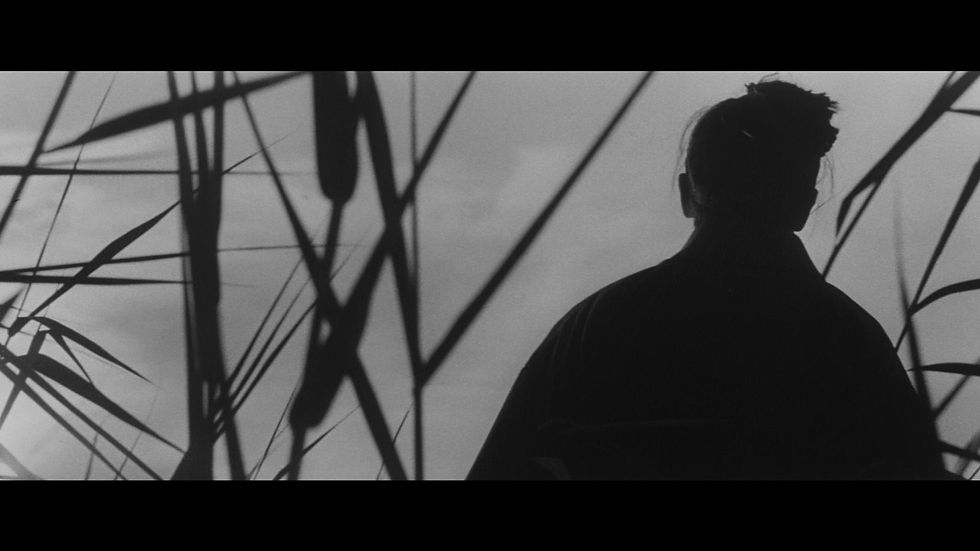
Ultimately – or thankfully, depending on one’s disposition – The Betrayal is too concerned with melodrama and romantic tragedy to hit the same nihilistic depths of Sword of Doom. Its main character, Takuma, portrayed by Shinobi and Sleepy Eyes superstar Raizo Ichikawa, is an inherently decent person incapable of wanton murder, no matter how far he falls into despair. The violence is also much less graphic than that of the aforementioned films, emphasizing emotional austerity over visceral shocks. That said, Tanaka was a proficient action director and the climactic battle is still spectacular, despite its relative lack of gore.
Tanaka trained under Akira Kurosawa and became one of Daiei Film’s stock filmmakers, contributing to several franchises, including the Sleepy Eyes of Death, Zatoichi, and Shinobi series. His non-franchise films, including The Betrayal and a collection of color fantasy/horror films (The Demon of Mount Oe [Japanese: Ōeyama Shuten Dōji, 1960], The Snow Woman [Japanese: Kaidan yukijorô, 1968], and The Haunted Castle [Japanese: Hiroku kaibyô-den, 1969]) offer a better indication of his abilities. I’m often impressed with his use of space – the emotional weight of empty space and, in contrast, the chaos of crowded action.

Video
I’m sure there were DVD releases of The Betrayal in Japan and possibly other Asian countries, but I can’t find any definitive evidence that the film was ever available on an English-friendly home video release before this new Blu-ray, simultaneously released in the US, UK, and Canada. As has been the case for most of Radiance’s Kadokawa Entertainment Blu-rays, the 1080p, 2.35:1, black & white transfer was supplied to them directly from the company. The Betrayal isn’t as starkly shot as the Shinobi films, leading to a lower contrast image and more subtle grey tones, but it does have a similarly raw and grainy appearance, which has been well-preserved without too much obvious DNR. Most of the texture-based shortcomings have more to do with the limitations of the material, which has a pulse-y quality. Otherwise, grain levels are consistent and details are only slightly diminished in the gloom of grit and diffusion.
Audio
The Betrayal is presented in its original Japanese mono in uncompressed LPCM 2.0. The sound quality is, again, typical of Radiance’s other ‘60s era Kadakawa releases. The tracks are consistent, dialogue is clean, and there’s little to no hiss or serious damage, but volume levels also top out into a crunch of minor distortion. The score is provided by Akira Ifukube, who mostly dabbles in desolate, melancholic soundscapes to match the visuals. Don’t expect rousing marches on par with the Godzilla theme from this film.

Extras
Select scene commentary with author/historian Tom Mes (41:23 in total):
The Samurai Film (15:54) – A general look at the stylistic development and evolution of samurai movies, the true history behind samurai stories, and differences between The Betrayal and other versions of the same story.
Japanese Film Studios (7:39) – A discussion of the studio system and how contracted actors fit into it.
Anatomy of a Samurai (14:25) – Another lesson in the history of Japanese cinema and differences between pre and post-war films
Grapes of Samurai Wrath (3:29) – Mes wraps things up with a quick look at the film’s climax.
The Path to Betrayal (9:42, HD ) – Critic and editor of Cinema: The Whole Story (Thames & Hudson, 2011) Philip Kemp compares The Betrayal to The Serpent (Japanese: Orochi), a 1925 silent version of the same story, including clips.
The Four Elements of Tokuzo Tanaka (9:24, HD) – Mes returns for an exploration of four key themes found within Tanaka’s work: mist, earth, fire, and time.


The images on this page are taken from the BD and sized for the page. Larger versions can be viewed by clicking the images. Note that there will be some JPG compression.
Comments