


Texas Chainsaw Massacre (2003) 4K UHD Review


Arrow Video
4K UHD Release: August 26, 2025
Video: 1.85:1/2160p (HDR10/Dolby Vision)/Color
Audio: English DTS-HD Master Audio 7.1, 5.1, and 2.0 stereo
Subtitles: English SDH
Run Time: 98:27
Director: Marcus Nispel
A group of carefree young adults' road trip through Texas is cut short when the panic-stricken hitchhiker they've picked up shoots herself in the back of their vehicle. Desperate to find help, our heroes are directed to the home of the local Sheriff, but little do they know they are stumbling into the lair of the Hewitts, the most violent family in all of Texas, including their chainsaw-wielding son. (From Arrow’s official synopsis)
What follows is a re-edited excerpt from a book I was once writing on American horror in the decade following the 9/11 attacks. I never finished, but I ended up with lots of material that has made it into retrospective reviews like this one.

Tobe Hooper’s original 1974 Texas Chain Saw Massacre was an unprecedented and unrepeatable motion picture experience that, nonetheless, led to countless imitations. Even Hooper himself struggled to recapture lightning in a bottle when he made The Texas Chainsaw Massacre Part 2 more than a decade later in 1986. The next two official franchise entries – Jeff Burr’s Leatherface: The Texas Chainsaw Massacre III (1990) and Kim Henkel’s Texas Chainsaw Massacre: The Next Generation (1994) – were remakes masquerading as sequels that barely garnered theatrical releases. The property remained dormant until the raw angst of the post-9/11 world finally spawned Marcus Nispel’s official reboot, also titled The Texas Chainsaw Massacre (with ‘chainsaw’ now a compound word), in 2003.
Beneath its nerve-shredding, genre re-defining imagery, Hooper’s Texas Chain Saw Massacre is a story of resentment in the American South. Certain regions were still nursing wounds inflicted during the Civil War when the area became an ideological battleground for the Civil Rights movement. The so-called Southern Way of Life was frequently challenged by progressive morals, often originating from the Northern states. In reaction, the Southern Rebel, once a hero of the matinee era, was cast as the villain in Hollywood movies and their B counterparts. Hooper’s film isn’t pro-secession, pro-slavery, or pro-Jim Crow, but it does understand and have a degree of sympathy for its monsters. As such, there are (at least) two ways to watch The Texas Chain Saw Massacre.

The first and most conventional reading is to see the story from the perspective of Sally Hardesty (Marilyn Burns), in which the cannibal family are portrayed as manic, predatory creatures. This is the framework that most of Texas Chain Saw Massacre’s imitators adopted. However, when watched from the perspective of the monsters, it becomes a reactionary tale, as indicated by larger cultural contexts and ancillary dialogue describing the recent hardships the cannibal family has endured. From their point-of-view, Sally and her friends are flaunting their comfortable lifestyles and loose morals (or progressive values, if you prefer). Furthermore, they are encroaching on private lands that they’ve been specifically told not to visit. Technically, they break the law when they enter the family’s home looking for help and Leatherface reacts as any good, undomesticated Texan would, by killing the trespassers.
Written by Scott Kosar and produced under blockbuster action director Michael Bay’s then-new Platinum Dunes banner, the 2003 Texas Chainsaw Massacre was a mannerly remake in that it was structurally devoted to the 1974 original. A few more characters were added to pad the body count and the exponentially larger budget allowed Nispel to broaden set-pieces, but the essential beats remained the same. The commitment extended to the early ‘70s setting, though it might as well have been taking place in 2002, given the comprehensively post-millennial cultural filters (lingo, fashion, on-the-nose needle drops, et cetera).

After establishing the supposed ‘true’ crimes that both versions of the film are based on (a fun marketing ploy), we are introduced to a new set of urban youths; this time complete Southland outsiders, rather than a new generation returning to once-familiar stomping grounds. All of their vices are magnified tenfold over the kids in Hooper’s version, as they dry-hump and curse their way across the countryside in possession of a piñata full of marajanna they intend to sell. These people are practically begging to be massacred via chainsaw.
The original film’s disturbed male hitchhiker is replaced by an incoherent young woman who mumbles something about her friends being dead as she shoots herself through the mouth, offering Nispel the opportunity to pull his camera through the hole in her head, out the rear window, and across the highway (possibly in reference to the ‘swing’ shot from the ‘74 film) in what may be the signature image of his entire career, one he sort of recreated it for his Friday the 13th remake (2009). The would-be drugrunners stew in the van with her rotting corpse and splattered brain matter until they finally find a gas station where they can contact the police. Unfortunately for them, the local sheriff is at the head of Rural Cabal (™) against the interlopers.

Unlike Hooper’s version, the remake’s rednecks are out-and-out villains who conspire to capture and murder any and all alien elements. Occasionally, Kosar’s script touches upon a reason for the villains to slaughter outsiders, such as the double amputee homeowner, who shouts “You can’t just go in my house!,” and the familial matriarch, who scolds a helpless Erin, shouting “I know your kind. Nothing but cruelty and ridicule for my boy!” But they are, for the most part, just inbred lunatics. It’s the systematic side of the killings, the macabre game the family is playing, that really changes Hooper’s otherwise sympathetic dynamic.
Positioning the main villain as a psychotic cop and caricature of authoritative rage is the key alteration to the original text. Sheriff Hoyt pretends not to believe that the hitchhiker’s death was a suicide and twists the story, so that he can frame the kids for murder, but, in reality, he’s really just role-playing as Bad Cop in the game. In fact, until he is emphatically aligned with the other villains at the start of the third act, Hoyt’s subplots are part of a completely different and much more interesting movie that is implicitly reacting to conservative America’s fear of modern terrorism.

The majority of Nispel’s energy is spent one-upping the original movie’s bombast. Leatherface’s limb-rending antics eventually become a numbing distraction from the evil sheriff’s exploits. In the most intense sequence (which has no real parallel in the 1974 movie), Hoyt berates the weak-willed Morgan (Jonathan Tucker) into pulling the trigger on an unloaded gun as a rationale to cart him back to the homestead for slaughter. From an allegorical standpoint, by forcing the passive youth to take up arms, Hoyt embodies the reactionary right’s frustration with pacifist Americans calling for restraint in Afghanistan and Iraq. The fact that Hoyt is played by real-life ex-Marine staff sergeant and star of Stanley Kubrick’s Full Metal Jacket (1987), R. Lee Ermey, draws blatant parallels to the Vietnam War angst hidden further beneath the subtext of Hopper’s film.
Elsewhere, instead of awkwardly patronizing the locals, like Hooper’s protagonists, the remake’s youths have zero patience for the rural residents and are outwardly rude to them. When threatened with real danger, most of Nispel’s protagonists are raring to ditch their friends, except for Erin (Jessica Biel), whose polite attitude, lack of premarital fornication (she actively wants to marry her boyfriend), and discomfort with the drug-trafficking scheme (which is initially kept secret from her) save her from a horrible fate. Erin’s counterpart in the original, Sally, was the prototypical Final Girl and it’s notable that Kosar was taking her back to those roots without irony, given the Scream era’s sarcastic opinion of slasher tropes.
Texas Chainsaw Massacre was by no means a revolutionary movie or even particularly good one, but it made quite a bit of money, so it became an aesthetic touchstone for post-9/11 horror, spawning a legion of hyper-contrasted, desaturated, and grainy studio releases. The abstract nightmarish qualities of Hooper’s human bone couches, caged chickens, and lampshade skins were replaced by the textures of dust-caked walls, rust-caked vehicles, and shit-caked toilets. Nispel’s use of gore wasn’t unique, but the remake’s popularity did open the door to grander acts of violence in mainstream pictures, leading directly to the buzzworthy and controversial rise of the so-called torture porn movement.
Video
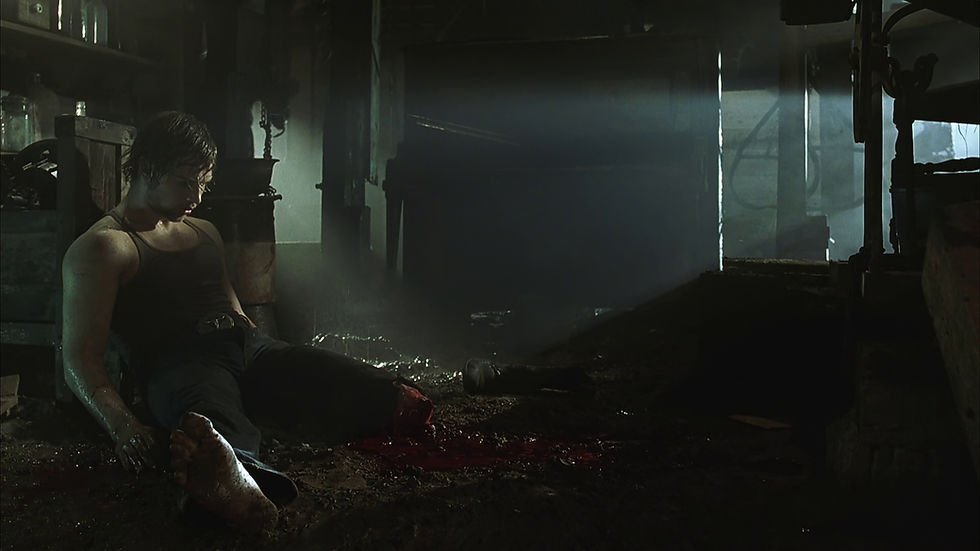
Texas Chainsaw Massacre was a hit in theaters and on home video during the early peak of the DVD era. It was released on DVD and Blu-ray across the world, including stacked special editions from New Line (it even made an appearance on UMD). This release represents its 4K UHD debut. Arrow’s 1.85:1, 2160p transfer is derived from Warner Bros.’ own 4K/16 bit scan of the original 35mm camera negative. As indicated in my review, this is a purposefully gritty and contrasty film and the 4K images follow suit (there was initially talk of shooting in 16mm). The extra resolution punches up the already aggressive textures and film grain, while also preventing clumping or obvious digital noise issues. For whatever reason, the original Blu-ray had some pretty heavy DNR, which this transfer corrects, along with the Blu-ray’s minor oversharpening problems. Cinematographer Daniel Pearl’s (the guy who shot Hooper’s original) gross, desaturated blueish/greenish/yellowish color-timing looks as nasty as ever and the Dolby Vision/HDR boost keeps those deep black levels bottomless without sacrificing any important detail. Note that the images on this page are from that Blu-ray, not the remastered edition.
Given how popular unrated cuts became as a home video marketing ploy during the 2000s, it’s surprising that Texas Chainsaw Massacre was never re-released without its R-rating and that includes this 4K disc. I suppose Texas Chainsaw Massacre was released just a little bit too early for the studio to have saved the few shots they trimmed to avoid an NC-17 (only a few were saved for the special features).

Audio
Texas Chainsaw Massacre is presented in uncompressed DTS-HD Master Audio with 7.1, 5.1, and 2.0 stereo options. The sound design is possibly the film’s greatest strength. Instead of trying to match the abstract nightmare atmosphere of the original film, Nispel went hyper-modern, utilizing every inch of the surround and stereo arena to keep the audience on edge. Composer Steve Jablonsky (who Michael Bay soon poached for his Transformers movies) provides a pretty standard issue symphonic horror movie score, at least in comparison to the melody-free 1974 version, but still makes room for some of the types of aural abstractions that make Hooper’s film so arresting.

Extras
Commentary with Steve ‘Uncle Creepy’ Barton and Chris MacGibbon – The Dread Central co-founder and Spooky Picture Show podcaster team up to explore the differences between Hooper and Nispel’s movies, the state of American horror in 2003, Texas Chainsaw Massacre’s legacy as a harbinger for the next decade of scary movies, the other films in the franchise, and the wider careers of the cast & crew.
Commentary with director Marcus Nispel, producer Michael Bay, executive producers Brad Fuller and Andrew Form, and New Line Cinema founder Robert Shaye – The first of three original 2004 DVD commentaries covers things from a production standpoint.
Commentary with Marcus Nispel, director of photography Daniel Pearl, production designer Greg Blair, art director Scott Gallagher, sound supervisor Trevor Jolly, and composer Steve Jablonsky – The second 2004 track takes a more technical approach.
Commentary with Marcus Nispel, Michael Bay, Brad Fuller, Andrew Form, writer Scott Kosar, and cast members Jessica Biel, Erica Leerhsen, Eric Balfour, Jonathan Tucker, Mike Vogel, and Andrew Bryniarski – The final 2004 commentary covers the story and characters.
Reimagining a Classic (16:25, HD) – Director Marcus Nispel looks back at his experience with/opinion of Hooper’s film, his music and advertising career, doing the film in part because he was friends with Daniel Pearl, the storywriting and production process, casting, and being pleasantly surprised by the public’s reaction.
Shadows of Yesteryear (16:54, HD) – Cinematographer Daniel Pearl talks about his relationship with Nispel, how his hiring helped turn the opinions of fans that didn’t like the idea of a remake, his music video career, shooting the film, and the then-new digital color timing technologies.
The Lost Leatherface (15:17, HD) – Actor Brett Wagner recalls playing Leatherface, meeting Gunnar Hanson (the original Leatherface), auditioning for the role, working with the cast and crew, and donning the costume.
Masks and Massacres (18:09, HD) – Makeup effects artist Scott Stoddard discusses his training and early career, collaborations with Michael Bay, designing a new Leatherface mask, and the technical aspects of the effects work.
Chainsaw Symphony (19:01, HD) – Composer Steve Jablonsky rounds out the new interviews chatting about his early career working in Hans Zimmer studio machine, opting to make a more traditional score, instead of trying to recreate the 1974 version’s weird soundscape, and his composing process.
Archival extras:
Chainsaw Redux: Making A Massacre (76:09, SD) – Director Jeffrey Schwarz’ 2004, feature-length behind-the-scenes documentary.
Ed Gein: The Ghoul of Plainfield (24:17, SD) – A 2004 featurette on serial killer Ed Gein, who inspired The Texas Chain Saw Massacre, Hitchcock’s Psycho (1960), Alan Ormsby & Jeff Gillen’s Deranged (1974), and Thomas Harris’ novel Silence of the Lambs (pub. 1981).
Severed Parts (16:42, SD) – A look at the deleted scenes with Nispel providing context via interstitial interviews (the scenes can be viewed without the interview clips as well).
Deleted scenes (SD):
Alternate asylum opening (1:26)
Alternate suicide (1:02)
Erin's news (1:17)
More Erin and Kemper (1:33)
Jedidiah's drawings (1:25)
Alternate Morgan death (0:32)
Alternate asylum ending (2:20)
Screen Tests (SD):
Jessica Biel (3:24)
Eric Balfour (3:06)
Erica Leerhsen (0:47)
Behind-the-scenes EPK footage (9:22, HD)
Cast & crew interviews (SD)
Jessica Biel (3:17)
Eric Balfour (2:02)
Jonathan Tucker (1:45)
Erica Leerhsen (1:28)
Mike Vogel (2:19)
R. Lee Ermey (2:06)
Marcus Nispel (2:45)
Brad Fuller & Andrew Form (2:11)
Teaser and theatrical trailer
8 TV spots
Concept art galleries
The images on this page are taken from the Warner Bros. Blu-ray – NOT Arrow’s new 4K UHD – and sized for the page. Larger versions can be viewed by clicking the images. Note that there will be some JPG compression.
I was going through some coding help threads and noticed how many people rely on different learning methods when dealing with Java problems. In the middle of one conversation, a java coursework help was mentioned as something people turn to when they get stuck with assignments or complex logic. It made me think about how programming is not just about knowing syntax but also about building problem-solving habits. I often find that I can read code and understand it, but writing it from scratch is a different challenge. Especially when working with arrays, conditions, and classes, small mistakes can completely change the output. Debugging also takes a lot of time, and sometimes the error messages are not very clear at…