


Shinobi: Volume 2 Blu-ray Review


Radiance Films
Blu-ray Release: August 19, 2025
Video: 2.35:1/1080p/Black & White
Audio: Japanese LPCM 2.0 Mono
Subtitles: English
Run Time: 87:19, 91:22, 88:59
Directors: Tokuzô Tanaka, Kazuo Ikehiro, Kazuo Mori
Note: The following introduction is re-edited from my review of the first three Shinobi series films.
If you grew up in America during the 1980s, you’d be forgiven for assuming that ninjas were an omnipresent piece of world pop culture. In truth, samurai fiction dominated what western audiences knew of Japanese culture for most of the decades leading up to an unprecedented media explosion that included the likes of American Ninja (1985), Ninja Gaiden video games, and the Teenage Mutant Ninja Turtles. While not the first Japanese film to center around a ninja protagonist by a long shot (you can trace that tradition back to the silent era), the popularity of Satsuo Yamamoto’s Band of Assassins (1962) and the subsequent films in the Shinobi no mono (sometimes Goemon) series certainly helped boost the ninja as an important pop culture figure in Japan, eventually spreading to outside recognition and cultural dominance in North America.

The Shinobi series consisted of eight official films and one attempted reboot, released between 1962 to 1970. The first three films were based on the exploits of historical figure Ishikawa Goemon, whose life, like that of many similar folk heroes, is largely lost to time, making it impossible to separate the fact from the legend. Over centuries of stories, kabuki performances, movies, and comics, Goemon has been a protagonist and villain, but the most enduring portrayal is that of a Robin Hood-like thief and man of the people (not to be confused with Nezumi Kozō, a different folk hero who stole from the rich and gave to the poor).
The next two films followed the similar adventures of Kirigakure ‘Mist’ Saizō – still portrayed by star Raizo Ichikawa – another folk hero with a vague historical basis. He was (alongside Sarutobi Sasuke) one of a group of rebel ninjas known as the Sanada Ten Braves or Ten Heroes of Sanada, whose adventures were first published as Sanada Sandaiki during the Edo era (1600-1868).

Shinobi No Mono: Siege (Japanese: Shinobi no mono: Kirigakure Saizō, 1964)
Legendary Iga ninja Mist Saizō (Raizo Ichikawa) is working in the service of warlord Yukimura Sanada (Tomisaburo Wakayama) and plotting the assassination of Shogun Ieyasu Tokugawa. (From Radiance’s official synopsis)
Assuming that its audience has already seen the other entries in the series and needs little introduction, Siege hits the ground sprinting. The latest conspiracy is explained, the new lead is introduced, and we are thrown into the end stages of an ongoing battle. From here, the story veers into familiar ‘outlaw on the run’ territory. Fortunately, the forward momentum rarely lets up and the creative ninja trappings keep the boiler plate story from growing stale (the central infiltration scene being a major highlight). Arguably, the first half moves too aggressively between set-pieces, making it easy to miss the plot points revealed in between. Thankfully, the frantic pacing comes to a deliberate halt when Saizō is captured, emphasizing his torment and leading us directly into the next chapter of the series.
Director Tokuzô Tanaka was one of Daiei Film’s stock filmmakers and contributed to several franchises and style movements, including the Sleepy Eyes of Death and Zatoichi franchises. Over his career, Tanaka excelled at disappearing into established franchise imagery; in this case, the stock Shinobi look as established by Satsuo Yamamoto. He still makes the film his own, though, with ethereal smoke effects and extra high contrast lighting schemes. His artistry was best utilized on a collection of color horror/fantasy films, including The Demon of Mount Oe (Japanese: Ōeyama Shuten Dōji, 1960), The Snow Woman (Japanese: Kaidan yukijorô, 1968), and The Haunted Castle (Japanese: Hiroku kaibyô-den, 1969). He brings a touch of his spooky skills to Siege for Gothic images of a crucified ninja and shots of Saizō rising from the grave after faking his death.
Note that Tomisaburo Wakayama does appear in Siege, but he is not playing the same guy he played in Band of Assassins and Vengeance.


Shinobi No Mono: The Return of Mist Saizō (Japanese: Shinobi no mono: Zoku Kirigakure Saizô, 1964)
Mist Saizō (Raizo Ichikawa) continues his mission to avenge his master, even after Ieyasu has abdicated from the throne. (From Radiance’s official synopsis)
While all of the films in the Shinobi series share a continuity, The Return of Mist Saizō (film five) is specifically designed to work as Siege Part II. It begins with a montage of the previous film’s major events so ragged and speedy that I don’t believe anyone who hadn’t seen Siege would have any idea what was going on. Following this and a breathless escape scene, The Return of Mist Saizō is more content to take its time than Siege, setting the stage and defining its character’s motivations a little more clearly. On the other hand, these scenes tend to highlight the fact that the Shinobi films are at their best when focusing on whatever character Raizo Ichikawa is playing and his place as a tool of vengeance within a broader historical relevance. To that notion, Saizō’s adventures in exile, where he experiences much of the political conspiracy from the outside looking in, and his increasingly gimmick-driven ninja antics are the moments where the film shines.
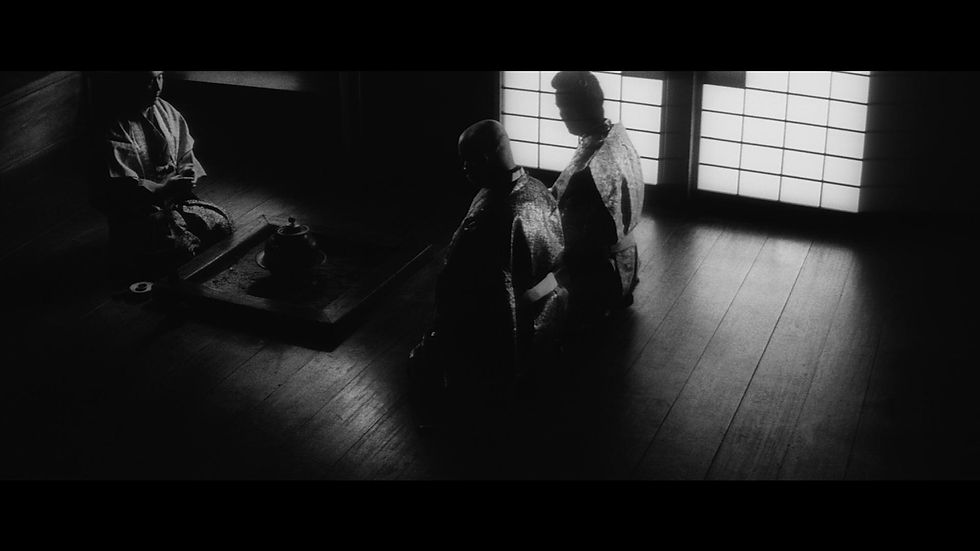
Kazuo Ikehiro was another Daiei stalwart who filled the director’s role on the Sleepy Eyes of Death and Zatoichi movies. The year after The Return of Mist Saizō, he directed Young Boss (Japanese: Waka oyabun, 1965), sparking a new franchise for the studio that ran for eight films, of which Ikehiro made four. Like Tanaka, he mostly disappears into the Shinobi house style, but adds some visual character when needed, especially the way he makes use of the scope aspect ratio, leaving large sections of the frame eerily empty to emphasize moments of emotional poignancy.



Shinobi no mono 6: The Last Iga Spy (Japanese: Shinobi no mono: Iga-yashiki, 1965)
Mist Saizō's son, Saisuke (Raizo Ichikawa), is recruited by a rebellious warlord to assist a plot to overthrow the government, but the Shogun hires a rival ninja clan to thwart the uprising. (From Radiance’s official synopsis)
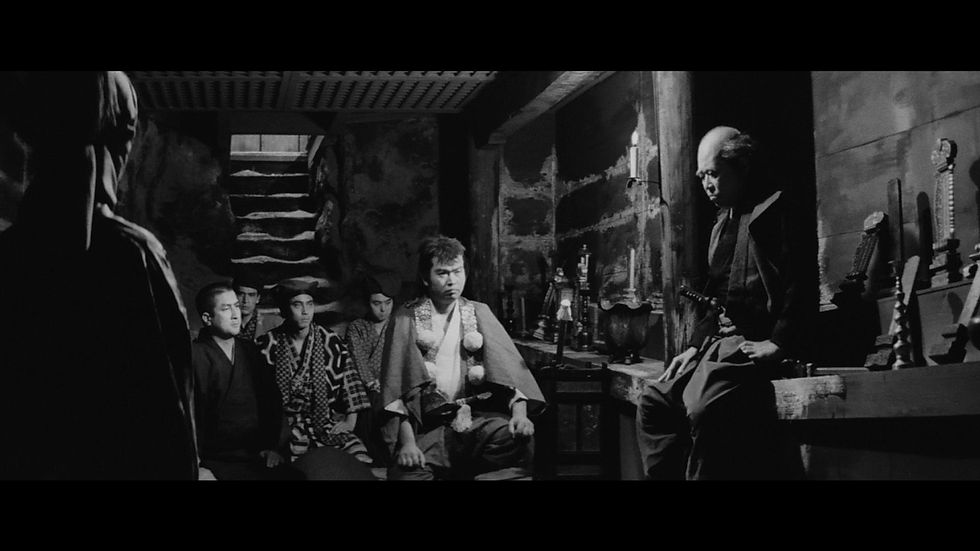
The Last Iga Spy begins with another prologue, where we witness Mist Saizō handing off the reigns of the franchise to his son, Saisuke, before committing ritual suicide, then features a second narrated prologue to sum up the last decade-plus of war. Kei Hattori and Kin'ya Naoi’s script is thoroughly tangled in historical political machinations, but veteran director Kazuo Mori is quite good at pacing the convoluted plot. To maintain momentum, he frames a lot of exposition and melodrama between sword-clanging set-pieces and does so more gracefully than Tanaka does with the similarly overcooked Siege. In terms of character development, Saisuke initially seems to be a roguish ronin/gunslinger type, but his personality and agenda quickly reset to match his predecessors, which is a minor disappointment.
Mori had already directed the third Shinobi film, Resurrection (1963), and would work on two more, Band of Assassins: New Saizo Kirigakure (Japanese: Shinobi no mono: Shin kirigakure Saizô, 1966) and Mission: Iron Castle (Japanese: Shinobi no shu, 1970), making him the series’ most prolific director. His other work included Vendetta of a Samurai (Japanese: Araki Mataemon: Kettô kagiya no tsuji, 1952), six Zatoichi movies, and the underrated third film in the Daimajin trilogy, Wrath of Daimajin (Japanese: Daimajin gyakushû, 1966). His imagery is slightly less poetic than Tanaka and Ikehiro, but his action direction is possibly the best the franchise has ever seen, at least up to this point (with the caveat that some of the set-pieces had already appeared in other films).
There are still three more Shinobi no mono films that Radiance hasn’t released (two more sequels and a pseudo reboot), so I assume a third set will be arriving sooner or later. As stated, Mori directed two and Ikehiro returned to direct Shinobi no mono 8: Three Enemies (Japanese: Shinsho Shinobi no Mono, 1966)



Bibliography:
Outlaw Masters of Japanese Cinema by Chris D. (including interview with Kazuo Ikehiro; I.B. Tauris, 2005)
Historical Dictionary of Japanese Cinema (Historical Dictionaries of Literature and the Arts) by Jasper Sharp (Scarecrow Press, 2011)
Excerpts from Yasumitsu Onishi’s MEI University lecture on Tomoyoshi Murayama
Video
The first four movies in the series, including Siege, were originally available on anamorphic North American DVD by AnimEigo and dubbed ‘volume 1,’ though it doesn’t appear that a second volume made it to print. The first HD home releases came from Kadokawa Entertainment in Japan and the included booklet verifies (once again) that Radiance used the exact same 1080p, 2.35:1, black & white transfers. These films were shot with harsh contrast, deep shadows, and overbaked whites. Daylight sequences are blown-out and especially grainy, while night shots and darkened interiors tend to exhibit more complex patterns and textures.
The black levels are rarely truly black, but one gets the feeling that Radiance/Kadokawa didn’t dare crank the darkness or contrast dials any further. The levels are already quite harsh as is. On occasion, I noticed shuddering effects during panning shots, but the most obvious artifacts are minor scratches and moldy blobs that last a frame or two, tops. All three films feature relatively intense anamorphic lens effects in the corners of the screen during panning shots. These are not mistakes, but an inherent part of the film’s visual design.

Audio
All three films are presented in their original Japanese mono in uncompressed DTS-HD Master Audio. Again, the sound design is about as stark as the visual design, leaving a lot of silent space. Mist Saizo Returns has a slightly more aggressive musical soundtrack and the presence of incidental effects vaguely increases during outdoor scenes to convey the environment (aside from Last Iga Spy’s very noisy, rainy rooftop fight), but the bulk of the sound is made up of crisp dialogue with a touch of hiss.
Extras
Disc 1
Select scene commentary with author/historian Tom Mes (48:57 in total):
In the Beginning (15:12) – Mes gives an introduction to the ninja tradition and mythology, the Shinobi series, and the franchise’s historical and literary bases.
The Legendary Samurai (8:23) – More on the historical siege of Osaka, the legacy of samurai Yukimura Sanda, and other films and literature on both subjects.
Raizo and Daiei (21:33) – Mes further explains actor Raizo Ichikawa’s collaborations with Daiei Film and the Cold War’s effect on Japanese cinema in this semi-follow-up to some of the first Shinobi collection’s extras.
Daiei Style (3:54) – A brief exploration of the visual characteristics of the studio’s house style.
Interview with Taichi Kasuga (24:10, HD) – The author and Japanese period film expert talks about Daiei’s tradition of historically-based films, the house style (like Mes, he remarks on the hard shadows and minimal lighting) and emphasis on technique, contract players, and the Shinobi series’ place in the pantheon.
The Faces of Raizo (4:21, HD) – Mes returns for a quick look at the many characters Ichikawa played during the ‘50s and ‘60s.

Disc 2
2025 interview with Mance Thompson (18:12, HD) – The ninja film and history scholar explores the Shinobi series, the larger histories and mythologies the films are based on, and (briefly) the preservation of silent era ninja films.
The Tragedy of Mist Saizō (11:34, HD) – Critic and translator Hayley Scanlon closes things out with another look at the wider plot and historical basis with emphasis on Saizō, the lead of the fourth and fifth movies.
The images on this page are taken from the BDs and sized for the page. Larger versions can be viewed by clicking the images. Note that there will be some JPG compression.
Comments