


Salon Kitty 50th Anniversary Blu-ray Review


Cult Films
Blu-ray Release: November 10, 2026
Video: 1.85:1/1080p/Color
Audio: English and Italian DTS-HD Master Audio 2.0 Mono
Subtitles: English, English SDH
Run Time: 133:09
Director: Tinto Brass
Note: Because there is so much overlap between all of the Italian Nazisploitation films, I’ve recycled a lot of my review of Cesare Canevari’s The Gestapo’s Last Orgy here.
Berlin, in the final years of the Third Reich. Salon Kitty is an elegant, high-class brothel where officers, diplomats and party officials come to unwind far from the pressures of the war. What none of them know is that the whole place has been quietly turned into a trap. Wallenberg (Helmut Berger), an ambitious and ruthless SS officer, has had hidden microphones installed in every room and has replaced Madame Kitty's (Ingrid Thulin) girls with party-loyalist women he personally selected and trained to seduce, listen, and report. His plan is coldly simple: gather every secret, every doubt, and every disloyal word spoken in those beds, then use that mountain of compromising material to blackmail his way to the very top, even above Hitler himself. (From Cult Films’ official synopsis)

Few things are as patently obscene as the Third Reich and the concentration camps that Hitler’s goons concocted in order to systematically murder millions of people. As such, it’s not surprising that there is a substantial exploitation subgenre devoted to these historical atrocities. Nazisploitation sprung from reputable movies, like Luchino Visconti’s The Damned (1969) and Liliana Cavani’s The Night Porter (1974), and less reputable S&M softcore and roughies, such as Joseph P. Mawra’s Olga 1964 trilogy – Olga’s Girls, White Slaves of Chinatown, and Olga’s House of Shame – as well as a growing contingent of WIP (women in prison) movies. North American filmmakers jumped onto the bandwagon early and stuck largely to the WIP formula, including Lee Frost’s Love Camp 7 (1969) and Don Edmonds’ Ilsa, She Wolf of the SS (1975).
As was often the case, the most distasteful and transgressive Nazisploitation movies were helmed by Italian filmmakers. The repulsive sadiconazista (a portmanteau that basically translates to ‘Nazi sadism’) cavalcade began with Luigi Batzella’s goofball gross-out SS Hell Camp (Italian: La bestia in calore, 1977) and continued with Pier Paolo Pasolini’s arthouse shocker Salò, or the 120 Days of Sodom (Italian: Salò o le 120 giornate di Sodom, 1970), Sergio Garrone’s SS Experiment Love Camp (Italian: Lager SSadis Kastrat Kommandantur, 1976), Mario Caiano’s Nazi Love Camp 27 (Italian: La svastica nel ventre, 1977), Cesare Canevari’s The Gestapo’s Last Orgy (Italian: L'ultima orgia del III Reich, 1977), and Tinto Brass’ Salon Kitty (1976).
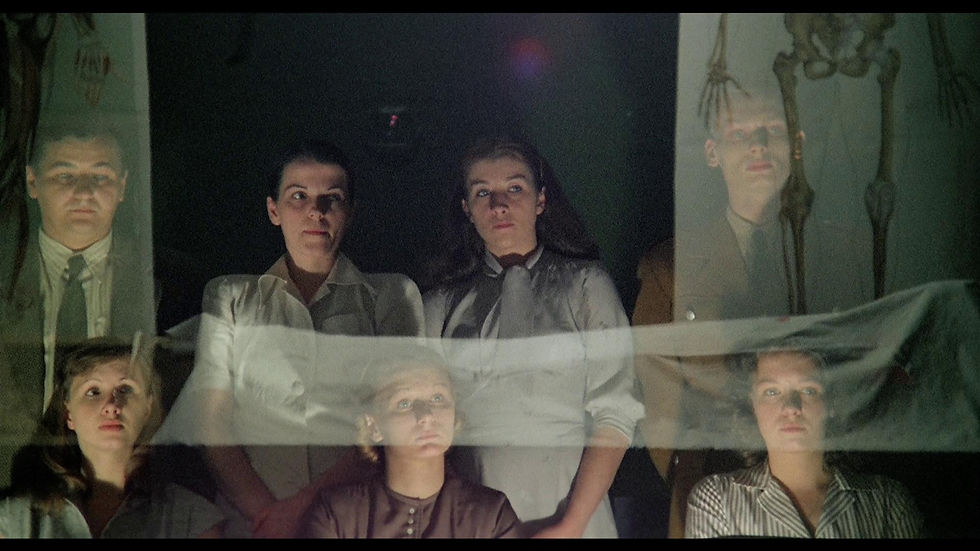
Salon Kitty occupies a strange space between ‘reputable’ Nazisploitation films, like The Damned (a film it very much resembles) and The Night Porter, and trashcan grindhouse fodder, like SS Hell Camp – a film better known by its alternate title, The Beast in Heat. Brass (who passed away at the age of 93 as I was writing this review) is better remembered these days for his patented softcore erotica, so it may come as a surprise – at least to those of us not familiar with his early, more avant-garde work or straight dramas – that Salon Kitty isn’t another romp. It has romp-like sequences and celebrates the female body in that trademark Tinto Brass fashion, but the transgressive fun and cheesecakery is repeatedly tempered with heavy melodrama and genuine shocks.
The tonal shifts work much better here than they do for Brass’ next film, Caligula (1979) – an infamously ill-fated attempt at combining the waning days of porno-chic with the death knell of the Hollywood costume epic. Where Caligula comes across as daft and crass, Salon Kitty is challenging and uniquely disturbing, utilizing Fellini-esque surrealism and Visconti-inspired musical sequences to portray the Nazi high command as a circus of bourgeois baffoonery. It doesn’t shirk the weight of the SS’ atrocities, it doesn’t hide behind the irony of bad taste, like the Ilsa movies, nor does it rub its audience’s noses in barbarism, like the significantly more mean-spirited Gestapo’s Last Orgy.

One way Salon Kitty does, unfortunately, resemble Caligula is in its bloated, episodic runtime, which stifles what little momentum and narrative structure the film has. There are at least six different cuts of Salon Kitty: the Italian theatrical cut is listed as 129 minutes, the US theatrical cut (via AIP) runs 110 minutes, US VHS versions from Media and Obsession Entertainment run 120 minutes (according to box art), UK and Japanese versions run about 112 minutes, the original German release was heavily cut to 106 minutes, and the fully uncut version runs 133 minutes.
Content warning: Obviously, an erotic drama about Nazis contains a lot of triggering imagery, but I wanted to specifically warn animal lovers that there is a brutal pig slaughtering sequence early in the film.

Video
The uncut version of Salon Kitty hit stateside DVD from Blue Underground in 2003. BU released the first Blu-ray edition in 2010, then reissued it in 2015. German/Austrian label Meteor Films released their BD in 2014 and, based on DVDBeaver’s review, it seems that both companies utilized the same HD transfer. Now, Cult Films (not to be confused with Cult Epics, the company that has been regularly putting out Tinto Brass titles on 4K UHD for years now), a company I believe is associated with Shameless Entertainment in the UK, has seemingly – to my eyes at least – recycled that same transfer yet again. That’s not necessarily a bad thing, because it’s a pretty good transfer, but Brass fans who might be hoping for a full 4K upgrade might be disappointed.
Grain is somewhat heavy, in part due to the use of diffusion and soft focus, and can become snowy/noisy during darker sequences. There’s a bit of frame wobble, too, but not an excess of print damage. The palette is muted, which I have to assume is intended, since this is the only version of the film I’ve seen. The exception is a handful of outdoor shots that fluctuate in tone and color, due to the age and condition of the original materials. Cinematographer Silvano Ippoliti, who was also behind the camera on Brass’ Deadly Sweet (Italian: Col cuore in gola, 1967) and Caligula, shoots everything in harsh light, creating deep, moody shadows and plush, billowing highlights. Again, I assume this was all by design and not a case of overzealous digital grading.

Audio
Salon Kitty is presented with English and Italian options, both in uncompressed DTS-HD Master Audio 2.0 mono sound. As would be the norm for Italian productions at the time, the film would’ve been shot largely without synced sound. The international cast was probably speaking multiple languages on set, though the leads are clearly performing in English and (I believe) mostly dubbing their own performances. There are some scenes with leads John Steiner and Helmut Berger that have such an accurate room tone that I wonder if Brass actually did record some onset audio. Either way, the English dub is preferred. Fiorenzo Carpi’s score and the litany of diegetic music sources are slightly condensed without any major distortion on either track.
Regardless of which language option you chose, because this extended cut was culled from multiple sources, some sequences (usually pornographic ones) briefly default to German, Italian, or Spanish with English subtitles.

Extras
Interview with Tinto Brass (23:48, SD) – In this 2011 interview, the director discusses the making of Salon Kitty, moral themes, the true history behind the plot, and working with his cast & crew.
International and US trailers
Miranda (1985) and The Night Porter trailers
The images on this page are taken from the Blu-ray and sized for the page. Larger versions can be viewed by clicking the images. Note that there will be some JPG compression.
Comments