


Red Sun 4K UHD Review
- Gabe Powers

- Jul 8
- 8 min read

Arrow Video
4K UHD Release: July 14, 2026
Video: 1.85:1/2160p (HDR10/Dolby Vision)/Color
Audio: English LPCM 1.0
Subtitles: English SDH
Run Time: 115:04
Directors: Terence Young
Note: This review recycles aspects of my review of Cauldron Films’ release of Shanghai Joe (1973).
A ceremonial samurai sword intended as a gift to the U.S. President from the Japanese ambassador is stolen by the devilish rogue, Gauche (Alain Delon). To restore their honor and return the sword to its rightful owner, disgraced samurai Kuroda Jubei (Toshiro Mifune), double-crossed bandit Link Stuart (Charles Bronson), and femme fatale Christina (Ursula Andress) must set aside their differences and hunt down the merciless Gauche across the beautiful vistas of the American west. (From Arrow’s official synopsis)
The so-called spaghetti westerns were a series of European films set largely in the American west, made mostly by Italians, shot in Spain, and often co-financed by West Germans. They were designed for multiregional release and utilized international casts to aid sales in other countries. These efforts ensured that the spaghettis were popular across Europe, North America, and Asia, especially in Japan, where the genre’s connections to samurai cinema weren’t forgotten, and in Hong Kong, where the style and mythical revisionism of the spaghettis inspired pioneering wuxia filmmakers.
Mutual admiration and the similar box office success of kung fu and samurai flicks eventually led to a collection of East meets West spaghettis, in which Japanese samurai and Chinese martial artists had adventures alongside cowboys in the American Southwest. Early examples were Enzo Peri’s Death Walks in Laredo (Italian: Tre pistole contro Cesare, 1968) and Don Taylor & Italo Zingarelli’s The 5-Man Army (Italian: Un esercito di 5 uomini, 1969), but 1973 was the year that the mini-genre broke out with Bruno Corbucci’s The Three Musketeers of the West (Italian: Tutti per uno... botte per tutti), Tonino Ricci’s Karate, Fists & Beans (Italian: Storia di karatè, pugni e fagioli), Alberto de Martino’s Here We Go Again, Eh Providence? (Italian: Ci risiamo, vero Provvidenza?), and Mario Caiano’s Shanghai Joe (Italian: Il mio nome è Shangai Joe)*.

There were higher-profile examples, too, like The Stranger and the Gunfighter (Italian: Là dove non batte il sole, 1974), which paired Lee Van Cleef and Lo Lieh, and Take a Hard Ride (1975), a spaghetti-blaxploitation vehicle that teamed-up Van Cleef with Jim Brown, Fred Williamson, and martial arts star Jim Kelly – both directed by Antonio Margheriti – but none had the budget or notoriety of Terence Young’s Red Sun (French: Soleil rouge; Italian: Sole rossois, 1971), which is to The Stranger and the Gunfighter, as Sergio Leone’s Once Upon a Time in the West (Italian: C'era una volta il West, 1968) is to Sergio Corbucci’s Django (1966) – a lavishly produced variation on a theme designed for blockbuster markets and critical praise. It’s not as good as Leone’s film, but it has the same spirit of scale and grandeur, and even shares a cast member in Charles Bronson.
Red Sun’s cultural melting pot is also bigger than its counterparts’. The cast is built around four leads, mirroring that of Once Upon a Time in the West (probably on purpose), right down to the three men to one woman ratio. Instead of blending Hollywood and Italian stars, Red Sun represents four distinct countries – America in Bronson (reportedly, Young wanted Clint Eastwood), Switzerland in Ursula Andress, France in Alain Delon, and Japan with Toshiro Mifune.

Young was a versatile filmmaker who shot thrillers, dramas, musicals, and comedies. He was particularly gifted at staging action, which made him a leading director of war films and scored him the job of bringing the James Bond novel series to the big screen. His greatest claims to fame are Dr. No (1962), From Russia with Love (1963), and Thunderball (1965) – the first, second, and fourth Bond films, respectively – making him one of the architects of post-war spy cinema. Extremely capable and extremely influential, especially in Italy, where his films spawned a series of 007 knock-offs, if any (currently working) English director could compete with Leone, it would be Terence Young.
Mifune is the centerpiece of the film’s meta-casting. Arguably the biggest jidaigeki star to have ever lived, his storied career included Akira Kurosawa’s Yojimbo (1961), the film Leone remade as Fistful of Dollars (Italian: Per un pugno di dollari, 1964), and Seven Samurai (1954), the film that John Sturges remade as Magnificent Seven (1960), co-starring Bronson. Red Sun was his only western, but not his first English language movie. Previously, he had a supporting part in John Frankenheimer’s Grand Prix (1966), alongside western legend James Garner, and John Boorman’s Hell in the Pacific (1968), alongside western legend Lee Marvin.

Andress and Young had worked together previously on Dr. No, a film that made them stars, but which also pigeonholed their wider careers as Bond Girl and Bond director. Andress had made one other western, Robert Aldrich’s comedy 4 for Texas (1963), which had Bronson in a supporting role. She was such a regular fixture in Italy throughout the ‘60s, ‘70s, and ‘80s that she might as well have been considered an Italian star at the time, instead of a Swiss one, for the sake of the box office.
Delon made his Hollywood debut in Ralph Nelson’s Once a Thief (1965), followed by his first western, Michael Gordon’s Texas Across the River (1966) with Andress’ 4 for Texas co-star Dean Martin. Like Andress, he was already very popular in Italy, having worked with Luchino Visconti and Michelangelo Antonioni. Around the same time as Red Sun, Delon was making crime movies with known spaghetti western hater Jean-Pierre Melville and transferred the cool persona he’d cultivated on Le Samouraï (1967), Le Cercle Rouge (1970), and Un Flic (1972) straight into his role as Red Sun’s main antagonist.

The film (not to be confused with Rudolf Thome’s Rote Sonne, also 1970) was co-financed by French, Italian, and Spanish producers and filmed in Almeria, Spain in locations and sets that are familiar to any spaghetti western fan – the opening train heist, for example, was shot in the same La Calahorra rock formation as the opening train heist from Damiano Damiani’s Bullet for the General (Italian: Quien Sabe?, 1966). The supporting cast includes familiar faces, too, including Luc Merenda, Guido Lollobrigida, Hungarian Barta Barri, Spaniard Ricardo Palacios, and Englishman Anthony Dawson (who also worked with Young on Dr. No and From Russia with Love).
Unlike Burt Kennedy’s Hannie Caulder (1971), which was also co-financed by Brits and shot around Almeria with a partially Spanish crew, Red Sun tries too hard to appeal to the broadest possible audience and finds itself lacking core themes and signature images. Making a spaghetti-baguette-paella-beans-on-toast western requires too many cooks in the kitchen, it seems. Still, Young was one of the greatest action directors of his generation and Red Sun is ultimately worth watching for its shoot outs and its novelty casting, especially during the scenes where Bronson, cast somewhat against type as the funny one, and Mifune play odd couple.

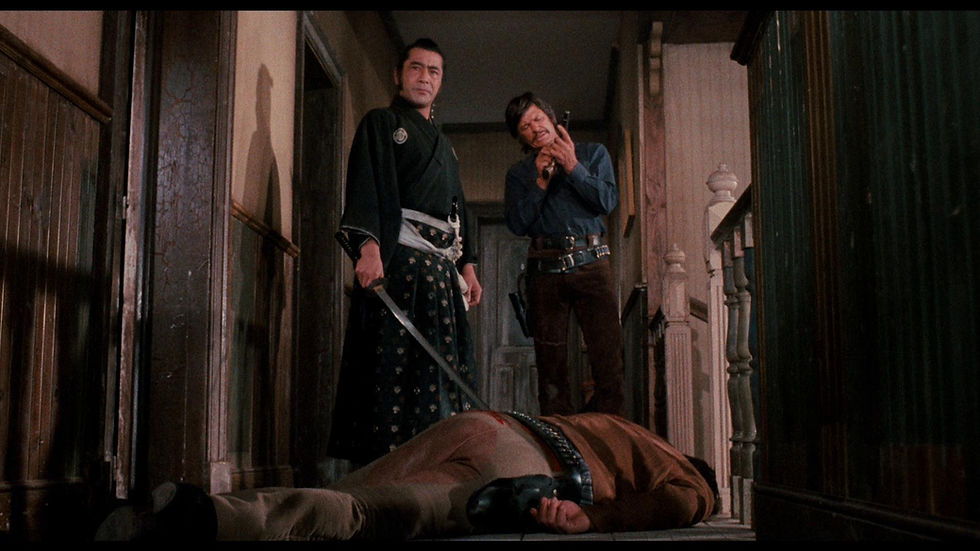
Just for fun, here’s a screencap from the beginning of the film. Note that the wanted poster beside Charles Bronson appears to have a picture of Tony Musante’s character, Paco, from Sergio Corbucci’s The Mercenary (Italian: Il Mercenario; aka: A Professional Gun, 1968) on it, albeit with a different name. I don’t believe that this is an intended easter egg, but the result of production designers reusing props.
* On the opposite end of the spectrum is Luigi Vanzi’s The Silent Stranger (Italian: Lo straniero di silenzio; aka: A Stranger in Japan, 1968), which flips the script, sending writer/star Tony Anthony’s titular bounty hunter to Edo Japan.
Bibliography:
East Meets West: Spaghetti Westerns and Martial Arts from The Spaghetti Western Database
10,000 Ways to Die: A Director's Take on the Spaghetti Western by Alex Cox (Kamera Books, 2009)
Video
Red Sun was borderline unwatchable on digital video in the US. There were two pan & scan DVDs from Fox Lorber and UAV, and it never had an official stateside Blu-ray release. Digital streaming or imports from Europe were the only available options. Studio Canal premiered the film on 4K UHD in the UK and France in 2024. At its base, Arrow’s US UHD/BD debut utilizes the Studio Canal’s 4K/HDR master; however, R3Store Studios and Arrow appear to have done their own grading pass, because the color timing is a bit different. The images on this page are taken from Arrow’s Blu-ray edition and I’ve also included some sliders featuring the UK Blu-ray release.
Neither 1080p transfer demonstrates the difference that the 4K resolution and Dolby Vision upgrades give both 2160p UHD transfers, but they do illustrate the subtle color differences. For example, the Arrow transfer corrects Studio Canal’s slightly greenish skies, but also pumps up the redness of the skin tones. What I can’t show you here is that the Arrow disc’s Dolby Vision pass is a bit more impressive than SC’s, but not really enough to garner re-buying the set if you already own the UK or French one. Outside of these very minor differences, both releases look great. I noticed some slightly mushy wide-angle details, but textures are consistent, grain is fine and natural, and there aren’t any major print damage artifacts.
Audio
Red Sun comes fitted with an uncompressed LPCM soundtrack in its original mono sound. Unlike most of the movies that fall under the Eurowestern heading, a lot of scenes appear to have been shot using sync’d sound, which is better for the performance quality, but does lead to issues of volume and clarity inconsistency. The track has a bit more depth than expected and exhibits only minor distortion at high volume. The final ingredient in this Hollywood-tier production crew is legendary composer Maurice Jarre, known best for collaborating with David Lean on Doctor Zhivago (1965) and Lawrence of Arabia (1962). Jarre doesn’t go full Lean, nor does he mimic Ennio Morricone, which would’ve still been in vogue.
Extras
Commentary by critics C. Courtney Joyner and Henry Parke – Joyner, the author of The Westerners: Interviews with Actors, Directors, Writers (McFarland, 2009) and director of Trancers III (1992), and Parke, author of The Greatest Westerns Ever Made and the People Who Made Them (TwoDot, 2024), explore the making of Red Sun, the ins & outs of international financing, connections to other European and American westerns, and the wider careers of the cast & crew.
A Global Western (31:54, HD) – Action/Spectacle: A Sight and Sound Reader (BFI, 2000) author Jose Arroyo discusses the film’s production, its mash-up quality, its structure, its release and eventual cult following, and the circular influence shared by European and Hollywood movies.
The Ghosts of the Samurai (31:12, HD) – Professor of Japanese Films at the University of California San Diego Daisuke Miyao focuses mostly on Mifune, the real history behind the film, the history of samurai fiction, western film influences in Japan, and connections between Mifune and Delon via Melville’s Le Samouraï.
The Man with the Gold Tooth (14:56, HD) – Action Figures: Men, Action Films, and Contemporary Adventure Narratives (Palgrave Macmillan, 2006) author Mark Gallagher wraps things up with a retrospective look at the career of Alain Delon.
Archival French TV promos:
Pour le cinéma (3:27, SD) – Behind-the-scenes featurette and Terence Young interview.
Un journal du cinéma (2:03, SD) – Press tour interviews with Terence Young and Toshiro Mifune.
Theatrical trailer
Image gallery

The images on this page are taken from Arrow and Studio Canal’s Blu-rays – NOT Arrow’s 4K UHD – and sized for the page. Larger versions can be viewed by clicking the images. Note that there will be some JPG compression.
One practical lesson from That's Not My Neighbor is that checking details in a fixed order is often more reliable than trusting intuition, especially when the game begins presenting less obvious discrepancies.