


Knock Off 4K UHD Review

Updated: Feb 19
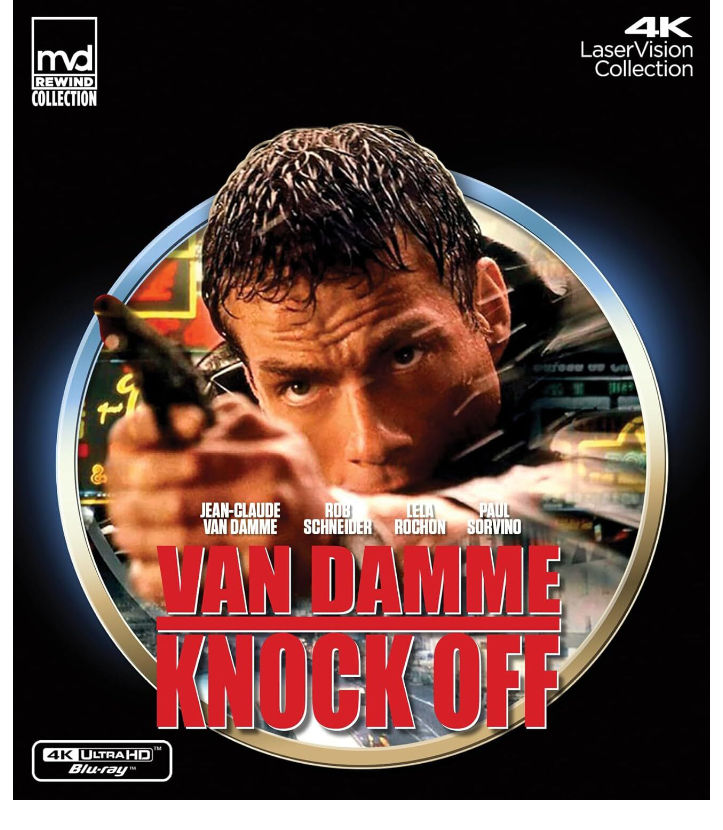
MVD Rewind
4K UHD Release: February 17, 2026
Video: 2.35:1/2160p (HDR)/Color
Audio: English DTS 5.1 Surround and LPCM 2.0 Stereo
Subtitles: English SDH
Run Time: 90:59
Director: Tsui Hark
Marcus Ray (Jean-Claude Van Damme) is a Hong Kong fashion designer who uncovers a deadly conspiracy involving explosive micro-bombs hidden in counterfeit products. Teaming up with a covert agent (Rob Schneider), Marcus must navigate the dangerous world of counterfeit fashion to stop the imminent threat and save lives. (From MVD’s official synopsis)

During the 1990s, a string of international hits brought the Hong Kong New Wave to the attention of Hollywood and several top tier filmmakers, including Jackie Chan, John Woo, Yuen Woo-ping, Ronny Yu, Ringo Lam, and Tsui Hark, were given deals making English-language films. Like previous attempts to import Hong Kong style action to America, most of these films – especially the ones not involving Chan, Woo, or Yuen – were modestly budgeted and either went straight-to-video or saw only limited stateside theatrical runs, leading the entire era to be dismissed by critics and largely overlooked by all but the most rabid martial arts and B-action fans.
This era coincided with the meteoric rise of Belgian martial artist and actor Jean-Claude Van Damme. Van Damme’s career peaked between 1992’s Universal Soldier (directed by German filmmaker Roland Emmerich) and 1993’s Hard Target, which marked his first collaboration with one of the Hong Kong New Wave imports – John Woo. Following the critical and box office disappointments (disappointments, not flops, for the record) of Steven E. de Souza’s Street Fighter (1994), Peter Hyams’ Sudden Death (1995), and the actor’s own directorial debut, The Quest (1996), Van Damme’s stock began to dip. Still, he continued making multiple films per year, which put him in contact with other HK transplants.

First up was Ringo Lam’s Maximum Risk (1996), co-starring Natasha Henstridge, which I believe is Lam’s only film to get a major release in US theaters. Lam and Van Damme then collaborated on Replicant (2001), In Hell (2003), and Wake of Death (2004), though Lam was replaced by Philippe Martínez. Directly after Maximum Risk, he made two films with Tsui Hark: Double Team (1997) and Knock Off (1998).
Born in Saigon and educated in the United States, Tsui Hark began working in the Hong Kong film industry during the late ‘70s. While he hadn’t been paying his dues as long as Woo, Chan, or Sammo Hung, Tsui’s genre mash-up sensibilities and Hollywood-type aspirations made him a cornerstone of the New Wave movement. His eclectic output ranged from dark thriller Dangerous Encounters of the First Kind (1980), fantasy special effects extravaganza Zu Warriors from the Magic Mountain (1981), and the Once Upon a Time in China series, to production duties on John Woo’s groundbreaking gangster shoot-em-up A Better Tomorrow (1996) and Yuen Woo-ping’s wuxia classic Iron Monkey (1992).

Given this almost unprecedented string of hits, Tsui’s Hollywood career seems particularly short-lived and disappointing, consisting only of his two Van Damme vehicles. Double Team was the higher profile of the two, garnering a major theatrical release, but his efforts were completely overshadowed by the bad press NBA player Dennis Rodman garnered in his feature debut*. Tsui’s direction was also lackluster, at times almost incoherent. It’s a bad movie that only endures because of Rodman’s laughable performance.
Knock Off shares some of its predecessor’s problems, mainly the nonsensical plotting and janky pre-millennial editing tricks, and ugly frame-rate ramping (we won’t hold the terrible CG effects against it), but leans into its ridiculousness, setting the stage early on with an infectiously quirky rickshaw race. Tsui’s sweeping camera work and dynamic close-up angles are somewhat muddled by the aforementioned editing techniques (some of which are so frenetic that they make the plot nearly incomprehensible), but there’s still a good sense of energy and momentum that exemplifies the HK New Wave ethos. Also in the Hong Kong tradition, the largest stunts are wildly irresponsible.

It’s a low bar, but Knock Off might be Saturday Night Live alumni Rob Schneider’s best movie role. Obnoxious solo comedies and pathetic personal politics aside, Schneider was a surprisingly reliable action movie sidekick between this and Judge Dredd (1995). Here, he’s able to play foil to Van Damme and have an enjoyable (albeit unbelievable) little pseudo-romance with Lela Rochon, who is, herself, pretty good, despite being miscast. Paul Sorvino, on the other hand, is perfectly cast as, well, Paul Sorvino.
The script was written by Steven E. de Souza, a Hollywood veteran known for 48 Hrs. (1982), Die Hard (1988), and Judge Dredd (strange that he wrote both of Schneider’s action sidekick movies), and for directing Van Damme’s failed Street Fighter movie. Knock Off fits de Souza’s pattern of writing unlikely heroes, though it’s hard to compare Van Damme’s hyper-capable fashion designer to the likes of the believable underdogs played by Eddie Murphy and Bruce Willis. I can imagine a more down-to-earth, maybe even ‘better’ version of this screenplay (setting the story against the 1997 UK to China handover hints at grander ambitions), but the haphazard combination of de Souza, Van Damme, and Tsui’s aesthetics ensures Knock Off’s cult appeal. A more cohesive film would simply be forgotten.
* Rodman followed up Double Team with a solo outing (and massive flop) called Simon Sez in 1999. American Kevin Alyn Elders was credited as director, but it was set to be co-directed by Elders and Ringo Lam, who still has a production credit.

Video
Knock Off made its US DVD debut from Tristar and was later included in a Mill Creek collection entitled Jean-Claude Van Damme Hollywood Hits. Fans with region-free players could import Blu-rays from the UK and Germany, but the film was not available on local Blu-ray or 4K until now. MVD’s newly restored transfer – made by scanning the original camera negative in 4K/16-bit – is being included with both a single disc BD and a two-disc 4K/BD pack. The images on this page are taken from the BD, but I’m mostly reviewing the UHD transfer.
The negative is in rougher shape than I expected, leading to some uneven grain, small blotches, and white flecks. Fortunately, MVD didn’t try to fix the issue with DNR and doesn’t oversharpen details to compensate. It’s a little messy, but it’s authentic. The flashy color palette is bright and vivid, assisted by the HDR upgrade, and black levels are tidy. The authentically HK New Wave-friendly smoky interiors and hazy street scenes don’t suffer from the snowy noise often seen from lesser HK Blu-ray transfers.

Audio
Knock Off is presented with 5.1 DTS-HD Master Audio and 2.0 LPCM audio options. It was made in the digital sound era and intended for a theatrical release, so I stuck with the 5.1 mix for this review. The first thing I noticed was how hearty the bass is. Every gunshot, punch, and explosion causes the LFE to rumble comically in reaction. In comparison, directional effects are minimal. The centered dialogue levels are a bit inconsistent, often due to a mix of set recorded sound and obvious ADR. Ron & Russell Mael (the Sparks guys), are credited with the thin faux-symphonic soundtrack, but most of their tracks were reportedly replaced by an uncredited Varouje Hagopian.
Edit: I neglected to check the subtitles on this title, since the film is in English, but have since learned that they are likely AI processed and full of errors.

Extras
Disc 1 (4K UHD)
Commentary with Mike Leeder and Arne Venema – This track featuring the oft-paired Hong Kong cinema experts has been borrowed from the 2020 88 Films Blu-ray. It is a typically lively, jovial, and fact-filled discussion that covers the production, the political context of the Hong Kong handover, the locations, and the careers of the cast & crew. They also include loads of personal anecdotes about their own experiences with Hong Kong knockoff culture.
Disc 2 (Blu-ray)
Commentary with Mike Leeder and Arne Venema
Interview with Steven E. de Souza (40:51, HD) – In this new interview, screenwriter de Souza talks about his entire career, from childhood home movies through early writing gigs and Hollywood stardome. It includes news clippings, tv/film clips, archival pictures, and some brief, hideous generative AI animation that I sincerely hope doesn’t become a normal thing from MVD.
Interview with Moshe Diamant (18;24, HD) – This second exclusive Zoom interview with the (uncredited) producer sticks mostly to the making of Knock Off and other collaborations with Van Damme and Tsui. No gen AI animation here.
Archival 2020 interview with Steven E. de Souza (HD, 9:49) – This is another holdover from the 88 Films BD.
Archival making-of EPK (23.15, SD)
Theatrical trailer
The images on this page are taken from MVD’s 4K remastered BD – NOT the 4K UHD – and sized for the page. Note that there will be some JPG compression.
Tsui’s Hollywood work lacked the impact of his earlier Hong Kong films but still showed his creativity, visual ambition, Geoguesser and unique action style.