


Drunken Master II 4K UHD Review

Updated: Jun 23

Arrow Video
4K UHD Release: June 30, 2026
Video: 2.35:1/2160p (HDR10/Dolby Vision)/Color (both cuts)
Audio: Cantonese, Mandarin, and English LPCM 1.0 mono (Hong Kong cut); English LPCM 1.0 Mono (international cut); English DTS-HD Master Audio 5.1 (US cut)
Subtitles: English, English SDH
Run Time: 102:07 (Hong Kong cut), 101:03 (international cut), 102:33 (US cut)
Directors: Lau Kar-leung, Jackie Chan (uncredited)
Note: Arrow is currently only offering Drunken Master II (1994), Rumble in the Bronx (1995), Thunderbolt (1995), Police Story 4: First Strike (1996), Mr. Nice Guy (1997), and Who Am I? (1998) as part of a 10-disc 4K UHD boxset they’re calling Jackie Chan's Breakout Hits.

Young Wong Fei-hung (Jackie Chan) is travelling home when he accidentally takes home an Imperial Seal at the center of a conflict between British colonizers and local rebels. Against his strict father’s (Ti Lung) wishes, Wong must use his martial arts abilities to defend himself, his family, and local steel workers.
Long before he had his Hollywood breakthrough with Rush Hour (1998) or his international breakthrough with Rumble in the Bronx (1995), Jackie Chan had his Hong Kong breakthrough with a pair of kung fu comedies in 1978 – Snake in the Eagle’s Shadow and Drunken Master – both made under choreographer-turned-director Yuen Woo-ping. Chan had been groomed as a possible replacement for the late Bruce Lee at Golden Harvest as early as 1976, when he starred in Lo Wei’s New Fist of Fury, but he really ‘arrived’ Yuen Woo-ping.

In Drunken Master, Chan played a younger version of Wong Fei-hung (or Fei-hong), a real-world folk hero that has been the subject of hundreds of films and TV shows since 1949. Author/critic Yu Mo-wan divides these films/shows into three categories: the Golden Era of the 1950s, a short revival during the ‘60s, and a bigger revival that began in the mid-’70s with Jeong Chang-hwa’s The Skyhawk (1974) and including Yuen’s film. Given that Yu delineated these categories in 1980, he didn’t account for a third revival that was kicked off in 1991 with Tsui Hark’s Once Upon a Time in China (1991), its six sequels, Yuen’s Iron Monkey (1993), and Chan’s Drunken Master II (1994), a mostly in-name-only sequel directed by Lau Kar-leung.
By the ‘90s, Chan had already worked with the best of the best choreographers and directors that Hong Kong had to offer, including the aforementioned Yuen Woo-ping and Peking opera schoolmates Sammo Hung and Corey Yuen – all artists who were all sniped by Hollywood studios when HK style action grew fashionable (mostly during the late ‘90s and early ‘00s). But Lau represented an earlier generation of choreographers, whose innovative work almost everyone else built upon. Previously, he’d worked as choreographer for Shaw Bros.’ most prolific filmmaker, Chang Cheh, and, when the two had a falling-out, Lau began directing his own films.

He never surpassed Chang in terms of sheer output, but Lau’s films were a consistent revenue stream for Shaw during its steady downturn and eventual fall to rival Golden Harvest (where Chan and Hung were working). Though best remembered in the present day for the supremely influential The 36th Chamber of Shaolin (1978), his string of hits included a series of martial arts comedies that evolved alongside and likely informed Yuen, Hung, and Chan’s next generation kung fu slapstick, including The Spiritual Boxer (1975), Dirty Ho (1979), and My Young Auntie (aka: Fangs of The Tigress, 1981).
Accounts claim that the director and star clashed frequently on set, leading Lau to leave the project and Chan to direct the climax himself. You can actually track the difference in each filmmaker’s style and ideology by contrasting the first fight – a weapons-based wuxia throwback between Chan and Lau that evolves into a friendly kung fu match – and the climatic, fist-to-foot battle between Chan and Ken Lo, which, despite utilizing some of the wirework Chan originally opposed, encapsulates the type of manic acrobatics and self-sacrificing stunt work he made his name on.

Remarkably, the on-set friction may have contributed to Drunken Master II’s fantastic quality in the end, as the final film represents the best that both filmmakers had to offer. It fits Lau’s ethos in that it depicts a diversity of martial arts styles as authentically as possible and is also a defining showcase of Chan’s hand-to-hand abilities at a time when his outrageous action stunts were becoming the centerpiece of his career. Combine that with each filmmaker’s impeccable sense of comedic timing and you’re left with the best film that Jackie Chan or Lau Kar-leung ever made. No small feat from the men that brought you absolute classics, like Project A (1983) and Eight Diagram Pole Fighter (1984).
After Rumble in the Bronx was a surprise hit for New Line, the loathsome Weinstein Bros. realized they had access to a number of Chan’s Hong Kong hits, including Armour of God II: Operation Condor (1991), Stanley Tong’s Police Story 3: Supercop (1992), Police Story 4: First Strike (1996), and Drunken Master II. Via Dimension Films, they re-edited, re-dubbed, and re-released these films, which were all well-received by American audiences. Fortunately, Drunken Master II, retitled Legend of the Drunken Master (to avoid confusion), suffered only minor cuts and musical changes (more on that below).

When Shaw collapsed in the ‘80s, Lau was set adrift, but still stayed relevant with the sensational shoot ‘em up, Tiger on the Beat (1988) and an Aces Go Places sequel (Aces Go Places 5: The Terracotta Hit, 1989). After the break-up with Chan, he quickly produced his own, more ‘authentic’ version of a Drunken Master sequel, starring Andy Lau and Simon Yam. Lau’s film was released about five months after Drunken Master II in 1994 under the title Drunken Master III. In 2003, he directed another film in the series, Drunken Monkey with producer Mona Fong and the remnants of Shaw Bros. Lau’s final credits as actor and choreographer were on Tsui’s Seven Swords (2005). He died of leukemia in 2013.
Bibliography:
Rumble in the USA: Jackie Chan in Translation by Mark Gallagher (2004)
The Autarkic World of Liu Chia-Liang, found in A Study of the Hong Kong Martial Arts Film (presented by the HK Urban Council, 1980) by Roger Garcia
The Prodigious Cinema of Huang Fei-Hong: An Introduction, also found in A Study of the Hong Kong Martial Arts Film (presented by the HK Urban Council, 1980), by Yu Mo-wan
Video
There are at least four different cuts of Drunken Master: the original Hong Kong cut, the original international cut, the Japanese cut, and the American Legend of the Drunken Master cut produced by the Weinsteins, who refrained from butchering too much of the film. For quite a while, Drunken Master II was only available on US home video from Dimension, so fans without region free players had to settle for the US version. Warner Archive finally released the Hong Kong cut on remastered, barebones Blu-ray in 2021. If for some reason fans still wanted the Weinstein version, they had to also own the 2011 Buena Vista Blu-ray.
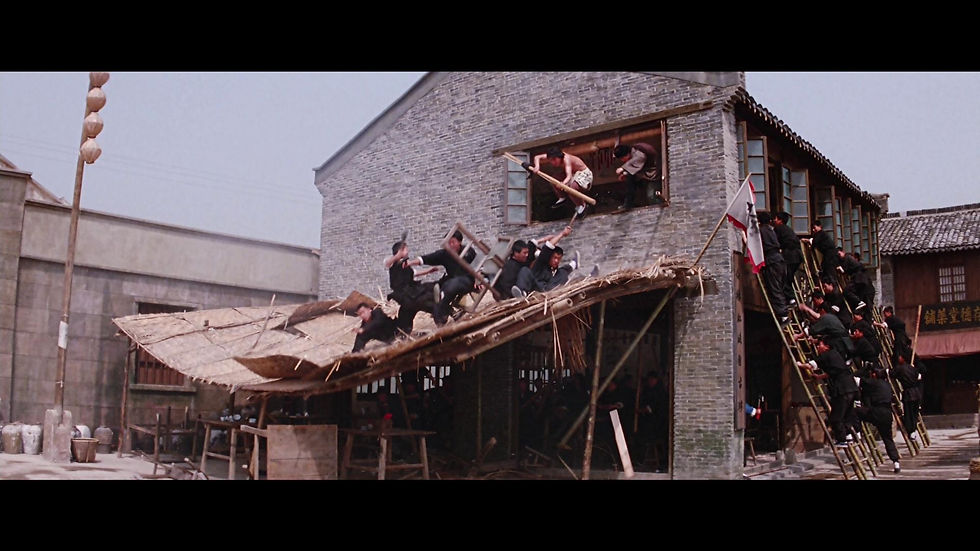
Arrow’s disc, which is part of their Jackie Chan Breakout Hits five film (10 disc) collection, represents the first 4K UHD release of the HK, international, and US cuts. The images on this page are taken from the Warner Archive Blu-ray and are a decent 1080p representation of what the full 2160p looks like, minus the Dolby Vision/HDR upgrades. In fact, I suspect this is an uncompressed version of the exact same 4K remaster that adorned the WA disc. Textures and details are tidy with only slight hints of oversharpening in a handful of scenes and grain levels appear mostly accurate, aside from some snowy moments. The HDR upgrade does threaten to oversaturate some shadows, leading to occasionally dark shots, though, again, the WA Blu-ray has a similar issue.

Audio
Drunken Master II is presented with Cantonese, Mandarin, and English dubs to go with the Hong Kong release, all in uncompressed LPCM mono, and the Dimension-exclusive redub for the Legend of the Drunken Master cut in DTS-HD Master Audio 5.1. Watching the Hong Kong cut, I notice that the Cantonese dub has obvious lip sync advantages and minor volume/clarity advantages over the Mandarin dub. There are limitations throughout all three original release dubs, mostly pertaining to the cramped single channel mix, but there aren’t many obvious aural artifacts.
I hate to admit it, but the Dimension dub is far superior to the original international English dub (it’s a better mix and Chan dubs himself), so, if you want to watch the film in English, you’re going to want to watch that cut as well. The main thing you’ll miss out on is the original end credit theme, which Chan sung himself. Wu Wai-lap is the only credited composer, but there are musical differences between the HK and US versions of the film.

Extras
Commentary with Frank Djeng and F.J. DeSanto – Everyone’s favorite Hong Kong cinema expert, Djeng, and writer/producer of various Transformers properties, DeSanto, explore the film’s troubled production, including details on Lau and Chan’s falling-out, the exact scenes Chan himself directed (something I’ve always wondered about), the wider careers of the cast & crew, the film’s historical setting, locations, and the larger tradition of Wong Fei-hung stories on film.
Before the Breakout (8:50, HD) – A new documentary featurette breaking down Chan’s early career, featuring interviews with stuntman/collaborator Wang Yao, academic Dr. Wayne Wong, and critics David West and James Mudge.
Breakout! Part 1 (9:28, HD) – The first part of a documentary that spans all the movies in the Jackie Chan Breakout Hits collection, this time focusing on Drunken Master II, featuring interviews with Dr. Wong, West, Mudge, and stuntman/collaborator Mars.
Deadly When Drunken (12:17, HD) – Co-writer Yuen Kai-chi discusses Drunken Master II’s inception under Lau, deciding to make it another Wong Fei-hung story, casting, Chinese shooting locations, and arguments between Lau and Chan.
Tipsy Tribulations (10:47, HD) – An expanded interview with Mars on the making of Drunken Master II.
Period Postures (12:17, HD) – Author and academic Dr. Lars Laamann delves into the film’s historical context and the political upheaval of Hong Kong’s colonial era before Japanese occupation.
Drunken Defiance (10:22, HD) – An appreciation by Eastern Heroes Magazine’s Ricky Baker.
Behind the Master (6:40, SD) – A 2000 EPK interview with Chan filmed for the American release.
Mandarin opening credits (1:18)
Alternate Mandarin version of a drinking scene (2:09)
Textless outtake reel (2:27, HD)
Chinese New Year messages recorded by Chan for the Taiwanese and Malaysian releases (0:42, SD)
Cantonese, English, and US trailers
Image gallery

The images on this page are taken from the older Warner Archive Blu-ray – NOT Arrow’s 4K UHD – and sized for the page. Larger versions can be viewed by clicking the images. Note that there will be some JPG compression.
Comments