


Dirty Dozen 4K UHD Review


Arrow Video
4K UHD Release: November 17, 2026
Video: 1.85:1/2160p (HDR10/Dolby Vision)/Color
Audio: English DTS-HD Master Audio 6.0 and 5.1; English LPCM 1.0 mono
Subtitles: English SDH
Run Time: 149:38
Director: Robert Aldrich
As the Allies prepare to strike Nazi-occupied France, Major John Reisman (Lee Marvin) is tasked with a top-secret mission to tip the scales of war: break into and destroy a French château housing numerous high-ranking Nazi generals. His team? Twelve vicious criminals – the worst of the worst – promised a pardon if they survive. Somehow, Reisman must turn these twelve mutineers into one unified fighting force or certain death awaits them all… (From Arrow’s official synopsis)

Men on a Mission is the enduring action/adventure subgenre in which a group of people (often men, but gender and age isn’t really significant) is assembled to tackle an often secretive, combat-related task. The members of the mission are usually chosen for specific abilities, either tactical, physical, or somehow important to the narrative. This includes popular Japanese jidaigeki variants, like Kenji Mizoguchi’s The 47 Ronin (1941) and Akira Kurosawa’s Seven Samurai (1954), but, for the most part, the genre revolves around modern warfare, beginning in the ‘40s with films like Zoltan Korda’s Sahara (1943), Raoul Walsh’s Objective, Burma (1945), and Lewis Milestone’s A Walk in the Sun (1945).
These were all well-liked and successful films, but the Men on a Mission didn’t become a mainstay of international pop culture until the 1960s. Two John Sturges films, Magnificent Seven (a western remake of Seven Samurai, 1960) and The Great Escape (1963) solidified the idea, J. Lee Thompson’s Guns of Navarone (1961) set the template, and, finally, Robert Aldrich’s The Dirty Dozen (1967) recast the mold. The latter two films, in particular, are intrinsically linked, because The Dirty Dozen was designed as a raucous, misfit antidote to Guns of Navarone’s traditional interpretation of wartime heroism.

Guns of Navarone and Dirty Dozen each inspired their own brand of imitator. From Guns of Navarone, we got glossy, classy pictures, like Richard Attenborough’s A Bridge Too Far (1977) and Brian G. Hutton’s Where Eagles Dare (1968). From The Dirty Dozen, we got increasingly vulgar, cheap, and comedic variations, like Brian G. Hutton’s Kelly’s Heroes (1970), Chu Yen-Ping’s Fantasy Mission Force (1983), and Robert Clouse’s Force Five (1981).
And, of course, the Italians churned out dozens of spaghetti-flavored Men on a Mission movies and most of them are direct descendents of The Dirty Dozen. Thanks to Tarantino’s similarly-titled film, Enzo G. Castellari’s Inglorious Bastards (Italian: Quel maledetto treno blindato, 1978) is the most famous example, but, for scale, Alberto De Martino’s Dirty Heroes (Italian: Dalle Ardenne all'inferno, 1967), Camillo Bazzoni’s Suicide Commandos (Italian: Commando suicida, 1968), and Armando Crispino’s Commandos (1968) were all released within a year of Aldrich’s original.

Man on a Mission movies are typically formulaic (borderline interchangeable) from a narrative standpoint, so casting and quality of action are key. Dirty Dozen is second only to The Great Escape in terms of the quality of its ensemble. Most of the key cast members actually became regular parts of the Men on a Mission ecosystem:
Charles Bronson had already made his name on Magnificent Seven and Great Escape.
Ernest Borgnine plays an authority figure here, but joined the bloody antics for Sam Peckinpah’s The Wild Bunch (1969) a year later.
Lee Marvin reprised the role of group leader in Samuel Fuller’s The Big Red One (1980).
Richard Jaeckel had a part in Allan Dwan’s Sands of Iwo Jima (1949), from which Dirty Dozen borrows its structure, and Andrew V. McLaglen’s The Devil’s Brigade (1968).
Telly Savalas and Donald Sutherland both appeared in Kelly’s Heroes, then Savalas starred in Tonino Valerii’s A Reason to Live, A Reason to Die (Italian: Una Ragione Per Vivere E Una Per Morire, 1972), which was a spaghetti western variation on the theme.
Robert Webber had a small part in Peter Hunt’s Wild Geese II (1985). He also starred in 12 Angry Men, which isn’t a Men on a Mission movie, but it is amusing that his two biggest hits were about a group of specifically 12 men.
Video
The Dirty Dozen is a perennial favorite on television and home video. It was released several times on VHS and DVD. It first hit Blu-ray from Warner Home Video in 2007 and has remained in print until now. Arrow’s UHD debut utilizes a new 4K scan of the original 35mm camera negative. It is presented in its original 1.85:1 aspect ratio and 2160p with HDR/Dolby Vision (note that when the film was blown up to 70mm for a roadshow tour, the aspect ratio was changed to 2.20:1).
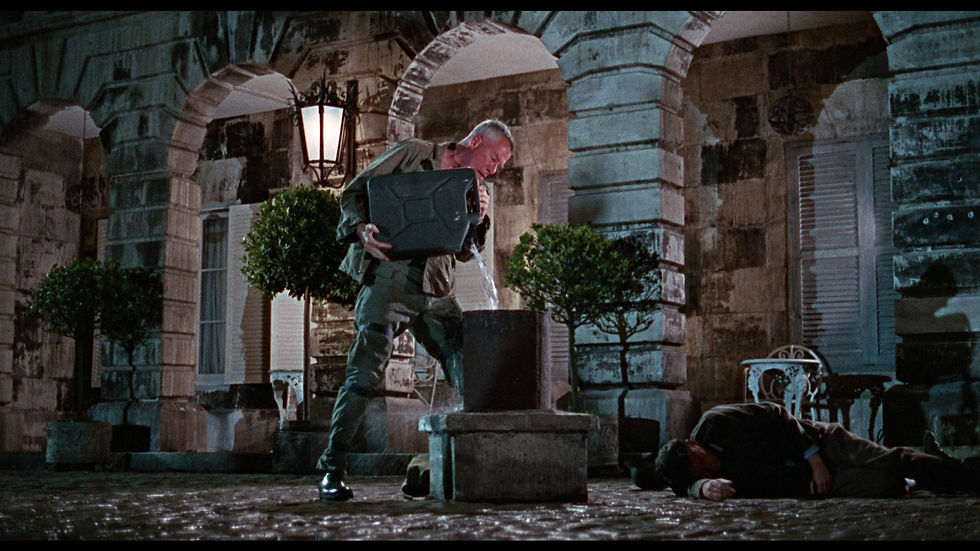
The images on this page are taken from the 1080p Blu-ray copy of the same remaster and illustrate the general color quality and grading without the full resolution or HDR upgrade. I’ve also included a few comparison sliders to clarify some of the differences between this and the older Warner release. As you can see, the new remaster is correctly framed and is a little warmer and brighter.
The full 2160p version brings out a lot of grain and texture, giving the experience a nice, natural quality. The HDR/Dolby Vision is tastefully applied, helping to delineate shapes during dark scenes and boosting highlights without creating blooming effects. Every once in a while, the footage shows its age with slight, but noticeable inconsistencies in sharpness and color quality, but there’s very little in the way of artifacts.
Audio
The Dirty Dozen is presented with three sound options – original mono LPCM, a DTS-HD Master Audio 5.1 remix, and the original 70mm release’s 6-track stereo, also in uncompressed DTS-HD Master Audio. The 6.0 track hasn’t previously been available on video, so it was how I opted to watch the majority of the film. It’s a little echoey overall and there aren’t many directional effects (I’m not sure studios were technically capable of much more than stereo movement), but it does make a difference where composer Frank De Vol’s score and Trini Lopez’ songs are concerned and the track is considerably louder than the other two. The perfect mix is probably somewhere between the crisp and clean dialogue of mono track and the musical impact of the 6.0 track. I’d avoid the muted, artificial-sounding 5.1 remix.
Extras
Disc 1 (4K UHD)
Commentary with actors Jim Brown, Trini Lopez, Stuart Cooper, and Colin Maitland; producer Kenneth Hyman, original novelist E.M. Nathanson, film historian David J. Schow, and military advisor Captain Dale Dye – This is the original 2006 DVD commentary, stitched together from multiple interviews. If I’m honest, I sort of miss this type of track, which you used to hear a lot more often from older DVDs, especially from Criterion.
Commentary with film historians Alain Silver and James Ursini – In this Arrow exclusive track, the co-editors of Whatever Happened to Robert Aldrich?: His Life and His Films (Limelight, 1995), among others, explore the director’s career, themes shared between his films, collaborators, the making of The Dirty Dozen, the progressive politics of the film, historical accuracy, critical reactions, and the wider careers of the cast & crew.
2006 introduction by Ernest Borgnine (3:28, SD)
Theatrical trailer
Image gallery
Disc 2 (Blu-ray)
The Dirty Dozen: The Next Mission (95:33, SD, 1985) – This was the first of three made-for-TV sequels, including The Dirty Dozen: The Deadly Mission (1987), and The Dirty Dozen: The Fatal Mission (1988). It’s directed by Andrew V. McLaglen, the Men on a Mission veteran who also made The Devil's Brigade and The Wild Geese (1978), and Lee Marvin, Ernest Borgnine, and Richard Jaeckel all reprise their roles. The film was also included with MGM’s Blu-ray. I assume that there is no HD source available, otherwise Arrow would’ve made the upgrade.
Arrow exclusive extras:
Behind the scenes footage from the Peter Whitehead Archives:
Raw, on set footage (14:00, HD)
Lee Marvin interview (6:11, HD)
War Is Over (23:41, HD) – Kim Newman, author of Nightmare Movies: Horror on Screen Since the 1960s (Bloomsbury, 2011), among others, discusses UK and US war movies during and after WWII, themes of disillusion and nostalgia in post-war films, the rise and development of the Men on a Mission genre, the true story behind the novel and film, changes made to the novel, and Dirty Dozen appealing to audiences across the political spectrum.
The War March (37:43, HD) – David Huckvale, author of Movie Magick: The Occult in Film (McFarland, 2018), among others, looks at composer Frank De Vol’s career, collaborations with Aldrich, and the Dirty Dozen score.
2006 Warner archival extras:
Armed and Deadly: The Making of The Dirty Dozen (30:57, SD) – The original behind-the-scenes featurette that includes interviews with several of the actors and cinema experts. Oddly, the film footage is misframed at 2.35:1.
The Filthy Thirteen: Real Stories from Behind the Lines (47:14, SD) – A documentary about the supposed true stories that inspired E. M. Nathanson’s novel, including interviews with the author, veterans, and historians. During his interview, Nathanson reveals that he heard the story from and researched the book with Russ Meyer (yes, that Russ Meyer).
Operation Dirty Dozen (9:14, SD) – The original 1967 behind-the-scenes EPK.
Combat Leadership: The Ultimate Challenge (29:42, SD) – A 1986 Marine Corps recruitment film narrated by Lee Marvin.
The images on this page are taken from Arrow’s remastered BD – NOT the 4K UHD – and sized for the page. Larger versions can be viewed by clicking the images. Note that there will be some JPG compression.
Comments