


Aswang Blu-ray Review


Mondo Macabro
Blu-ray Release: October 13, 2026 (standard edition)
Video: 1.33:1/1080p/Color
Audio: English DTS-HD Master Audio 5.1 and 2.0 Mono
Run Time: 82:18
Director: Wrye Martin & Barry Poltermann
A young, pregnant woman named Katrina (Tina Ona Paukstelis) is paid an exorbitant fee to act as a surrogate and pretend wife for Peter (Norman Moses), who needs an heir in order to secure a large inheritance. The deal is complicated when Peter takes Katrina to an isolated estate, where she is expected to give birth in the company of an extended family that may or may not be bloodthirsty monsters.

The popular concept of the motion picture vampire has, over a hundred years and thousands of movies, become a largely homogenized mythology, based on Eastern European folklore, a couple of bestselling books (Bram Stoker’s Dracula [1897] and Frances Burney’s Camilla [1796]), and Christian religious doctrine. Creative types will always find an interesting angle to the classic vampire, but unique versions of blood-sucking monsters already exist throughout the world. In Asia alone, you’ll find an extraordinary menagerie of ghosts, demons, and ghouls, including a floating head trailed by its own intestines called a penanggalan and the beloved hopping corpses known as jiangshi.
In the Philippines, they have the aswang – a shapeshifting vampire, spirit, witch, and werecreature all in one with a meter-long tongue and a special affinity for drinking the blood of unborn children. Technically speaking, ‘aswang’ is something of a catchall (like yokai in Japan) for supernatural monsters in the region, so there are more specific terms for these creatures – such as mandurugo, manananggal, busaw, and bubuu – but, for brevity's sake, we’re sticking with the generic ‘aswang’ as a descriptor for the rest of this review.

The aswang were a vital piece of Filipino cinema since its beginnings and have endured into the modern era, but, for this review, we’re looking specifically at Filipino monsters finding their way into an independent American horror movie. In 1994, writer/directors Wrye Martin & Barry Poltermann, and co-writer Frank L. Anderson released Aswang (not to be confused with Peque Gallaga & Lore Reyes’ 1992 film of the same name) – a northwoods Wisconsin variation on the classic vampire cabal template, informed by Anderson’s childhood in the Philippines.
Anderson’s version of the myths he’d been told were then further filtered through Martin & Poltermann’s midwestern sensibilities, creating a hybrid creature that pays homage to Filipino culture, but which owes just as much to Western horror cinema. Its clearest ties in this regard are to Roman Polanski’s Rosemary’s Baby (1968), Stanley Kubrick’s The Shining (1980), and especially Sam Raimi’s Evil Dead (1982), in terms of forest cabin locations, energy, and style*. Anderson, Martin, and Poltermann’s plot also structurally references Stoker’s novel, in that an innocent outsider is taken to an isolated mansion under false pretenses at the invitation of a secret vampire. Additionally, Filipino housekeeper/doula Cupid (Mildred Nierras) fills a Renfield-esque role as the vampire family’s protector/caretaker and the studious Dr. Harper character (John Kishline) is a sort of Van Helsing stand-in. In an especially fun twist on tradition, the aswang (aswangs?) appear to be devout Catholics.

To this day, Aswang is sold on its violence, which isn’t as extreme as it once appeared, but still packs a punch where it counts. It’s less a matter of the gore appearing overtly graphic, it’s that it’s so eclectically gross and imaginatively icky. Highlights include dead animals and people cocooned in slime, an aswang tongue bursting through a man’s windpipe, a garden hoe is embedded in a woman’s forehead, and one character is forced to self-administered a gnarly hand amputation (perhaps another reference to the Evil Dead series).
As a resident of Minnesota, I’m loathe to admit that Wisconsin’s indie horror scene outshines our own, including the many efforts from Z-movie luminary Bill Rebane, Don Keeslar’s Bog (1979), Fabrice-Ange Zaphiratos’ French co-production Blood Beat, Jim Mallon’s Blood Hook (1987, noting that Mallon is from Minnesota), and Lew Lehman’s The Pit (1981, produced by Canadians). Aswang’s connections to the region’s specific pop culture includes actor Victor DeLorenzo’s tenure as drummer with The Violent Femmes, the seeding of other actors from Milwaukee’s Theatre X drama company, and fact that co-director Poltermann edited Chris Smith’s seminal chronicling of Menomonee Falls circa the late ‘90s, American Movie (1999).

* The connections to the Evil Dead franchise have only strengthened in recent years, thanks to the two latest entries, Evil Dead Rise (2023) and Evil Dead Burn (2026), which revolve around family units, instead of vacationing college kids or the adventures of one hypercapable bozo named Ash.
Bibliography:
In a Climate of Terror: The Filipino Monster Movie by Mauro Feria Tumbocon, Jr., found in Fear without Frontiers: Horror Cinema Across the Globe (FAB Press 2003)
Video
Aswang premiered at the Sundance Film Festival, but it was mostly a straight to home video rollout. Unfortunately, the violence proved intense enough that the MPAA slapped it with an NC-17 rating (or at least threatened to) and the US VHS release from Prism Entertainment, under the alternate title The Unearthing, was edited to secure an R rating. Mondo Digital rescued Aswang from obscurity when they put out an uncut DVD in 2003. The film was shot on a tiny budget (just over $100k) and 16mm by relative amateurs and often not under the best of conditions, so it’s not the best candidate for a big money 4K remaster, but Mondo has done their best, anyway.
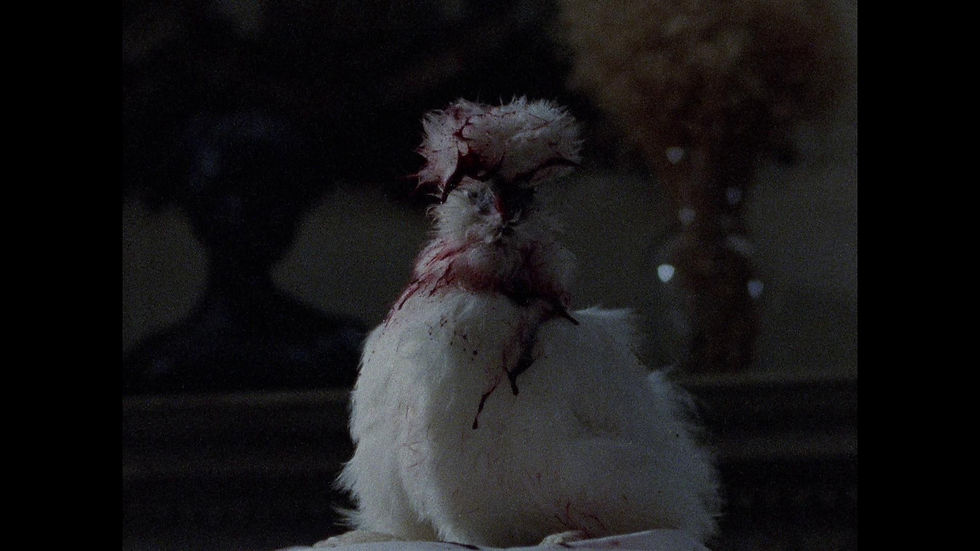
Taken from the original 16mm negative, this 1080p transfer is presented in open-matte 1.33:1, unlike the previous DVD, which was matted at 1.85:1 (IMDb lists 1.66:1 as the theatrical AR). Cinematographer Jim Zabilla gets a lot of mileage out of hard contrast and wide dynamic range throughout, all of which helps to clarify important details and textures, in spite of the format’s limitations. The colors are eclectic, consistent, and rich in that sort of soft 16mm fashion. The footage isn’t in pristine condition, but, again, most of this is expected given the smaller gauge of the format, including consistently chunkier grain, detail loss in the darkest shots, and slightly magnified damage to the negative. Artifacts are pretty easily ignored, consisting mostly of small scratches, white blots, and a trickle of blue dots that occasionally slip down the left side of the frame. There are few, if any, notable compression problems.

Audio
Aswang is presented with original stereo and remixed 5.1 audio options, both in uncompressed DTS-HD Master Audio. The remix admittedly does give Ken Brahmstedt’s music a nice boost, but is otherwise pretty unnecessary in my opinion (though I’m happy that Mondo preserved it here). The stereo mix is clear with simple dialogue and crisp incidental effects work. The sound editors/designers punch things up with phasing effects and reverb, giving the stereo channels a nice workout alongside the eerie, dynamic music. I would warn viewers to keep their eye on the volume control, because the early, dialogue-driven sequences are pretty quiet compared to the much more bombastic latter half of the film.

Extras
Commentary with co-directors Wrye Martin & Barry Poltermann – This track with the co-directors was recorded for the original DVD and is moderated by Mondo Macabro co-founder and author Pete Tombs. Tombs has to prod the filmmakers a bit in the beginning, but manages to get a lot of good information out of them, including loads of behind-the-scenes anecdotes.
Commentary with David Dahlman, Norman Moses, Tina Ona Paukstelis, and John Kishline – Another original DVD track, this time with producer Dahlman and actors Moses, Paukstelis, and Kishline (who doesn’t talk a lot). Paukstelis and Moses end up leading the discussion with memories from the set, while Dahlman fills in production details.
Different Than Hollywood: Making Of Aswang (27:53, SD) – This 2003 retrospective featurette includes interviews with Martin, Poltermann, Dahlman, Moses, Paukstelis, Kishline, actress Flora Coker, and co-writer Frank Anderson, alongside behind-the-scenes clips and photos.
Lost scene narration by actor John Kishline (6:42, SD) – This scene would’ve filled in backstory on the Dr. Harper character, making him more of an overt Van Helsing type.
Audition tapes – Norman Moses (3:29, SD) and John Garekis (3:13, SD)
“The Nullberry Cooler” (2:28, SD) – Anderson reminisces about a song he wrote for the film that ultimately wasn’t used. The song also plays in its entirety.
Fundraising teaser, theatrical trailer, and alternate The Unearthing trailer
The images on this page are taken from the Blu-ray and sized for the page. Larger versions can be viewed by clicking the images. Note that there will be some JPG compression.
Comments