


88 Films Golden Harvest Collection

88 Films
Blu-ray Release: May 12, 2026
Video: 2.35:1 and 1.85:1 (The Himalayan only)/1080p/Color
Audio: Mandarin LPCM 2.0 mono; English LPCM 2.0 mono (The Angry River only)
Subtitles: English, English SDH
Run Times: 98:58 (The Invincible Eight), 90:39 (The Angry River), 112:06 (The Himalayan)
Directors: Lo Wei (The Invincible Eight), Feng Huang (The Angry River and The Himalayan)
Prior to 1970, the Hong Kong film industry was firmly in the hands of Shaw Bros. Studios, who exerted a near-monopoly on production and distribution. But things began to change as television became a key piece of the entertainment market, censorship standards shifted, and executives Raymond Chow, Peter Choi, and Leonard Ho left Shaw to found Golden Harvest Studios. Golden Harvest embraced the independent market and offered up-and-coming artists and performers relative creative freedom, compared to Shaw.
Golden Harvest eventually found major success in modern-set kung fu films, thanks in large part to the breakout international popularity of Lo Wei’s The Big Boss (aka: Fists of Fury, 1971), which made a superstar of Bruce Lee, then overtook Shaw with the help of Sammo Hung and Jackie Chan action comedies, many of which were also set in the modern era. However, when they first opened up shop, Golden Harvest took aim at beating Shaw at their own game, producing a series of prestigious films in the period-set, wuxia tradition that was developed in literature and stage performances in the days before Hong Kong or Chinese cinema existed.
What follows are three such films from two different filmmakers, all making their Blu-ray debut this month from 88 Films. Note that they are currently all available as separate, single disc collections.


The Invincible Eight (1971)
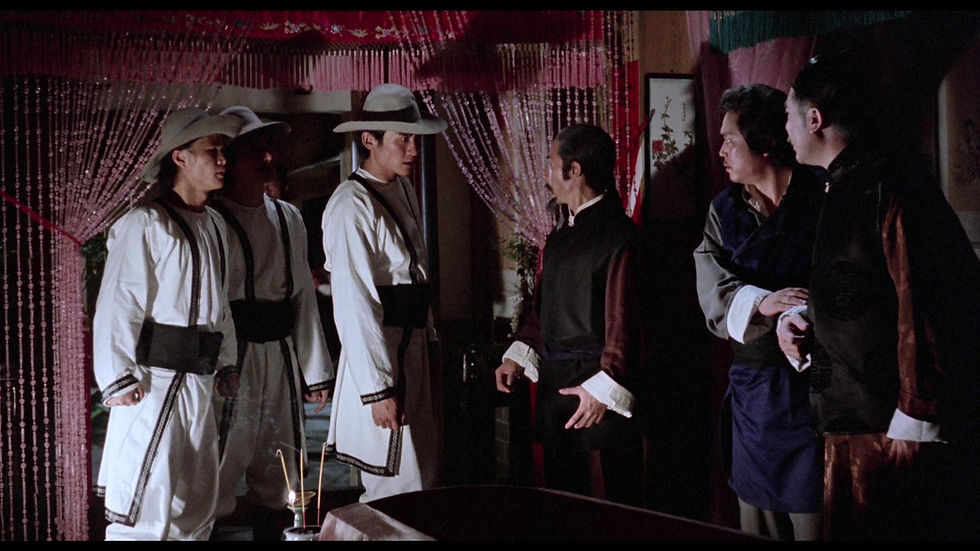
Eight warriors are driven by the same burning purpose: to avenge the brutal murders of their fathers at the hands of a ruthless general. (From 88 Films’ official synopsis)
Golden Harvest came out of the gate with ten films in 1971, the first (and the studio’s debut) was The Invincible Eight from director Lo Wei, who also made the same year’s The Comet Strikes and the aforementioned mega-hit The Big Boss. Reportedly very expensive and a relative financial disappointment, the film plays it safe by treading familiar narrative ground. Direct comparisons have been made to Lo’s own Brothers Five, released the year before under the Shaw Bros. banner, but even these accusations understate how generic its exposition-heavy revenge scheme plotline really is. Not surprisingly, this particular story (though not final script) is credited to Ni Kuang, aka: the hardest working writer in Hong Kong wuxia history, who was known to recycle a plot or two.
What The Invincible Eight lacks in originality and pacing, it tends to make up for with Lo’s professional direction, attractive production design, and good action choreography from Sammo Hung. Hung’s specific style, defined by speed and creativity, was better served by hand-to-hand kung fu, but he and Lo combine for some pretty elaborate group fight shots and make good use of whips, which are the bad guys’ weapon of choice. These early Golden Harvest period pieces set themselves apart from the competition with lush Taiwan, Korea, and Nepal locations. Their sets have an earthy, lived-in quality absent from Shaw’s recognizable and increasingly cartoonish backlots. I love those backlots, but the change of scenery is appreciated.
The top-tier cast is front-loaded with major stars Angela Mao, Nora Miao, Paul Chang Chung, Tang Ching, and James Tien. Mao and Hung are vital components to the three films I’m covering in this review, so here I’d like to single out actress Lydia Shum for a minute. Also poached from Shaw, Shum (aka: Shum Din-ha) was an unlikely wuxia/kung fu star in that she was plus-sized. What’s truly remarkable is that Shum’s weight isn’t played for laughs, despite her being a gifted comedian and Hung’s similar build being a punchline throughout his career. She’s just one of the gang and capable of holding her own.


The Angry River (1971)
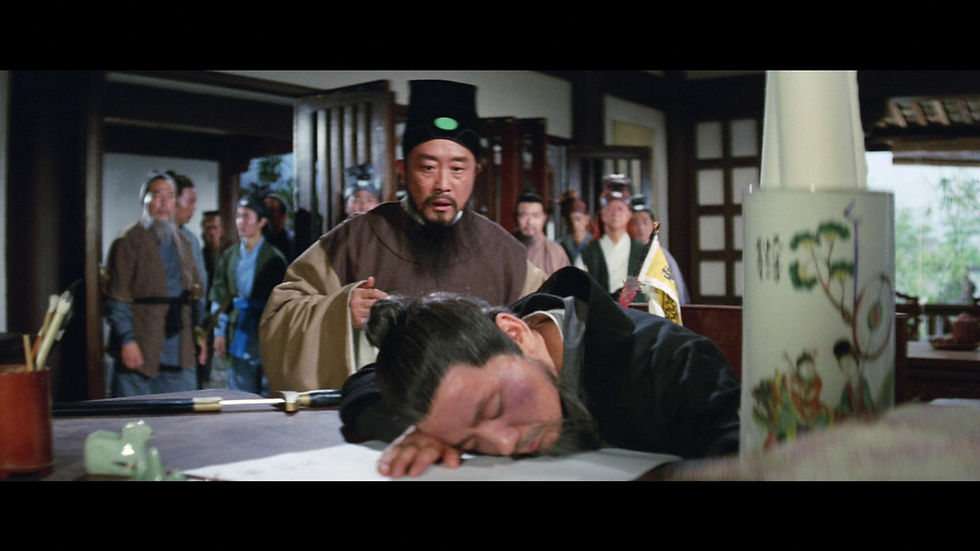
Lan Feng (Angela Mao) is a courageous young woman on a desperate mission to find a cure for her gravely injured father. But danger lurks at every turn, as the very villains responsible for her father's fate pursue her relentlessly. (From 88 Films’ official synopsis)
A contemporary of Lo Wei who also broke out at Golden Harvest as contemporary kung fu began to outpace period wuxia, Huang Feng’s success is often tied directly to that of star Angela Mao, who he is credited with discovering. The duo’s first film at the studio, The Angry River, was announced as the debut of a new female talent, but, for whatever reason, production was delayed and The Invincible Eight beat it to theaters by several months. The Angry River was Huang’s second feature as director, following several writing credits and his first directing credit on The Crimson Charm, a thematically similar film that was released early in 1971 via Shaw Bros.
Huang (who wrote both scripts) again borrows common folktale tropes, but combats doldrums with relentless momentum and a genuinely rousing climax. Huang also embraces the fantastical side of the genre with wire work, composite effects, and a surprise appearance from a rubbery, man-in-suit monster. As such, The Angry River functions like a bridge between King Hu’s grounded fantasy dramas and the outrageous martial arts fables of the 1980s, like Tsui Hark’s Zu Warriors from the Magic Mountain (1983) and even Akira Toriyama’s Dragon Ball (1984-present).
Mao found her niche when Golden Harvest started touting her as the ‘Female Bruce Lee’ in further collaborations with Huang, including Lady Whirlwind (1972), Hapkido (1972), Deadly China Doll (1973), When Taekwondo Strikes (1973), The Shrine of Ultimate Bliss (1974), The Tournament (1974), The Himalayan (see below), and The Legendary Strike (1978). While her badass persona better fits these bone-crunching kung fu roles, it’s still interesting to see her playing a Cheng Pei-pei type heroine. She’s joined here by Fung Ngai, King Hu favorites Pai Ying and Han Ying-Chieh, Shaw veteran Chiang Nan, Mr. Vampire (1985) star Lam Ching-Ying, Sammo Hung (who, again, acted as choreographer), and Jackie Chan in an early cameo.


The Himalayan (1976)
After she’s framed for adultery by her wicked brother-in-law, Tseng Ching Lam (Angela Mao) takes to the hills to plot her revenge. (From 88 Films’ official synopsis)
We end on Feng Huang’s The Himalayan, which was released five years after the other two and three years after the untimely death of Bruce Lee. As such, it retains some wuxia adventure conventions, but accounts for the rising popularity of kung fu flicks with hand-to-hand fights in place of bladed weapons. More than anything, though, The Himalayan is an exercise in cultural storytelling, in that it is structured entirely around the gorgeous Nepalese locations, Tibetan customs, rituals, costumes, and music, as well as a uniquely provincial style of martial art that the film refers to as ‘Mi’ or the ‘Esoteric School,’ and claims is only practiced in the area.
This is all in the vein of Huang and choreographer Sammo Hung’s approach to Hapkido and When Taekwondo Strikes, which saw them delving into Korean martial arts and culture, but there are moments when The Himalayan enters documentary territory. Even the early fight scenes have a sort of demonstrative quality. Whether or not it’s an accurate portrait of the culture is up for debate, but the filmmakers approach the subject matter with significantly more respect than the mondo shockumentaries The Himalayan somewhat resembles (be warned – it does include mondo-style on-screen killing of chickens).
The overarching issue isn’t a lack of emotional resonance or spectacle, but that Huang isn’t quite capable of melding his pseudo-docu-drama approach with one of returning screenwriter Ni Kuang’s overly-contrived stories. The melodrama is mostly effective, especially the central betrayal and various expressions of nostalgia during flashbacks, but it takes almost an hour for the various conspiracies to come to a head and finally kick the plot into gear with any sense of urgency and, even then, around 30 minutes is spent on requisite training sequences. Ultimately, The Himalayan would be improved, had it been edited in the same mercenary fashion as The Angry River.
Mao’s role is somewhat reduced as the film struggles to set the narrative stakes during its first half. She ends up sort of sharing the lead with Korean actor Tan Tao-liang and Shaw star Chan Sing, who plays the main antagonist. Hung has a more prominent cameo this time around (he’s one of the chicken killers, actually) and, if you look real carefully, you’ll also see Jackie Chan, Corey Yuen, and Yuen Wah.




Bibliography
Golden Harvest: Leading Change in Changing Times (Hong Kong Film Archive, 2013), including essays:
The Organisational Structure and Developmental History of Golden Harvest by Po Fung
The Female Kung Fu Chop in Golden Harvest’s Films of the 1970s by Stephen Teo
Like Brother, Like Sister: Angela Mao, the ‘Female Dragon’ in the Eyes of Japanese Fans by Udagawa Koyo

Video
Previous to these releases, the only way to watch The Invincible Eight stateside would be to import a Hong Kong DVD. I can’t find any record of The Angry River being available on home video, but there would at least have been a Hong Kong VHS tape issued. The Himalayan was released on North American DVD as part of Shout Factory’s Angela Mao Ying Collection, alongside When Taekwondo Strikes, Broken Oath (1977), Stoner (1974), A Queen's Ransom (1976), and The Tournament (1974).
All the movies covered in this review have been remastered in 2K from their original negatives. The Dyali-Scope, Eastmancolor stock is rich across all three discs, though the color-timing skews a bit orange throughout Invincible Eight and The Himalayan (the latter of which is also the only one presented in a 1.85.1 aspect ratio). Texture and patterns are better than most of 88 Films’ Shaw Bros. discs, which tend to come from older Celestial Films transfers. Grain can appear a bit noisy and some of the lighter edges have a slight wobble, but the overall effect is natural and black levels are quite clean. Having been shot anamorphically with wide-angle lenses, Invincible Eight and Angry River have some issues with focus and stretch that should not be blamed on the transfer.

Audio
All three films feature original Mandarin language mono soundtracks in uncompressed LPCM and The Angry River has an additional English track, also in LPCM mono, which sounds similar to the Mandarin track, but is one of the most lethargic dubs I’ve ever heard. The sound quality of the Mandarin tracks generally matches across discs. Dialogue is slightly muffled/condensed, but there aren’t many notable distortion effects outside of a few pops and crackles, and hiss is minimal compared to a lot of similar Shaw Bros. releases.
I’m not as familiar with Golden Harvest’s early scoring processes as I am with Shaw’s, but I believe they were mixing library and original music. Either way, Wang Fu-Ling is credited with scoring The Invincible Eight and The Angry River, and Wei Wang with The Himalayan’s more traditional motifs. The Angry River’s main theme is a particularly intense, driving little ditty, bolstered by what sounds like a heavily distorted electric bass, possibly meant to evoke the gritty guitars of Ennio Morricone’s spaghetti western themes.
Extras
Commentary with Frank Djeng and Michael Worth on all three movies – Everyone’s favorite festival programmer and Hong Kong movie expert, Djeng, and martial artist/filmmaker Worth explore each film’s production, release, and themes, the history of Golden Harvest, the wider careers of the casts & crews, the martial arts presented in each film, the Taiwanese and Nepalese locations, and various cultural meanings (which is really helpful in the case of The Himalayan’s Tibetan scenes and use of Esoteric Buddhism).
Image galleries
Theatrical trailers
The images on this page are taken from the BDs and sized for the page. Larger versions can be viewed by clicking the images. Note that there will be some JPG compression.
This looks like a fascinating collection for anyone who enjoys exploring older and lesser-known films. I especially like the idea of revisiting movies from different eras and discovering how filmmaking styles and storytelling have changed over time. Between watching films, studying, and keeping up with deadlines, Bookkeeping Assignment Help UK can also be handy for students who need a little extra academic support. Definitely a collection worth exploring for film lovers who enjoy discovering something beyond the usual favourites.
The film collection post discusses classic Golden Harvest movies and their impact on action cinema, especially in shaping martial arts storytelling and global film culture. It shows how older films continue to influence modern entertainment. During my studies, I once chose University assignment help online when I was struggling with deadlines, and it helped me better organise my coursework.
This post about the Golden Harvest film collection is really interesting because it shows how classic movies shaped action cinema and inspired many modern filmmakers. I liked how it explains the importance of old films in a simple way. During a busy school term, I struggled with many assignments, so I used Cheap assignments service support to manage my workload and stay on track. It helped me feel more organized while still enjoying learning about film history.