


Lost in Space (1998) 4K UHD Review


Arrow Video
Blu-ray Release: September 2nd, 2025
Video: 2.39:1/2160p/Color
Audio: English DTS-HD Master Audio 5.1, English LPCM 2.0
Subtitles: English SDH
Run Time: 130:11
Director: Stephen Hopkins
The year is 2058, and time is running out for planet Earth, thanks to pollution and ozone depletion. Thankfully, Professor John Robinson (William Hurt) has a solution called the Hypergate, which will allow ships to instantly jump from Earth to Alpha Prime, a new home for the citizens of the world. However, while the Earth end is in progress, someone's gotta go ahead to Alpha Prime and set up the other side of the Hypergate, and naturally, Professor Robinson has volunteered his reluctant family: his wife, Maureen (Mimi Rogers); his two young children, Penny (Lacey Chabert) and Will (Jack Johnson); his adult daughter, doctor Judy (Heather Graham); an unhappy, second-choice hotshot pilot, Major Don West (Matt LeBlanc)...and a secret stowaway saboteur, Dr. Zachary Smith (Gary Oldman), whose presence leads the journey astray...
1998. Bill Clinton's affair was uncovered, leading to his impeachment -- bad behavior we now know was only the tip of the iceberg. Andrew Wakefield published a bullshit study that lead to the current, deadly anti-vax movement. Google was founded, arguably launching our current tech oligarchy. Lastly (but perhaps most importantly) New Line Cinema's expensive TV-to-movie adaptation Lost in Space cratered at the box office, grossing only $136.1 million against an $80 million budget. No doubt New Line thought they could one-up Star Wars - Episode I: The Phantom Menace by opening their space movie over a year earlier. Perhaps in an alternate dimension, the combination of Lost in Space winning over movie audiences and the disappointment at the time surrounding Menace would've spelled the end for Star Wars and the beginning of a new love affair with a different space franchise.
Of course, it probably would've helped if they'd made a movie that was any good.
Obviously, I'm kidding: I don't think we'd all be watching several New Line+ shows exploring other corners of the Lost in Space (1998) Cinematic Universe had things gone differently. However, the most obvious thing about Lost in Space, from beginning to end, is that it is blatantly indebted and inferior to Star Wars. The cribbing starts immediately with LeBlanc's Major West leading a space battle to protect the Earth-side Hypergate, complete with embarrassing, Han Solo-off-Wish quippy banter that LeBlanc is both not right for and doesn't seem to enjoy delivering. Next, the film establishes a flimsy, familiar family dynamic: the absent important dad, the stern-but-warm mom, the smart-but-sassy older daughter, a mall-and-boy-crazy younger daughter, and whiz-kid prodigy son. Worse, all of this material additionally carries the stink of screenwriter Akiva Goldsman (or, if I'm being generous, Goldsman juggling studio notes) trying too hard to convey that this isn't the old "Lost in Space" TV show your parents watched on Nick at Nite, this is the new and hip version. How do you do, fellow kids?
Another obvious hurdle for the script: although "Lost in Space" is an obvious riff on Johann David Wyss's Swiss Family Robinson (even keeping the family's surname), and that book was a closed story, the TV show was open-ended, something the movie doesn't know how to handle. Goldsman awkwardly contrives a way for the characters to misuse the their ship's Hyperdrive in order to save themselves from a fatal collision with the sun, sending them to an unknown point in the universe, after which it strikes me as logical to have anywhere from three to five 20-minute chunks where the characters visit different uncharted worlds, trying to figure out where they are and how to get home. Instead, the movie just sort of meanders, sending them to an abandoned ship where they are attacked by metal spiders for a generic action beat, and then having them crash-land on a nearby planet, where they encounter a mysterious distortion (that any viewer will deduce most of the meaning of well before the supposedly hyper-intelligent characters). Even though the distortion leads to some of the movie's only interesting scenes, it's hard not to question the sense of designing a summer blockbuster that literally has no forward momentum.

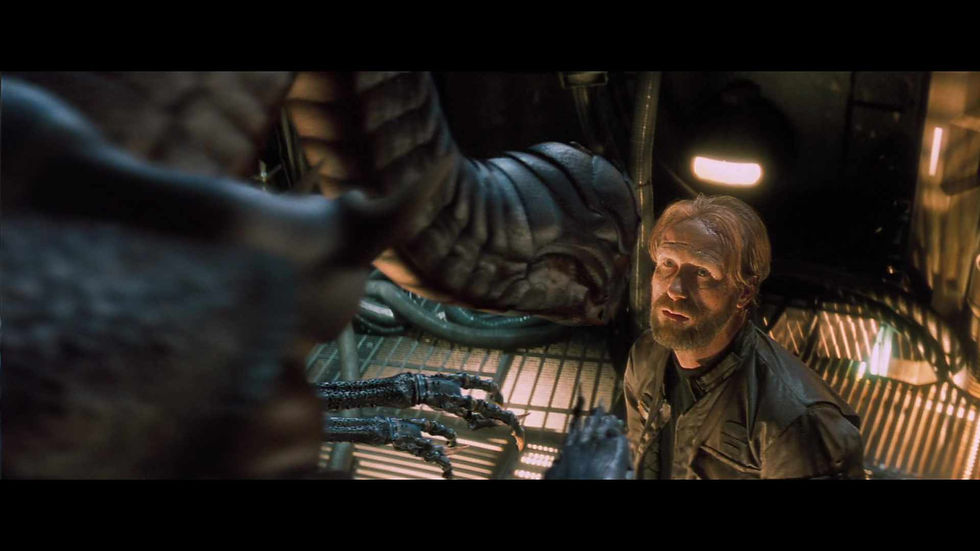
A better movie could have gotten by anyway on the strength of its characters, but Lost in Space fails to come up with any. The excruciating scenes start to rack up. Maureen encounters John and Major West having an argument and behaves like a mother scolding two young boys -- she's a mom, so she has no actual personality. Judy and Major West flirt with one another using Warner Bros. IP (parent company of New Line Cinema!) and great dialogue like "We really are lost, aren't we?" Lost in Space was made years before the term "negging" was a thing, but Goldsman may have invented it with West, whose "charm" is acting like he's owed Judy's affections, even through to the end. Chabert and Johnson acquit themselves adequately, although mostly by playing against the types the script keeps trying to establish: Penny is most likable when she's cheerful rather than moody, and Will is best when the movie isn't attending to the "absent dad" plot. The brightest spot among the cast is top-billed Gary Oldman as Dr. Smith. Hurt, Oldman, and Jared Harris have the strongest pedigree among the cast, but Hurt seems checked out and Harris is only around for a few minutes. Like everyone else, Oldman remains at the mercy of undercooked material, but as the film moves into the second half, he valiantly wrings some blood from the movie's stony matter, first creating a convincing enough dynamic with young Will as he schemes to get control of his situation, and secondly, when the film unveils one of its only interesting developments: a version of Smith that has mutated into some sort of horrible monster. It's not dramatically compelling in the way Goldsman thinks it is, but at least it's unpredictably weird (and the CGI manages to best the notorious reappearance of The Rock as The Scorpion King in The Mummy Returns, despite three additional years of CGI advancement), although I suppose there's also no attempt to put Oldman's real face on the creature).
Speaking of the CGI, in general, while it looks harsher in the light of 2026 than 1998, the effects are one of the only consistently effective elements. Although many of the structures and inanimate objects look like they're waiting to have textures applied, they're still pretty well-done and integrated into the film. Once the characters are stranded, production design also scores with some great, massive-looking outdoor sets of the surface, and the film's climax of the characters flying through an imploding planet is mildly impressive. On the other hand, a CGI monkey is dated even by Jar Jar Binks standards (it doesn't help that none of the actors seem to know how to sell the illusion or interact with the effect), and there are also times where the movie sacrifices logic for effects, such as a mid-movie scene where Major West flies the length of a space station for the sake of the shot when he should just be trying to put as much distance between himself and the station as possible.
Video
In this new era of split rights between Blu-ray and UHD releases, Lost in Space is getting a third go-round, transfer-wise. In 2010, Warner Bros. released the film on Blu-ray with a transfer that sounds like it was a pre-existing master, potentially even the one used to produce the 1998 DVD. In 2024, Shout! Factory rereleased the film in a Collector's Edition, and they commissioned a new 2K from the interpositive that improved upon Warner's initial effort. Now, just one year later, Warner has come back to right their wrongs with a new 4K scan of the original camera negative, completed by Warner's MPI and provided to Arrow. I don't think I've seen Lost in Space since DVD or even VHS, so I can't make any useful comparisons to those older versions, but to my eyes this is a technically proficient 4K transfer that also doesn't necessarily make for much of an eye-popper. Director Stephen Hopkins tends to favor wider shots, and he and cinematographer Peter Levy seem to have gone for a bit of a contrasty look, with brighter lights and darker shadows (perhaps to help integrate primitive CGI with the rest of the image), leading to a surprisingly flat first half inside the ship. The best-looking material arrives later in the film, in scenes on the outside of the ship after it's crashed, in the snow and other external environments that are more brightly-lit. Color is a strong suit throughout the movie, with a wide range of environments and lighting, and grain looks fine. Overall, I both have no complaints and no particular praise, although to be clear, the limitations of the image strike me as having to do with the filmmakers' chosen look rather than any technical issues with the disc.

Audio
Two audio tracks are included, a DTS-HD Master Audio 5.1 track and an LPCM 2.0 track. As previously mentioned, I don't have the Warner Blu-ray to compare, but I would be pretty surprised if this were a different DTS-HD MA track than the one included on their release, and Shout! Factory's 2024 Blu-ray. In any case, it sounds totally decent, with the expected sci-fi space battle atmospheric effects and directional flourishes. I would probably say this is a little punchier than the picture, although like the visuals, this is not exactly demo material -- to me, it sounds like what one would expect a big-budget summer blockbuster to sound like, and any sorts of limitations on creativity are probably set by what the filmmakers could imagine or afford to realize.
Extras
In addition to the robust selection of archival extras ported over from the 1998 New Line Platinum Series DVD (which were replicated on Warner's 2010 Blu-ray edition), Arrow has commissioned some new extras for the film's 4K UHD debut. Note that the interviews here with director Stephen Hopkins and screenwriter Akiva Goldsman are unique to Arrow's release, and different from the new interviews that they contributed to the aforementioned Shout! Factory Blu-ray, which were edited together into a featurette called "We're Lost, Aren't We?" (Since Arrow's releases are single format, die-hard fans who like combo packs will want to pick up Shout's BD and combine it with Arrow's for the ultimate Lost in Space edition.)
"A Space Odyssey" Interview with Director Stephen Hopkins (20:58) - Hopkins talks about being brought on board thanks to his acquaintance with screenwriter Akiva Goldsman, his history with New Line and familiarity with the original TV series (which he says may have reminded him of "Doctor Who" as a Brit), before diving into the various trials and tribulations of working on a major Hollywood blockbuster. Much of his focus is related to the technical aspects of the film, including working on a movie at the end of the "big set" era, dealing with the challenges of early visual effects, and his respect for the amount of money and resources being devoted to the film. The interview concludes with some discussion of the score, and his feelings about the reception of the film, including discussion of fanmail he's received about it from children.

"A Journey Through Time" Interview with Producer/Screenwriter Akiva Goldsman (17:56) - The veteran screenwriter talks about his love of the original "Lost in Space" TV show, producing the movie, whether or not Lost in Space might be key DNA in the Marvel Cinematic Universe, working with visual effects, the talented cast assembled for the film, the endless production schedule, and the film's legacy. This is an interesting interview because Goldsman comes off as fairly humble, openly admitting his lack of experience with producing a movie and the help he needed to finish the film, and has some great insights into the effects process (noting that test audiences, when presented with an unfinished visual effect, will either reject it or imagine something that fits perfectly, both of which create challenges for the filmmakers).
"Lights in the Sky" Interview with Director of Photography Peter Levy (17:27) - A dry but nonetheless interesting chat with the cinematographer, who discusses his relationship with Hopkins, working with visual effects (and his limitations when it came to his ability to explain to the actors, like William Hurt, what the finished results would look like), and plenty of discussion of the changes in technology since the movie and the things that would be easy now, as well as touching on the box office. Two especially fun stories stand out: one about Robert Shaye's reaction to seeing the first footage from the film, and another about Gary Oldman's experience on Lost in Space coming off of his directorial debut with Nil By Mouth.
"Art of Space" Interview with Supervising Art Director Keith Pain (32:17) - Pain is enthusiastic but a bit unfocused as he describes several stories from the set of Lost in Space. Probably the most meandering of the interviews, and also the longest. No shade to Pain, who seems like a sweet fellow, but this is definitely for the devotees.
"Sound in Space" Interview with Sound Mixer Simon Kaye and Re-Recording Mixer Robin O'Donohue (9:20) - The two mixers are interviewed separately and then spliced together for a brief look into the design of the sound for the film. This piece, among other things, discusses something I haven't heard very much in behind-the-scenes extras, which is discussion of how the microphones were integrated into the costumes. Beyond that, the piece also generally touches on a fair amount of explanation of the on-set approach (especially in relation to the robots), which again generally feels like it comes secondary to discussion of post-production mixing in these kinds of extras.
"Crafting Reality" Interview with Mold Shop Supervisor Kenny Wilson (6:54) - Last but not least for the new extras is a quick piece on the various costumes, robots, and other various effects throughout the film that were contributed by the Jim Henson Creature Shop. For a film that is all about the effects, most of the stories in the other interview are generalized overviews or more anecdotal, leaving this piece to be one of the more nuts-and-bolts interviews. Only issue is that Wilson is a quiet man, so you may get a bit of whiplash turning it up to hear him and then turning it down so the film clips aren't deafening.

"Lost But Not Forgotten in Space?" Visual Essay by Matt Donato (18:32) - The new extras wrap up with this video piece by Donato, a writer for IGN, Yahoo, and other online outlets. This piece cheerfully examines the cult status of the film since its flare-out on the big screen in 1998. Donato is a cheerful, funny host, but I admit this upbeat piece is probably geared toward people who enjoy the movie significantly more than I do.
Archival extras - Returning from older editions: two commentary tracks, one featuring director Stephen Hopkins and screenwriter Akiva Goldsman, and the other featuring visual effects supervisors Angus Bickerton and Lauren Ritchie, cinematographer Peter Levy, editor Ray Lovejoy, and producer Carla Fry; the featurettes "Building the Special Effects," "The Future of Time Travel," and "Q&A With the Original Cast - The TV Years," deleted scenes, and the film's original theatrical trailer. Additional archival material added for this edition includes a blooper reel (2:44) and three image galleries. Note for the die-hards that the music video for "Lost in Space" by Apollo Four Forty has not made the migration to any discs after the original Warner Bros. Blu-ray, so if that's of great importance to you, then you'll actually need three releases for the truly complete package.
As usual, while the check disc Genre Grinder received technically represents the Limited Edition release, none of the actual packaging has been included. Those who buy the retail version will also get a slipcover, a reversible sleeve featuring new and original artwork, and a collector's booklet featuring writing by Neil Sinyard, articles from American Cinematographer and an excerpt from the original production notes.
Conclusion
I saw Lost in Space theatrically back in 1998, and at the time I sort of liked it, so I was kind of looking forward to revisiting it. Once I was actually watching it, unfortunately, it took me several hours over the course of two different days to slog through the film. Still, that's just my opinion -- if you enjoy the movie, I cannot imagine a better way to own it than this decked-out 4K UHD edition, which features a solid presentation and significantly more extras than the film deserves (and what's offered here isn't even all of what's out there!).
The images on this page are taken from the 2010 Warner Bros. Blu-ray and sized for the page, and are not representative of this release. Larger versions can be viewed by clicking the images. Note that there will be some JPG compression.
Even without obvious progression systems, there’s still a sense of improvement over time. In the beginning, you’re just reacting to what’s happening, but as you play more, the Crazy balls game starts to feel more predictable in a good way. Somewhere in the middle of extended gameplay, you notice that your responses become quicker and more accurate. That gradual improvement creates a subtle feeling of progress, even though the structure itself remains mostly unchanged, which helps maintain long-term interest.